Agentic Mermaid
Render, verify, describe, and safely edit Mermaid diagrams through MCP.
Agentic Mermaid
Beautiful diagrams, made with your agent.
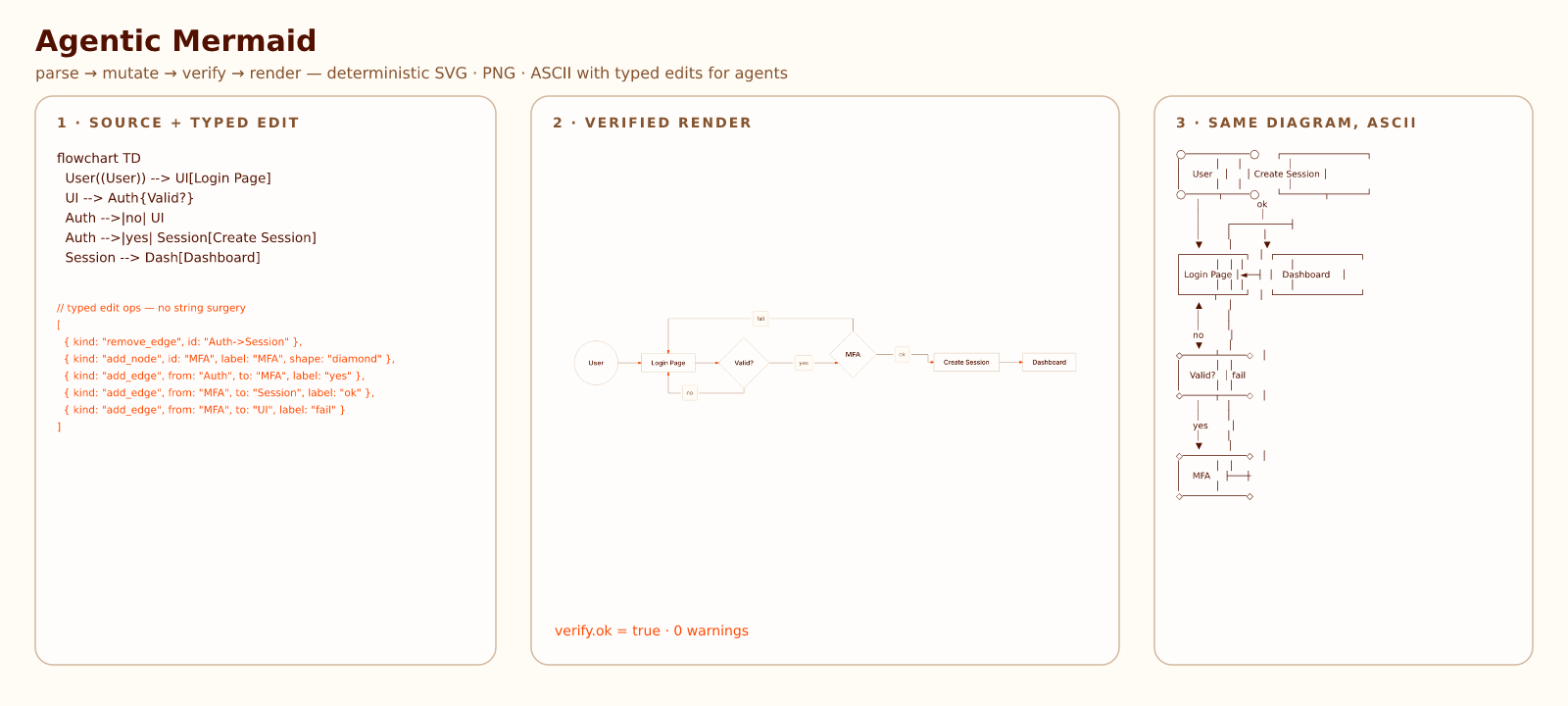
Agentic Mermaid is an open-source Mermaid toolkit for people who want AI agents to create diagrams that look finished: SVG and PNG renders, ASCII and Unicode for review, deterministic layout, and Style + Palette controls for brand colors, typography, strokes, fills, and backdrops.
It is forked from lukilabs/beautiful-mermaid. Published on npm as agentic-mermaid; the GitHub repository is adewale/agentic-mermaid; the canonical live site is agentic-mermaid.dev, a Cloudflare Workers deployment.
Live Demo & Samples · Live Editor
Docs: docs index · getting started · agent guide · agent API cookbook · design system · skills · fork differences · vs Mermaid & Beautiful Mermaid · changelog
Why Agentic Mermaid
Use it when you want to describe a diagram in plain language and get back something you can publish without a design cleanup pass.
| You want | Agentic Mermaid gives you |
|---|---|
| An agent to draft the diagram | Mermaid source plus a verified render path |
| Beautiful defaults | Built-in looks such as watercolor, blueprint, hand-drawn, and publication-figure |
| Brand fit | Style + Palette stacks and custom JSON palettes you can keep in your repo |
| Safe edits later | parseRegisteredMermaid → family narrower → mutate → verifyMermaid → serializeMermaid |
| Reviewable artifacts | SVG, PNG, ASCII, Unicode, and JSON layout from the same source |
The agent workflow is the guardrail behind the polish: agents should not guess from pixels, concatenate strings, or regenerate whole diagrams when a structured edit is available.
Highlights
- Descriptor-registered diagram families — built-ins and namespaced extensions share one discovery and capability contract.
- SVG, PNG, ASCII, Unicode, JSON — one resolved request with explicit graphical, terminal, and positioned-layout projections.
- Synchronous, zero-DOM SVG renderer — no Puppeteer, no browser flash.
- Composable styles —
{ style: ['hand-drawn', 'dracula'] }stacks a look over a palette; discoverable full looks cover sketch, watercolor, blueprint, accessibility, print, operational, physical-media, architecture, and editorial/report use cases. Custom styles are plain JSON records any agent can author (docs/style-authoring.md).seedre-rolls the ink, never the layout. - Discoverable palettes + Shiki compatibility — a theme is a palette-only style: discover the canonical catalog at runtime, theme from two colors, or adapt a VS Code theme.
- Agent-native editing — typed mutation for every registered renderable family; source-level round-trip only for opaque fallbacks containing unmodeled syntax.
- CLI + MCP + library —
am,agentic-mermaid-mcp,agentic-mermaid,agentic-mermaid/agent, and the browser/workerd-safeagentic-mermaid/agent/core. Audit reports and trusted host-resource helpers remain repository tooling instead of published runtime entry points.
Installation
npm install agentic-mermaid       # or: bun add agentic-mermaid / pnpm add agentic-mermaid
npx --no-install agentic-mermaid --help
npx --no-install agentic-mermaid mcp
For repository development, install from source and run the Bun entrypoints:
git clone https://github.com/adewale/agentic-mermaid
cd agentic-mermaid
bun install
bun run build
bun run bin/am.ts --help
bun run bin/agentic-mermaid-mcp.ts   # MCP stdio server
ESM-only.
agentic-mermaidships ES modules (there is no CommonJS build);require()consumers should use dynamicimport()instead. Requires Node ≥ 22.The
am …examples below name the published bin. After a project-local npm install, invoke it from a shell asnpx --no-install agentic-mermaid …(or from an npm script asam …). From a source checkout, usebun run bin/am.ts …instead.
Output quick starts
Use agentic-mermaid/agent when you want one import path for styled renders, output formats, and the structured edit API.
SVG
import { renderMermaidSVG } from 'agentic-mermaid/agent'

const svg = renderMermaidSVG(`flowchart TD
  Start --> Done`, { security: 'strict' })
PNG
import { writeFileSync } from 'node:fs'
import { renderMermaidPNG } from 'agentic-mermaid/agent'

const png = renderMermaidPNG(`flowchart TD
  Start --> Done`, {
  fitTo: { width: 1200 },
  background: '#fff',
})

writeFileSync('diagram.png', png)
CLI equivalent:
am render diagram.mmd --format png --output diagram.png
ASCII / Unicode
import { renderMermaidASCII } from 'agentic-mermaid/agent'

const unicode = renderMermaidASCII(`flowchart LR
  A --> B`)
const ascii = renderMermaidASCII(`flowchart LR
  A --> B`, { useAscii: true })
Agent quick start
If your coding agent can read repo files, point it at:
skills/agentic-mermaid-diagram-workflow/SKILL.mdfor diagram authoring/editing.skills/agentic-mermaid-live-editor/SKILL.mdfor editor changes.
If it only has shell access:
am --agent-instructions
am capabilities --json
am preview diagram.mmd --security strict --open
am mutate diagram.mmd --op '{"kind":"add_node","id":"Cache","label":"Cache"}' --json
Zero-install prompt for a coding agent: read https://agentic-mermaid.dev/llms.txt and follow the parse → narrow → mutate → verify → serialize workflow. To wire Agentic Mermaid into another repo, run npx agentic-mermaid init-agent (or bun run bin/am.ts init-agent from a source checkout); it writes a non-clobbering AGENTS.md section, root skills/ bundle, and .mcp.json sample.
Use strict preview for human inspection and mutate --op/--ops for verified one-shot or batched edits.
For multi-step MCP edits, connect agentic-mermaid-mcp and use Code Mode execute(code) with the same mermaid.* SDK names. Stdio is the default transport; agentic-mermaid-mcp --transport http starts HTTP/SSE and managed PNG file/URL artifacts. See the agent API cookbook for copy-pasteable library, CLI, and MCP recipes.
MCP server
Agentic Mermaid ships a Model Context Protocol server so MCP-capable agents can render and safely edit diagrams without shelling out.
- Self-hosted (default).
agentic-mermaid-mcpruns a stdio server exposingexecute(Code Mode sandbox),describe_sdk(one family's mutation schema on demand),render_png, anddescribe. Package runners can usenpx -y agentic-mermaid mcp; themcpargument routes the package-name binary to the same stdio server. Add--transport httpfor HTTP/SSE with managed PNG file/URL artifacts. Seedocs/mcp-http-transport.mdanddocs/mcp-code-mode-rationale.md. - Hosted. A stateless Streamable HTTP endpoint is available at
https://agentic-mermaid.dev/mcp(tools:execute,describe_sdk,render_svg,render_ascii,render_png,verify,describe,mutate,build; 64 KB input caps). Calldescribe_sdkfor compact signatures or exact fields before authoring unfamiliar ops. It is MCP JSON-RPC only, not a REST render API. Hostedexecuteruns the samemermaid.*facade in a Cloudflare Dynamic Worker isolate with no network; hosted PNG returns base64 only.
Local-first is the default posture: prefer the library, CLI, or a self-hosted MCP for anything sensitive, offline, larger than the hosted caps, or needing local PNG file/URL artifacts. The hosted endpoint is a public, unauthenticated convenience for zero-install render/verify/describe and bounded structured edits.
Directory maintainers can use the canonical MCP listing record. Hosted data handling is described in the MCP privacy notice.
Structured edit example
import { parseRegisteredMermaid, asFlowchart, mutate, verifyMermaid, serializeMermaid } from 'agentic-mermaid/agent'

const parsed = parseRegisteredMermaid('flowchart TD\n  API --> DB')
if (!parsed.ok) throw new Error('parse failed')

const flow = asFlowchart(parsed.value)
if (!flow) throw new Error(`not a structured flowchart: ${parsed.value.kind}`)

const next = mutate(flow, { kind: 'add_node', id: 'Cache', label: 'Cache' })
if (!next.ok) throw new Error(next.error.message)

const verify = verifyMermaid(next.value)
if (!verify.ok) throw new Error(JSON.stringify(verify.warnings, null, 2))

const source = serializeMermaid(next.value)
Rules:
- Use the matching exported
as<Family>narrower before mutating an existing structured diagram. - Mutation ops use
kind, nottype. - Run
verifyMermaidbefore every commit point. - Do not call
mutateon opaque fallback bodies; the narrower returnsnullfor unmodeled syntax.
Supported diagram families
Family support and its executable evidence are projected from the
FamilyDescriptor registry into the generated
Section A capability report.
See diagram families for syntax examples and
compatibility notes.
More documentation
- System architecture — start here for the rendered resolved-request, family-descriptor, positioned-artifact, and output-security overview (dogfooded, drift-proof).
- API reference — renderers, agent API, options, CLI/MCP pointers.
- Agent API cookbook — practical recipes for agents.
- Theming — two-color themes, built-ins, Shiki compatibility.
- Custom style cookbook — JSON style files, screenshots, schema usage, and CLI commands.
- Fonts in custom styles — font selection, SVG declarations, PNG directories, fallbacks, and browser usage.
- React integration — zero-flash
useMemorendering. - ASCII output — terminal output, color modes, XY charts.
- Mermaid config — frontmatter, init directives, runtime config.
- Features, quality, security, fork differences.
- Adding diagram types for contributors.
Live editor and examples
- Examples — supported families, Style + Palette combinations, and the rich shared examples corpus.
- Live editor — SVG/PNG exports and URL sharing.
examples/agent-loop.tsexamples/mcp-vs-cli-complex-diagrams.tsexamples/agent-improve-auth-flow.ts
Attribution
Agentic Mermaid is a fork of Beautiful Mermaid by Luki Labs. The ASCII rendering engine is based on mermaid-ascii by Alexander Grooff and extended for Agentic Mermaid.
License
MIT
Installation
Source-derived launch command. Check the maintainer’s required arguments and credentials before running:
npx -y agentic-mermaidSet up in your AI client
Merge this template into ~/Library/Application Support/Claude/claude_desktop_config.json. Keep existing servers. Add any arguments, credentials, and permissions required by the maintainer; this template has not been install-tested.
{
  "mcpServers": {
    "io-github-adewale-agentic-mermaid": {
      "command": "npx",
      "args": [
        "-y",
        "agentic-mermaid"
      ]
    }
  }
}
Restart Claude Desktop completely for changes to take effect. Confirm the server appears connected in the client’s tool list, then try a read-only example from its documentation.
Claude Desktop setup referencePackage
agentic-mermaidnpmCompatible MCP Clients
Agentic Mermaid works with any MCP-compatible client. Copy the config snippet from the Configuration section above and add it to the file shown for your client, then restart the application.
- Claude Desktop
~/Library/Application Support/Claude/claude_desktop_config.jsonRestart Claude Desktop completely for changes to take effect. - Cursor
~/.cursor/mcp.jsonRestart Cursor for changes to take effect. - VS Code
.vscode/mcp.jsonReload VS Code window for changes to take effect. - Windsurf
~/.codeium/windsurf/mcp_config.jsonRestart Windsurf for changes to take effect. - Claude Code
.mcp.jsonSave at the project root, then start Claude Code in that project and review the MCP server approval prompt. Keep real credentials out of shared files.