Echo Memory
Shared memory for AI agents, as a graph in your own Postgres. Writes never call an LLM.
Echo Memory
Shared memory for AI coding agents. What Claude Code learns, Codex and Cursor can recall — in one graph, on your own machine, with every write auditable.
Apache 2.0. The server makes no LLM call on the write path, so storing a memory adds no inference cost of its own.
Install
Run it yourself — nothing leaves your machine:
pipx install echo-mem
echo-memory quickstart
That starts the database, applies the schema, and prints the claude mcp add command
that registers it with your tools, filled in with the port it actually used. Docker is the only prerequisite; the Postgres image is published, so
nothing is compiled.
Or use the hosted service and run no database at all:
pipx install echo-mem
echo-memory connect <key>          # a key from https://api.echo-mem.com
Either way, restart your client afterwards. An MCP server holds the code and config it started with.
Then, once per machine, so the agent knows when to record and recall rather than only that the tools exist:
echo-memory install --global
Why
Every AI agent starts from zero unless something remembers what happened last time, and remembers it well enough and fast enough to still be useful after months or years of accumulated history. Most memory tools solve short-term recall with plain vector search over stored facts. That degrades as history grows: more candidates, more noise, slower retrieval. Echo Memory is built around the read/write algorithm and the data structure that keeps working at long horizons, not just at day one:
- A temporal, self-consolidating memory graph. Facts are edges between entities, not
flat vector rows. Old, rarely-accessed memory doesn't just accumulate: it gets
consolidated into higher-level summaries over time (never deleted, always traceable
back to the original), so retrieval cost stays bounded by what's currently relevant,
not by everything that's ever been written. See
docs/designs/echo-memory-design.mdfor the actual mechanism. - Real graph structure, not just similarity. Multi-hop queries like "how did we end up here?", answerable because facts are connected, not just individually embedded.
- Causal typing, not just similarity. Edges can be tagged
caused_by,led_to,blocked_by,contradicts, set by the agent's own read of the conversation, not inferred statistically. Honest about what's tractable today and what isn't. - Auditable by design. Every change to memory is logged, with a plain-language reason
you can read back (
echo-memory why <fact_id>). Memory that consolidates and edits itself is only trustworthy if you can see why. - A write path that adds no inference. Extraction happens in the calling agent, never
on the server, so recording a memory makes zero additional LLM calls. The work does
not vanish - it moves to a model that already has the conversation in context - and the
figures below measure the server receiving facts, not the extraction that produced them. Measured locally with
echo-memory benchmark: write 15ms median, query 8ms, digest 1ms, $0.00 inference cost per episode. The tradeoff is explicit and worth stating: the agent must arrive with entities and facts already extracted, which is more work for the caller and the reason the MCP tool contract spells the shape out. The comparison that makes this matter is Zep/Graphiti, the closest architectural match (bi-temporal edges, fact invalidation, episode provenance): its own published description of ingestion is that "every episode triggers multiple LLM calls for extraction, entity resolution, and invalidation" and that "write cost scales with volume". Here it doesn't. - One storage engine, every scale. Postgres + pgvector + Apache AGE, from a single local agent up to an organization-wide shared graph spanning every agent a business runs. No forced migration later. (The novel work is the memory structure and algorithm running on top of Postgres, not a new database engine; see the design doc for why.)
- Any agent, not one vendor's. The interface is MCP: any MCP-compatible agent can read and write the same memory graph, whether that's a coding assistant, a chatbot, an ops agent, or something built in-house.
Who this is for
- A developer running local agents who wants Claude Code, Cursor, or anything else to stop losing context between sessions and tools.
- A team or organization running agentic systems in production (support bots, DevOps agents, internal tooling) that needs a shared memory layer instead of N disconnected ones, with the tenancy model (below) to keep it scoped correctly per agent, per team, or org-wide.
Status
Early and staged. See docs/designs/ for the full architecture and the
v1a → v1b build plan. The validated wedge driving v1a is specifically cross-tool coding
agent memory (the founder's own daily pain, real and tested). The broader vision above
is the target this architecture is built toward, not yet something v1a itself proves. v1a
proves basic recall works before v1b adds causal typing and multi-hop graph retrieval, and
before v1.1 adds the org-wide tenancy the broader vision depends on.
Setting it up by hand
quickstart is the short way. If you would rather see every step, or you are working on
Echo Memory itself, docs/DEVELOPMENT.md has the long version:
clone, docker compose up -d, pip install -e ".[dev]", alembic upgrade head, and the
claude mcp add line with its environment.
Wiring a second tool? Give it its own ECHO_MEMORY_AGENT_ID. Cursor should say
cursor, Claude Desktop claude-desktop. Memory is shared either way, but a fact records
which tool learned it, and two tools claiming the same id makes cross-tool recall
impossible to see afterwards. echo-memory adopt wires every MCP client on the machine at
once, each with its own id, and shows the diff before writing anything.
Scoped to one project instead — a single Claude project, a Cursor workspace, a repo whose
memory should not mingle with the rest? echo-memory install [path] writes a
project-scoped MCP config plus a skill (or, for Cursor, an always-applied rule), committed
alongside the code.
See docs/INTEGRATIONS.md for using Echo Memory from an agent
that does not speak MCP — a chatbot, a DevOps agent, or any custom tool-calling loop.
The graph
Memory is a graph, not a list of notes. Entities are nodes; a fact is an edge between two of them. That is the whole data model, and everything below follows from it.
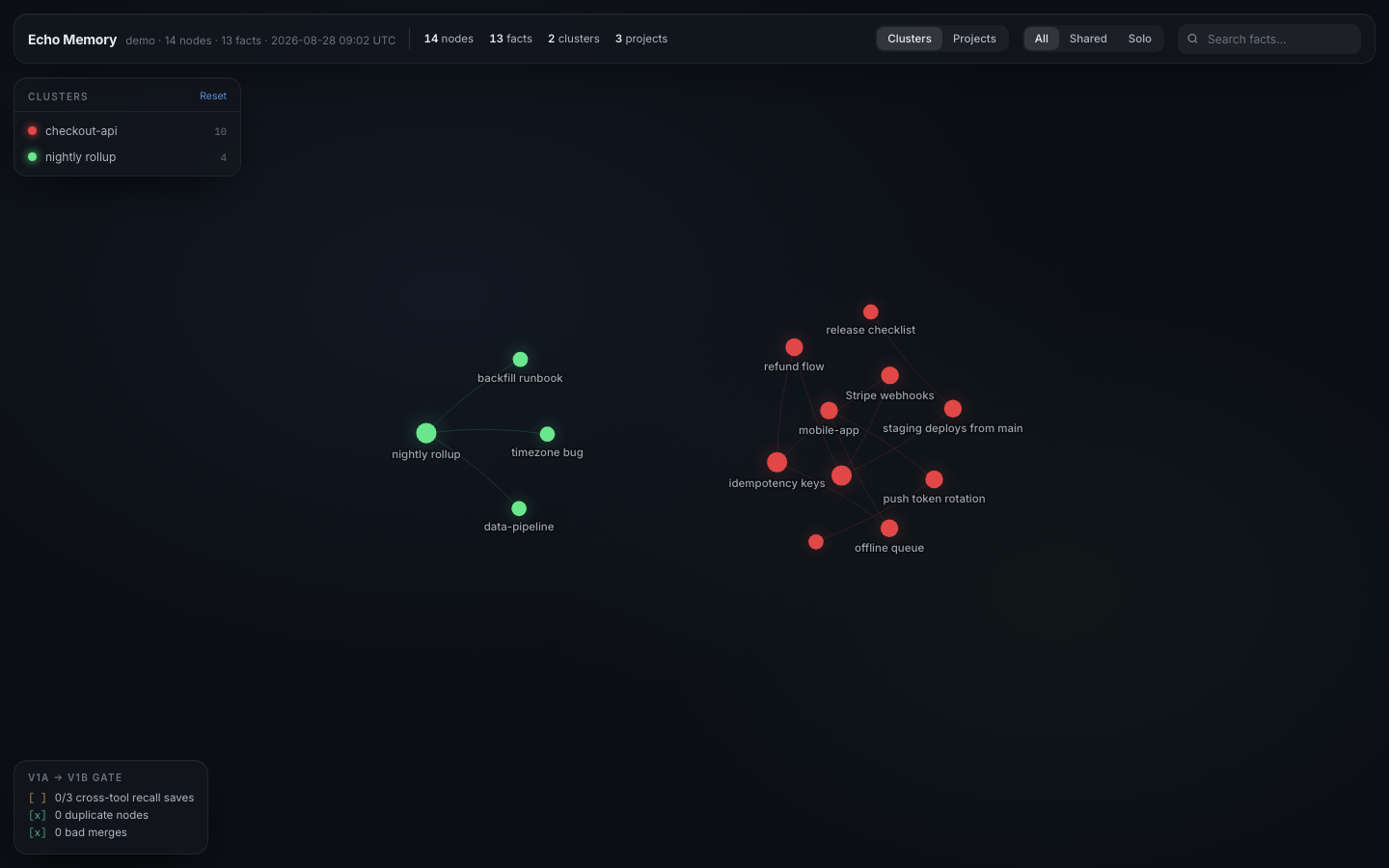
Three projects here. checkout-api, mobile-app and data-pipeline were
recorded in separate sessions and never told about each other, yet the picture
already separates them — because separation is a property of the edges, not a
label anyone applied.
Clusters come from structure. Densely connected facts are grouped by label
propagation over the edges, and each cluster is named after its most-connected
node. That is why data-pipeline sits apart on the left: nothing it knows
touches payments. It is also why checkout-api and mobile-app share a cluster
despite being different codebases — they genuinely do share an idea, and the
graph found it rather than being told.
Components are the stronger claim. Two nodes in different components have no path between them at all, which is the strongest statement this graph can make that two memories are unrelated.
Projects are a facet, not the structure. Every fact records the project it was written from, and you can colour by it, but project says where a fact was written, not what it belongs with.
Click a node: everything it takes part in
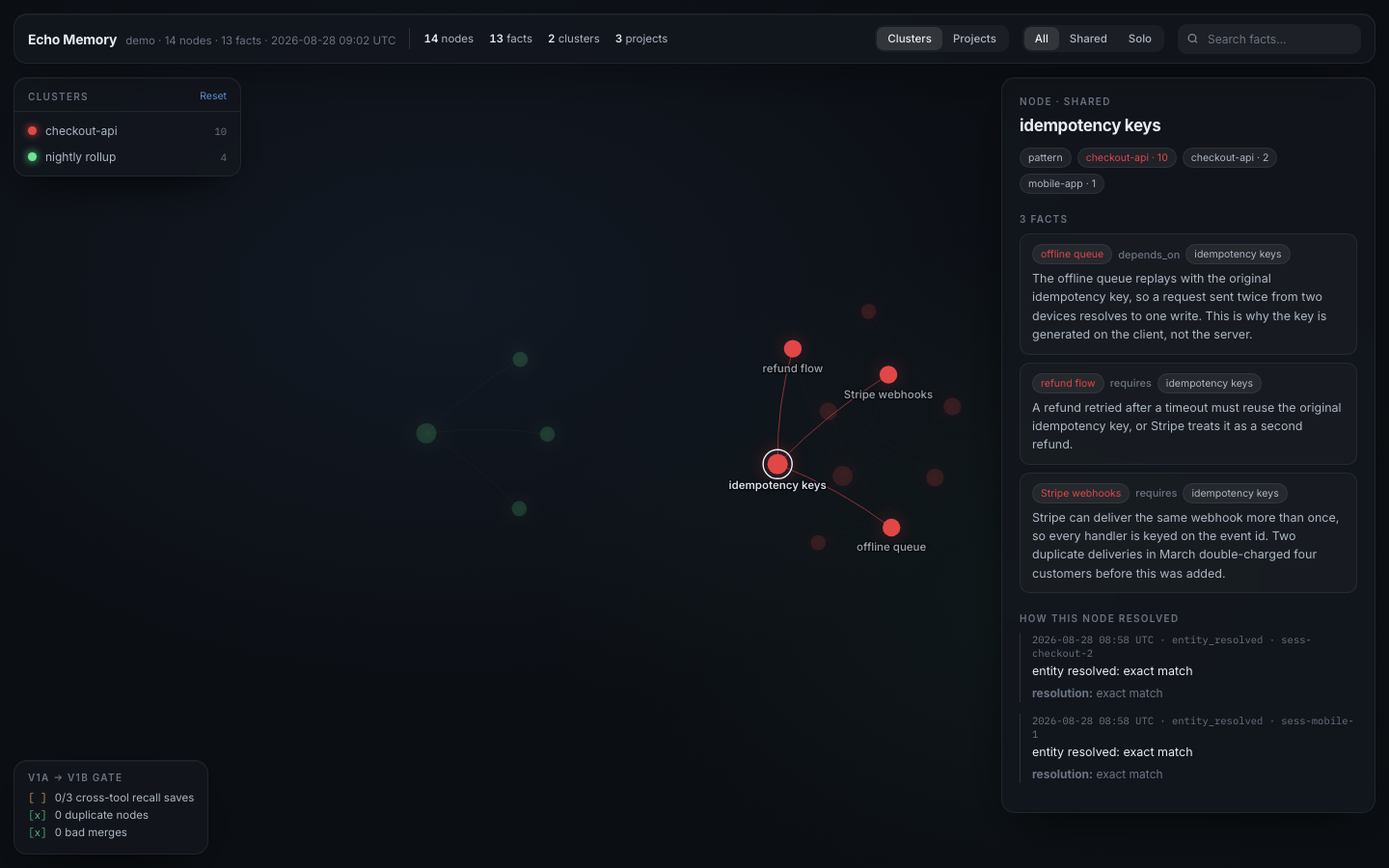
idempotency keys is the concept that joined those two codebases. The panel
shows it referenced from checkout-api twice and mobile-app once, the three
facts it appears in, and how the node itself resolved — each mention matched an
existing node by exact name rather than creating a duplicate.
Nobody wrote "these projects are related." Two sessions independently recorded a fact about idempotency keys, entity resolution matched them to one node, and the relationship exists as a consequence.
Click a link: why memory believes it
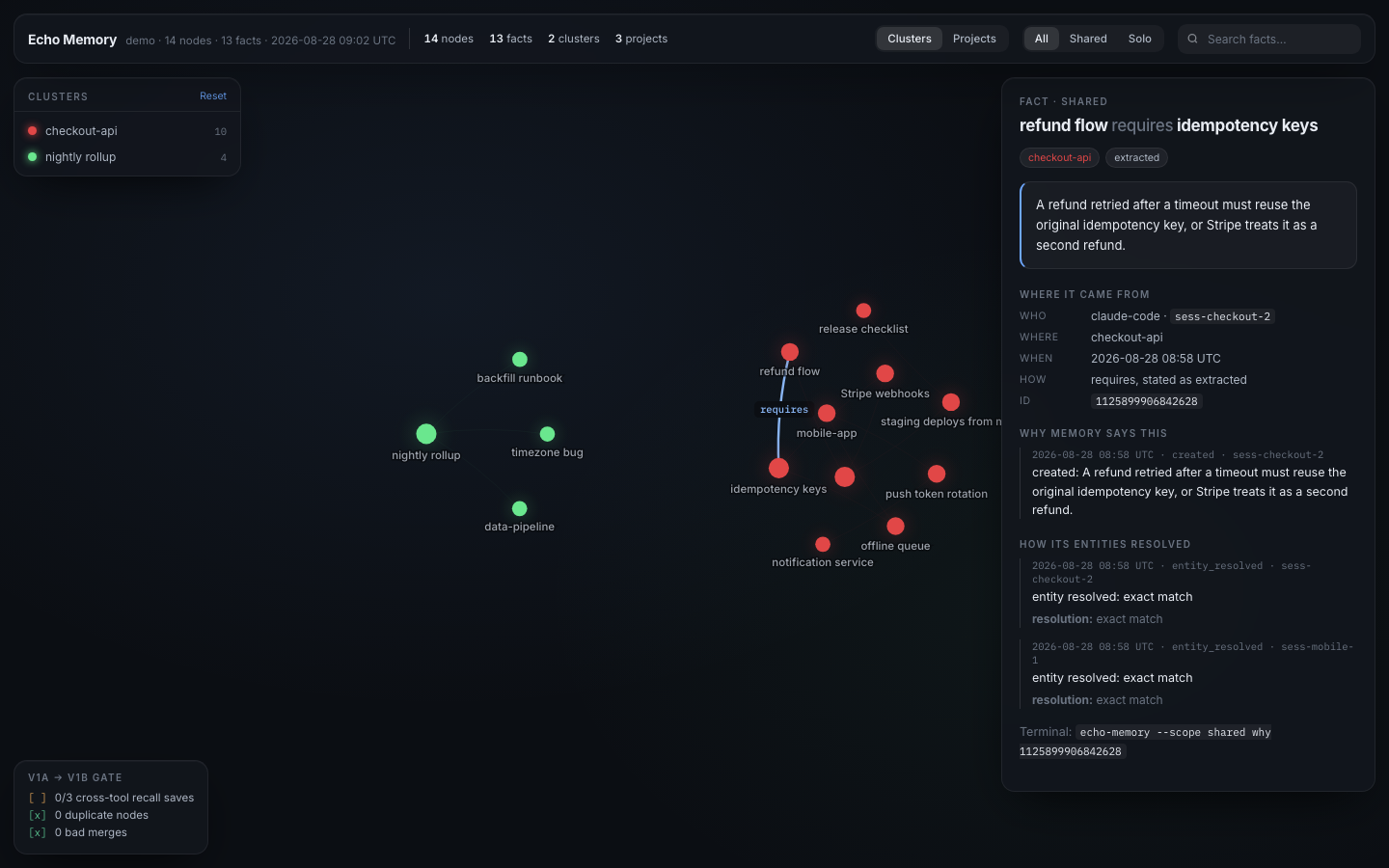
This is what a knowledge graph gives you that a code map cannot. Selecting the edge answers, for that single fact:
| what | the sentence, its relation_type, and how confidently it was stated |
| when | when it became valid, and when it was superseded if it has been |
| who | which agent wrote it, in which session |
| where | which project it came from |
| why | the audit trail — created, superseded from what to what, and the entity-resolution rationale for the nodes at either end |
A superseded fact is never deleted. It stops being drawn, because the graph no
longer asserts that relationship, but it stays reachable from its node and keeps
its full history. echo-memory why <fact_id> prints the same trail in a terminal.
Seeing your own
echo-memory dashboard --serve --open
The images above come from a synthetic dataset (scripts/demo-seed.py) rather
than a real store, for the obvious reason: a real memory graph is full of
hostnames, account numbers and client names.
Architecture
- Storage: PostgreSQL with the
pgvectorand Apache AGE extensions - Retrieval: hybrid vector + full-text search (v1a), with Personalized PageRank via
networkxadded in v1b for multi-hop associative retrieval - Interface: Model Context Protocol server:
write_episode,query_memory,record_recall_save,get_audit_log
Is the graph in good shape?
echo-memory health
A score, what is strong, what needs attention, and what to do about each,
including what recall has cost: how often memory was read, how often a read
returned anything, roughly how many tokens were injected, and how many saves
those reads produced. Writes were counted from the start; reads were not counted
at all, so nothing could answer whether recall earns what it costs. It
exists to be run when you have no question - a store can look healthy by every
number this CLI reports while most of its facts came from a bulk import, the
last real write was a week ago, and only one of several wired agents has ever
written anything. --json for machine-readable output.
Nothing in it is gated. The paid tiers sell hosting and the things that only exist when several people share a graph; diagnostics about your own data are not a thing to withhold from the person whose data it is.
Contributing
See CONTRIBUTING.md. Issues and PRs welcome; please read the design
docs first so proposals fit the staged build plan. A first pull request is asked to sign
the Contributor License Agreement — once, in the PR thread.
License
Apache License 2.0. See LICENSE.
mcp-name: io.github.ayushcodes10/echo-mem
Installation
Source-derived launch command. Check the maintainer’s required arguments and credentials before running:
uvx echo-memSet up in your AI client
Merge this template into ~/Library/Application Support/Claude/claude_desktop_config.json. Keep existing servers. Add any arguments, credentials, and permissions required by the maintainer; this template has not been install-tested.
{
  "mcpServers": {
    "io-github-ayushcodes10-echo-mem": {
      "command": "uvx",
      "args": [
        "echo-mem"
      ]
    }
  }
}
Restart Claude Desktop completely for changes to take effect. Confirm the server appears connected in the client’s tool list, then try a read-only example from its documentation.
Claude Desktop setup referencePackage
echo-mempypiCompatible MCP Clients
Echo Memory works with any MCP-compatible client. Copy the config snippet from the Configuration section above and add it to the file shown for your client, then restart the application.
- Claude Desktop
~/Library/Application Support/Claude/claude_desktop_config.jsonRestart Claude Desktop completely for changes to take effect. - Cursor
~/.cursor/mcp.jsonRestart Cursor for changes to take effect. - VS Code
.vscode/mcp.jsonReload VS Code window for changes to take effect. - Windsurf
~/.codeium/windsurf/mcp_config.jsonRestart Windsurf for changes to take effect. - Claude Code
.mcp.jsonSave at the project root, then start Claude Code in that project and review the MCP server approval prompt. Keep real credentials out of shared files.