Short Video Agent Kit
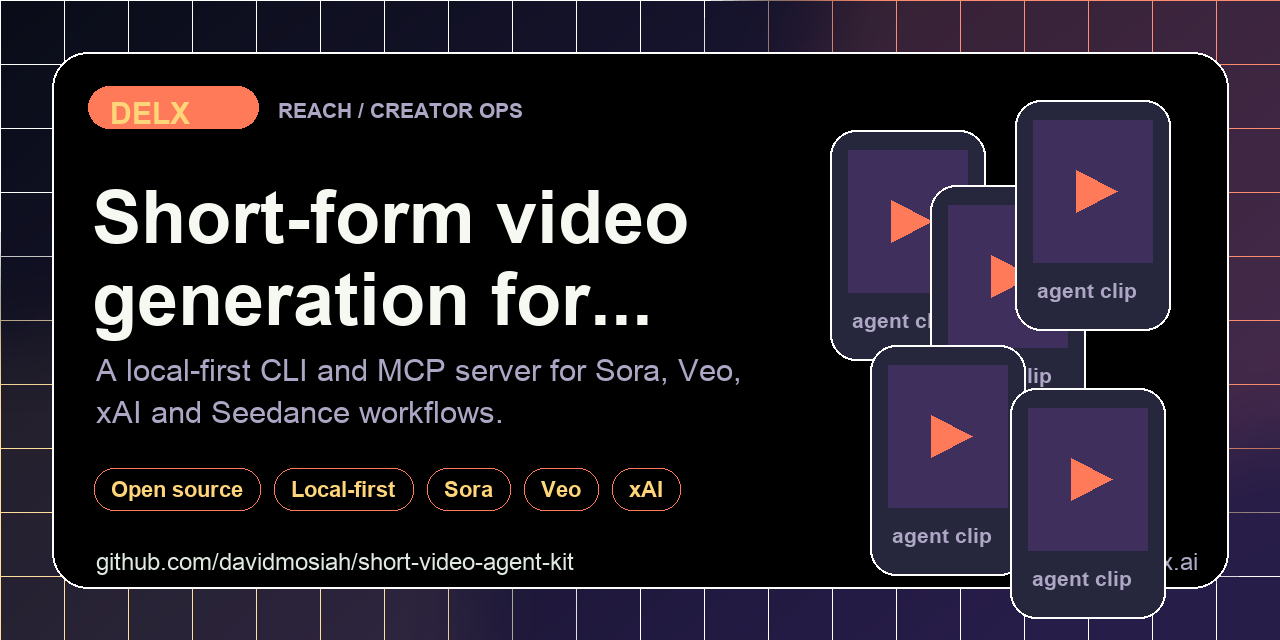
Provider-neutral short-form AI video toolkit for agents: Sora, Gemini Veo, xAI/Grok, Seedance.
⭐ If this agent-first tool helps your workflow, please star the repo. Stars make this tooling easier for other builders to discover and help Delx keep shipping open infrastructure.
🧱 Part of the Delx agent stack — 15 open-source MCP servers across body, reach and coordination.
HTTP (v2 stateless)
Default is stdio. Optional Streamable HTTP — no session id, JSON responses, loopback only:
npx -y -p short-video-agent-kit short-video-mcp --http
# GET  http://127.0.0.1:3033/health
# POST http://127.0.0.1:3033/mcp   (sessionless)
Env: SHORT_VIDEO_MCP_HOST, SHORT_VIDEO_MCP_PORT, SHORT_VIDEO_MCP_TRANSPORT=http.
Provider-neutral short-form AI video toolkit for agents. It gives Codex, Claude, Cursor, Hermes, OpenClaw and other MCP clients one interface for building dry-run payloads and, when explicitly enabled, generating vertical video through Sora/OpenAI, Gemini Veo, xAI/Grok and Seedance/PiAPI-style providers.
Use it when an agent needs one safe interface for prompt-to-video payload validation and optional paid generation across multiple providers.
Why It Is Agent-First
Video generation can be expensive and prompt-sensitive. This package makes agents start with safe steps:
- inspect provider readiness
- return privacy boundaries
- build payloads without spending credits
- require
--liveorSHORT_VIDEO_DRY_RUN=falsebefore provider calls - keep prompts and outputs in local user-controlled paths
Install
npm install -g short-video-agent-kit
Or run directly:
npm exec --yes --package=short-video-agent-kit -- short-video-agent-kit doctor
Quickstart
No API key needed to try it — generation is dry-run by default, so the kit returns the exact provider-neutral plan it would send without spending a credit.
Build a Sora plan for an 8-second vertical teaser:
short-video-agent-kit generate \
  --provider openai_sora \
  --prompt "Vertical 8-second product teaser for a minimalist water bottle, soft studio light, slow dolly-in" \
  --output ./output/teaser.mp4
Real output (no provider call, no credits spent):
{
  "ok": true,
  "dry_run": true,
  "next_step": "Pass --live or set SHORT_VIDEO_DRY_RUN=false to call the provider API.",
  "provider": "openai_sora",
  "endpoint": "POST /v1/videos",
  "payload": {
    "model": "sora-2",
    "prompt": "Vertical 8-second product teaser for a minimalist water bottle, soft studio light, slow dolly-in",
    "seconds": "8",
    "size": "720x1280"
  }
}
Same prompt, different provider — the plan re-targets the endpoint and parameter shape for you. payload returns just the plan (no dry_run wrapper):
short-video-agent-kit payload --provider gemini_veo --prompt "Same teaser, 9:16, cinematic"
{
  "provider": "gemini_veo",
  "endpoint": "POST /models/{model}:predictLongRunning",
  "payload": {
    "instances": [
      {
        "prompt": "Same teaser, 9:16, cinematic"
      }
    ],
    "parameters": {
      "aspectRatio": "9:16",
      "durationSeconds": 8
    }
  }
}
Check which providers are wired up (keys are detected, never printed):
short-video-agent-kit doctor
{
  "ok": false,
  "dry_run": true,
  "providers": {
    "openai_sora": { "configured": false, "env_keys": ["OPENAI_API_KEY"], "models": ["sora-2"] },
    "gemini_veo": { "configured": false, "env_keys": ["GEMINI_API_KEY", "GOOGLE_API_KEY"], "models": ["veo-3.1-fast-generate-preview"] },
    "xai_grok": { "configured": false, "env_keys": ["XAI_API_KEY"], "models": ["grok-imagine-video", "grok-imagine-image"] },
    "seedance_piapi": { "configured": false, "env_keys": ["PIAPI_KEY", "SEEDANCE_API_KEY"], "models": ["seedance-2-fast-preview"] }
  },
  "output_dir": "./output",
  "next_steps": [
    "Set one provider key: OPENAI_API_KEY, GEMINI_API_KEY, XAI_API_KEY or PIAPI_KEY."
  ]
}
When you are ready to actually render, set a provider key and re-run generate with --live (or SHORT_VIDEO_DRY_RUN=false).
CLI
short-video-agent-kit manifest --client codex
short-video-agent-kit doctor
short-video-agent-kit privacy-audit
short-video-agent-kit payload --provider gemini_veo --prompt-file prompt.txt
short-video-agent-kit generate --provider openai_sora --prompt "Vertical product teaser" --output ./output/teaser.mp4
short-video-agent-kit generate --provider openai_sora --prompt-file prompt.txt --output ./output/teaser.mp4 --live
Supported providers:
openai_soragemini_veoxai_grokseedance_piapi
MCP
short-video-mcp
HTTP transport:
SHORT_VIDEO_MCP_TRANSPORT=http short-video-mcp
Hermes-style config:
mcp_servers:
  short_video:
    command: npx
    args: ["-y", "short-video-agent-kit"]
    sampling:
      enabled: false
Recommended first calls:
short_video_connection_statusshort_video_privacy_auditshort_video_build_payloadshort_video_generate
Agent Surfaces
| Tool | Purpose |
|---|---|
short_video_agent_manifest | Install/runtime guidance for Codex, Claude, Cursor, Hermes and OpenClaw |
short_video_connection_status | Provider readiness without API keys |
short_video_privacy_audit | Prompt, output and reference-asset boundaries |
short_video_build_payload | Provider-specific payload without paid generation |
short_video_generate | Dry-run by default, live only when explicitly requested |
Copy-Paste Agent Prompt
Use short-video-agent-kit. First call short_video_connection_status and short_video_privacy_audit.
Build the payload before generation. Only set live=true if I explicitly confirm a paid provider call.
Configuration
Copy .env.example to .env and fill only the provider keys you plan to use. .env, output/ and .agent-data/ are ignored by Git.
Safety Model
- Dry-run is the default.
- API keys are never returned by tools.
- Paid generation requires
--live, MCPlive=true, orSHORT_VIDEO_DRY_RUN=false. - Reference images must be user-owned or licensed.
- Outputs are written to local paths controlled by the user.
Development
npm install
npm test
npm run check
📧 Contact & Support
- 📨 support@delx.ai — general questions, integration help, partnerships
- 🐛 Bug reports / feature requests — GitHub Issues
- 🐦 Updates — @delx369 on X
- 🌐 Site — wellness.delx.ai
Installation
Source-derived launch command. Check the maintainer’s required arguments and credentials before running:
npx -y short-video-agent-kitSet up in your AI client
Merge this template into ~/Library/Application Support/Claude/claude_desktop_config.json. Keep existing servers. Add any arguments, credentials, and permissions required by the maintainer; this template has not been install-tested.
{
  "mcpServers": {
    "io-github-davidmosiah-short-video-agent-kit": {
      "command": "npx",
      "args": [
        "-y",
        "short-video-agent-kit"
      ]
    }
  }
}
Restart Claude Desktop completely for changes to take effect. Confirm the server appears connected in the client’s tool list, then try a read-only example from its documentation.
Claude Desktop setup referencePackage
short-video-agent-kitnpmCompatible MCP Clients
Short Video Agent Kit works with any MCP-compatible client. Copy the config snippet from the Configuration section above and add it to the file shown for your client, then restart the application.
- Claude Desktop
~/Library/Application Support/Claude/claude_desktop_config.jsonRestart Claude Desktop completely for changes to take effect. - Cursor
~/.cursor/mcp.jsonRestart Cursor for changes to take effect. - VS Code
.vscode/mcp.jsonReload VS Code window for changes to take effect. - Windsurf
~/.codeium/windsurf/mcp_config.jsonRestart Windsurf for changes to take effect. - Claude Code
.mcp.jsonSave at the project root, then start Claude Code in that project and review the MCP server approval prompt. Keep real credentials out of shared files.