Heroku Code MCP
Search and execute Heroku Platform API operations
Heroku Code MCP
A compact MCP server for the Heroku Platform API using a Code Mode pattern:
search+execute+auth_status.
Heroku Code MCP gives agent clients a small, token-efficient control surface for Heroku operations. Pair it with Heroku Skills when you want workflow guidance, safety checks, and Heroku product context alongside live API tools.
Design references:
Quick Start
Default MCP URL: http://127.0.0.1:3000/mcp
git clone https://github.com/dsouzaAnush/heroku-code-mcp.git
cd heroku-code-mcp
npm install
npm run build
npm test
Seed auth from the Heroku CLI:
heroku auth:whoami
npm run seed:token
Start the server:
TOKEN_STORE_PATH=./data/tokens.integration.json \
TOKEN_ENCRYPTION_KEY_BASE64="<seed-output-key>" \
PORT=3000 HOST=127.0.0.1 npm run dev
Smoke test:
curl -sS http://127.0.0.1:3000/healthz
MCP_URL=http://127.0.0.1:3000/mcp USER_ID=default npm run smoke:mcp
Before npm publication, the package can also run from GitHub:
HOST=127.0.0.1 PORT=3333 \
TOKEN_STORE_PATH="$HOME/.heroku-code-mcp/tokens.json" \
TOKEN_ENCRYPTION_KEY_BASE64="<base64-32-byte-key>" \
WRITE_CONFIRMATION_SECRET="<random-secret>" \
npx -y github:dsouzaAnush/heroku-code-mcp
Install in Agent Clients
 Claude Code
Install the companion plugin for skills plus MCP wiring:
claude plugin marketplace add dsouzaAnush/heroku-plugin
claude plugin install heroku@heroku-plugin
claude plugin enable heroku@heroku-plugin
Or add the running MCP server directly:
claude mcp add \
  --transport http \
  --scope local \
  heroku-code-mcp \
  http://127.0.0.1:3000/mcp \
  --header "x-user-id: default"
Claude Desktop
Use the HTTP endpoint directly when supported:
{
  "mcpServers": {
    "heroku-code-mcp": {
      "type": "http",
      "url": "http://127.0.0.1:3000/mcp",
      "headers": {
        "x-user-id": "default"
      }
    }
  }
}
For Desktop builds that expect stdio servers, bridge through mcp-remote:
{
  "mcpServers": {
    "heroku-code-mcp": {
      "command": "npx",
      "args": ["-y", "mcp-remote", "http://127.0.0.1:3000/mcp", "--allow-http", "--header", "x-user-id:default"]
    }
  }
}
Build a .mcpb bundle with:
npm run build:mcpb
 Codex
Codex
Codex uses Heroku Plugin for skills and optional MCP wiring:
codex plugin marketplace add dsouzaAnush/heroku-plugin --ref main
Enable heroku-plugin@heroku-plugin in the Codex Plugins tab, or add:
[plugins."heroku-plugin@heroku-plugin"]
enabled = true
Run this MCP server on http://127.0.0.1:3333/mcp when you want live Heroku API tools through the plugin.
 Cursor
git clone https://github.com/dsouzaAnush/heroku-plugin.git
cursor agent --plugin-dir heroku-plugin
Add the MCP server to ~/.cursor/mcp.json or project-local .cursor/mcp.json:
{
  "mcpServers": {
    "heroku-code-mcp": {
      "type": "streamable-http",
      "url": "http://127.0.0.1:3333/mcp",
      "headers": {
        "x-user-id": "default"
      }
    }
  }
}
Other MCP Clients
Use streamable HTTP:
{
  "mcpServers": {
    "heroku-code-mcp": {
      "transport": "streamable_http",
      "url": "http://127.0.0.1:3000/mcp",
      "headers": {
        "x-user-id": "default"
      }
    }
  }
}
Or bridge to stdio:
{
  "mcpServers": {
    "heroku-code-mcp": {
      "command": "npx",
      "args": ["-y", "mcp-remote", "http://127.0.0.1:3000/mcp", "--allow-http", "--header", "x-user-id:default"]
    }
  }
}
How It Works
| Tool | What it does | Why it exists |
|---|---|---|
auth_status | Reports whether the caller is authenticated with Heroku | Lets agents branch cleanly before API work |
search | Ranks Heroku operations from schema and docs context | Avoids exposing dozens of endpoint-shaped tools up front |
execute | Validates params/body and calls the selected Heroku operation | Gives one deterministic execution path |
Typical flow:
- Call
auth_status. - Call
searchwith natural language intent. - Choose one
operation_id. - Call
executewithpath_params,query_params, andbody. - For writes, run
dry_run=true, then replay withconfirm_write_tokenandALLOW_WRITES=true.
Examples:
{
  "query": "list apps",
  "limit": 5
}
{
  "operation_id": "GET /apps"
}
{
  "operation_id": "PATCH /apps/{app_identity}",
  "path_params": {
    "app_identity": "my-app"
  },
  "body": {
    "maintenance": true
  },
  "dry_run": true
}
Safety and Configuration
Mutations (POST, PATCH, PUT, DELETE) are blocked by default. To allow a write, set ALLOW_WRITES=true, request a dry run, and replay with the returned confirm_write_token. Sensitive headers and body fields are redacted.
Key env vars:
ALLOW_WRITESREQUEST_TIMEOUT_MSMAX_RETRIESCATALOG_CACHE_PATHREAD_CACHE_TTL_MSEXECUTE_MAX_BODY_BYTESEXECUTE_BODY_PREVIEW_CHARS
Full example: .env.example
Benchmarks
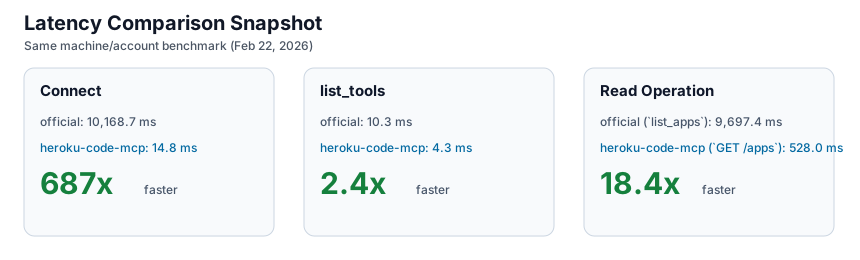
Benchmarks were captured on February 22, 2026 on the same machine and account for both implementations.
| Metric | heroku-code-mcp | official Heroku MCP | Delta |
|---|---|---|---|
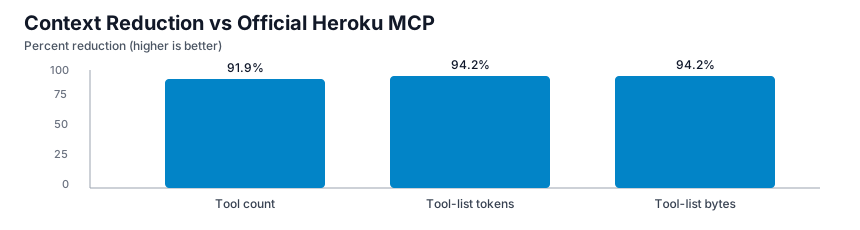
| Tool count | 3 | 37 | 91.9% lower |
| Tool-list payload bytes | 1,469 | 25,500 | 94.2% lower |
| Tool-list approx tokens | 368 | 6,375 | 94.2% lower |
| Connect avg | 14.8 ms | 10,168.7 ms | 687x faster |
list_tools avg | 4.3 ms | 10.3 ms | 2.4x faster |
| Read op avg | 528.0 ms (execute GET /apps) | 9,697.4 ms (list_apps) | 18.4x faster |
Charts:
Full methodology and artifacts live in BENCHMARKS.md and benchmarks/results/.
Development and Release
Validate locally:
npm run build
npm test
npm run validate:server
npm run publish:dry-run
This repo uses free GitHub Actions:
validate.ymlruns build, tests,server.jsonvalidation, and npm pack dry-run on PRs and pushes tomain.release.ymlruns onv*tags, builds the.mcpb, updates releaseserver.json, creates or updates the GitHub Release, and publishes to the MCP Registry through GitHub OIDC.- Dependabot checks npm and GitHub Actions dependencies weekly.
Publish manually when needed:
npm publish --access public
mcp-publisher login github
mcp-publisher publish server.json
For CI-based npm publishing, configure npm trusted publishing for repo dsouzaAnush/heroku-code-mcp and workflow release.yml, then run the release workflow with publish_npm=true.
Repository Layout
src/schema/*: ingestion, operation normalization, and cachesrc/search/*: search index and rankingsrc/execute/*: validation and Heroku API executionsrc/auth/*: OAuth and encrypted token storagetests/*: catalog, search, and execute testsbenchmarks/results/*: benchmark artifactsserver.json: MCP Registry metadata
Brand and Troubleshooting
This repo includes the official Heroku wordmark and mark under assets. Use them according to the Heroku Brand Guidelines.
Common fixes:
- MCP Inspector connection error: confirm URL
http://127.0.0.1:3000/mcpand server health. AUTH_REQUIRED: seed a token or complete OAuth.- Write blocked: confirm
ALLOW_WRITES=trueand send the dry-run confirmation token. - Large response body: narrow query scope or lower output caps.
Setup from the maintainer
This listing does not have a supported local package template. Use the maintainer’s documentation for its hosted endpoint, authentication, and client-specific setup. No install command has been inferred.
Package
https://github.com/dsouzaAnush/heroku-code-mcp/releases/download/v0.1.0/heroku-code-mcp.mcpbotherCompatible MCP Clients
Heroku Code MCP works with any MCP-compatible client. Copy the config snippet from the Configuration section above and add it to the file shown for your client, then restart the application.
- Claude Desktop
~/Library/Application Support/Claude/claude_desktop_config.jsonRestart Claude Desktop completely for changes to take effect. - Cursor
~/.cursor/mcp.jsonRestart Cursor for changes to take effect. - VS Code
.vscode/mcp.jsonReload VS Code window for changes to take effect. - Windsurf
~/.codeium/windsurf/mcp_config.jsonRestart Windsurf for changes to take effect. - Claude Code
.mcp.jsonSave at the project root, then start Claude Code in that project and review the MCP server approval prompt. Keep real credentials out of shared files.