HEY Research Lab
Evidence-backed Robinhood Chain research: builders, ships, contracts, changes, market context.
HEY Research Lab
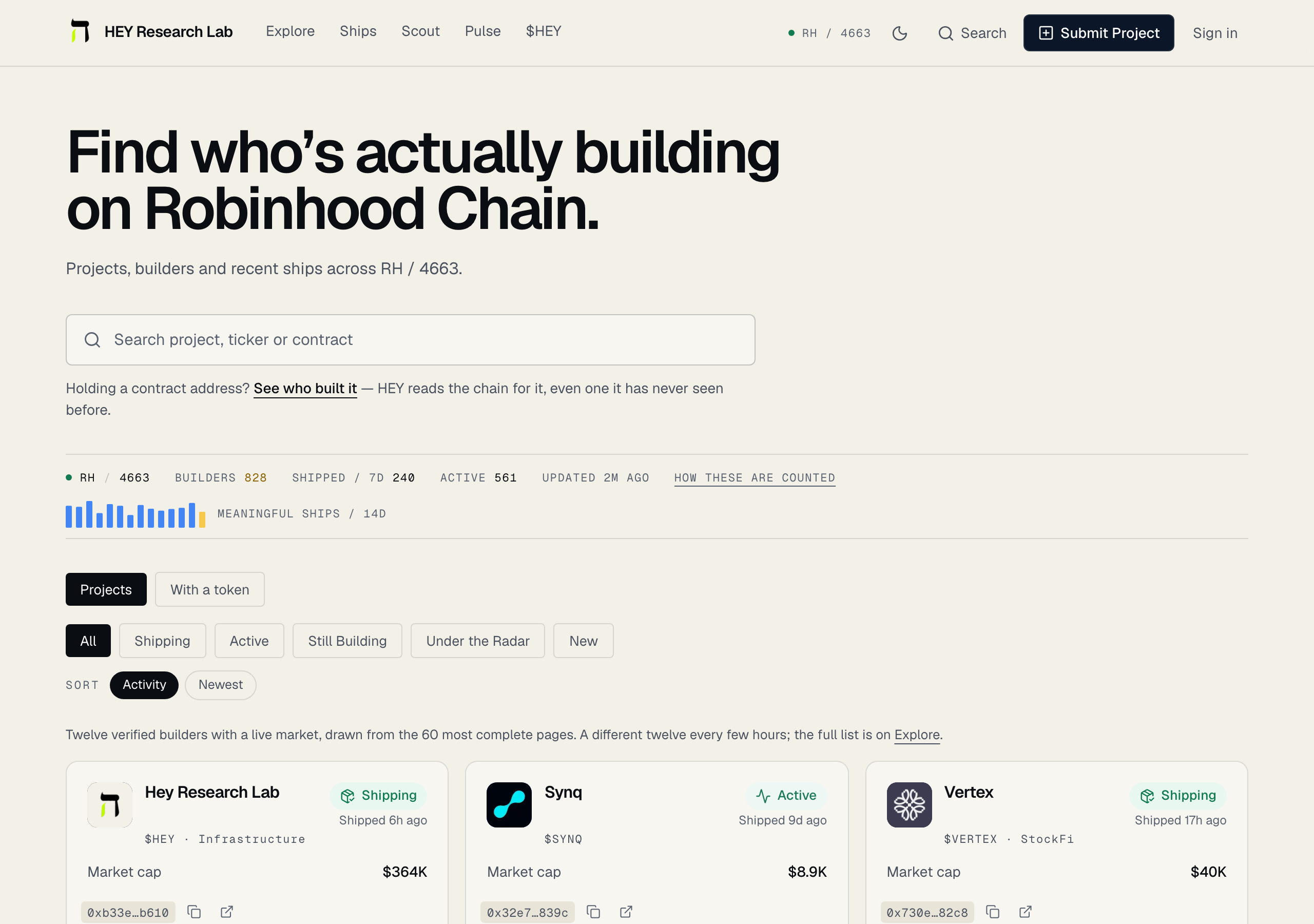
Find who's actually building on Robinhood Chain.





Site · Public API · MCP server · Sources · Changelog
The question
Not which wallet bought and not which token is pumping, but:
Which projects are still building, what have they shipped, and which of them is nobody looking at?
Price tells you what the market is doing. HEY tells you what the builder is doing.
Every answer on HEY is a fact with the source it came from. There is no score of a project's worth, no grade, no verdict, and the words rug and scam appear nowhere in the product — an end-to-end test asserts it.
A project page opens with its story: whether the builder is building (in plain words first), the latest ship and why it matters as a build event, whether the product is used, the token market as context, and what HEY does not know yet. Where HEY has nothing to read building from, the page says so once and lists what it does know, what it cannot verify yet and what it is still to read. A Research coverage block counts the dimensions HEY measured for that project — a count of states, never a score. The badge and the story read one table of research-level words, so a "Researched" page never says "Not researched yet", and a Verified Builder whose ships came from a deployment reads "Verified builder · no shipping source HEY can read yet", never "not linked". A latest change that is a market or lock event says so, and its link opens that event's own record.
What it looks like
| Explore the catalogue | One project's evidence |
|---|---|
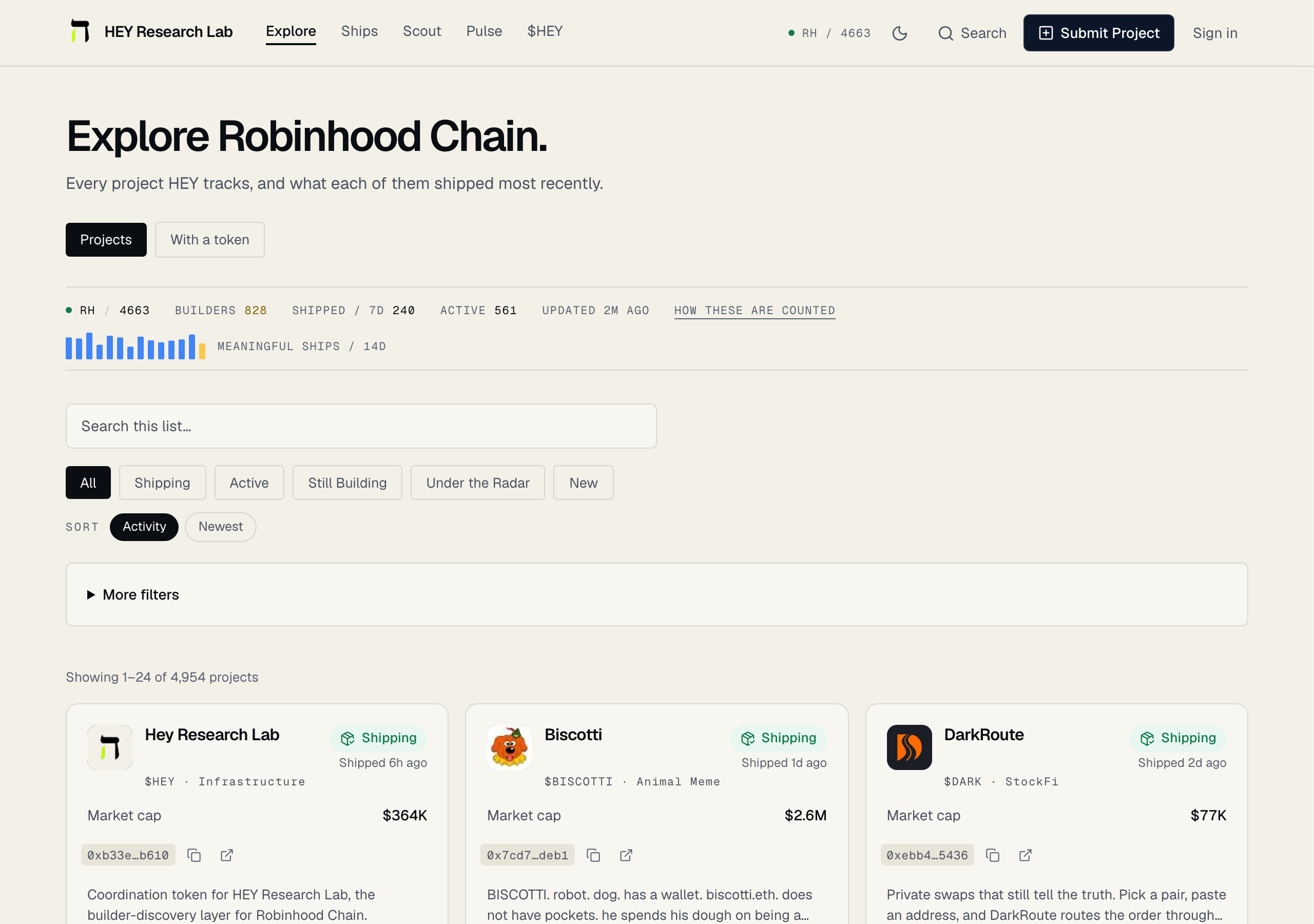 | 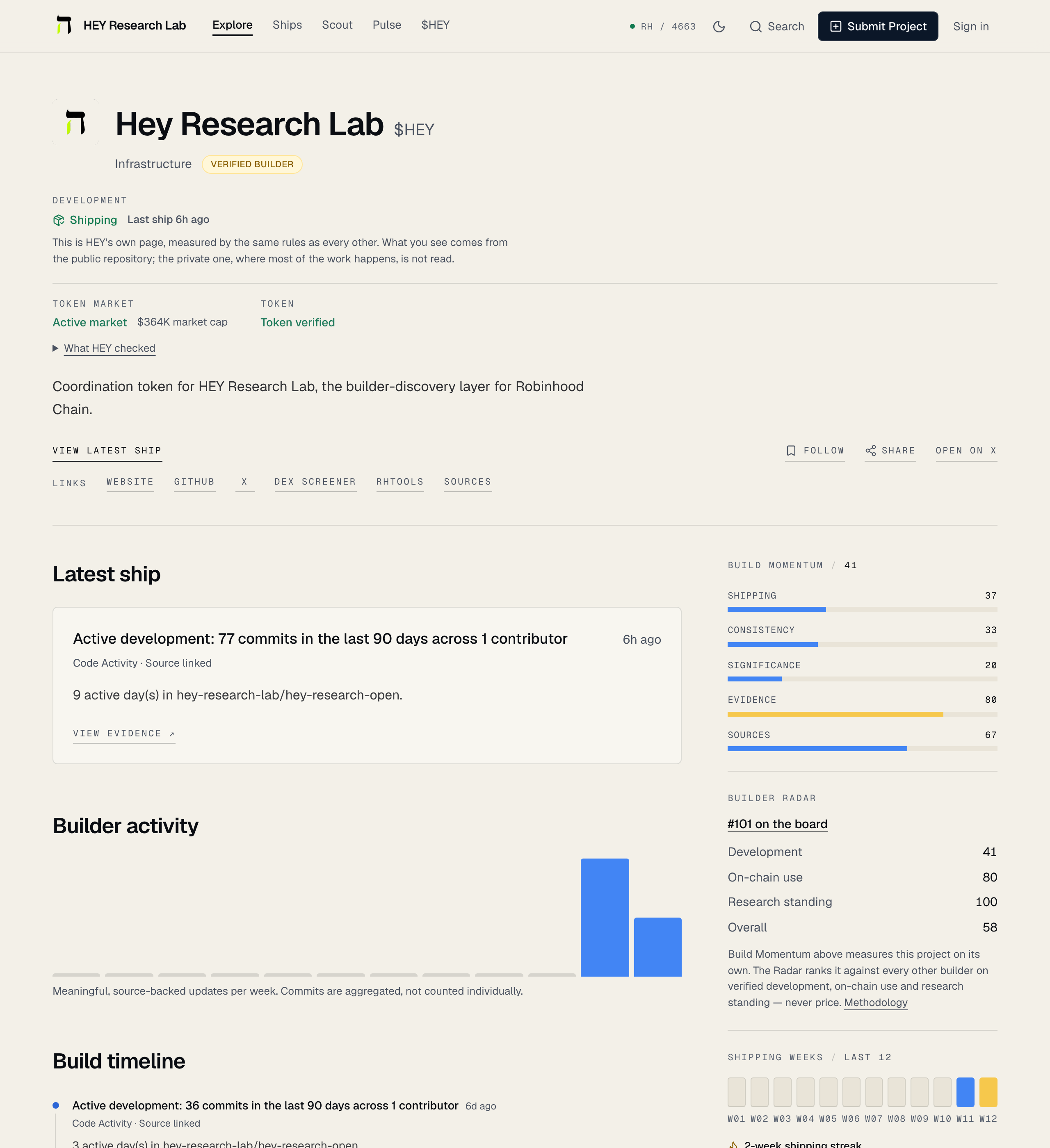 |
| Builder Radar | HEY Signal |
|---|---|
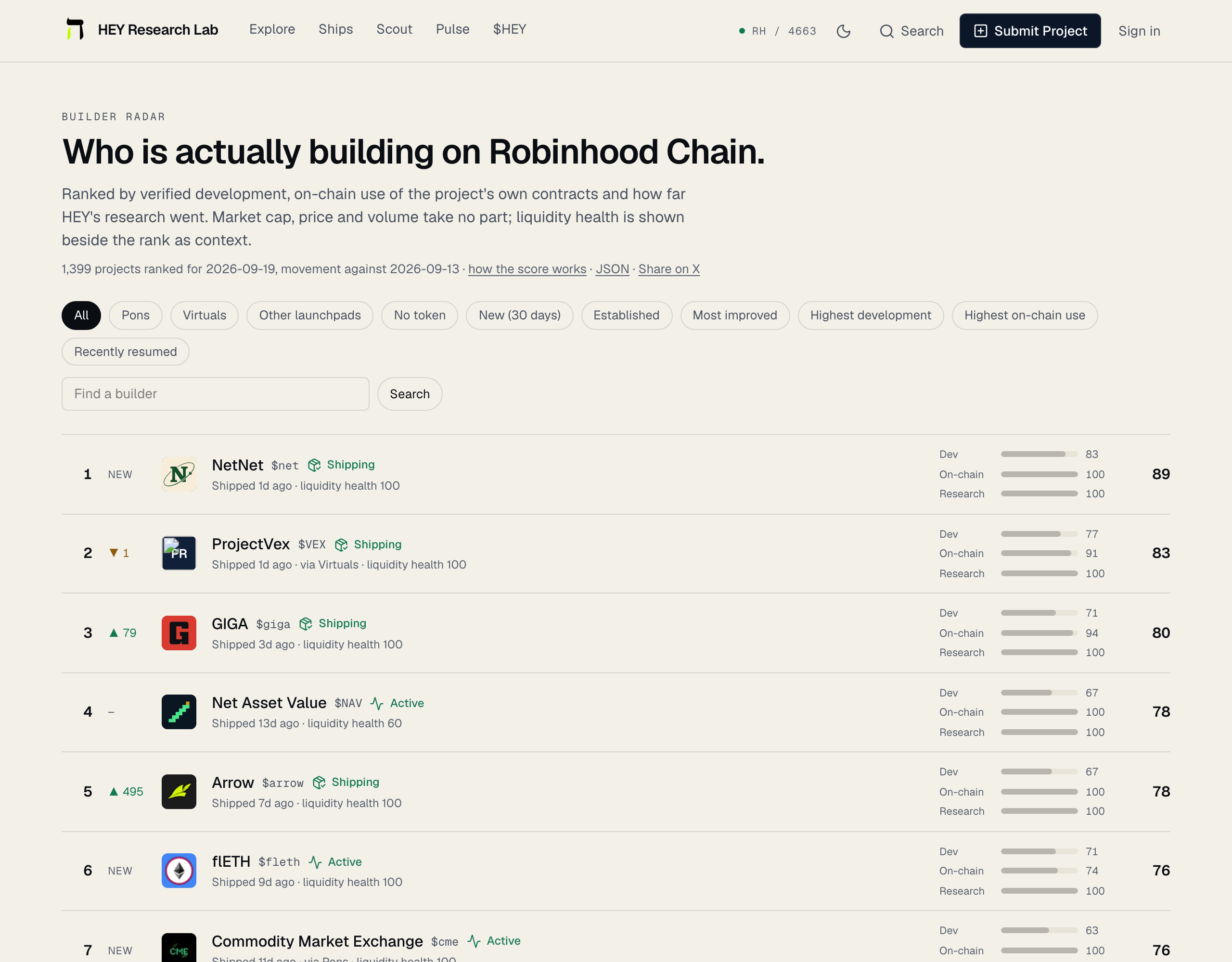 | 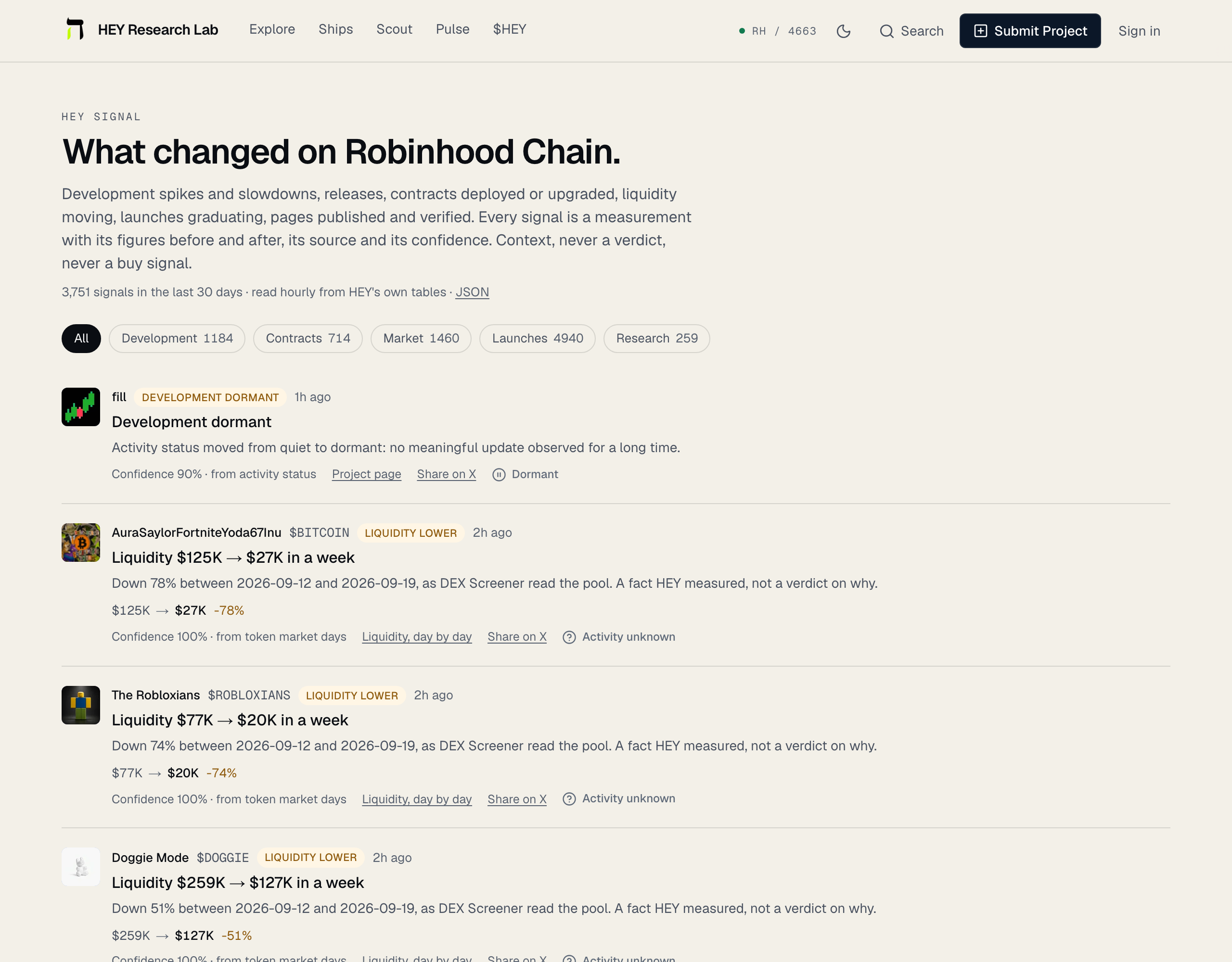 |
More surfaces: Pulse, Ships, Scout, Bounties, Developers, Methodology, mobile
| Pulse — the chain, day by day | Ships — what landed |
|---|---|
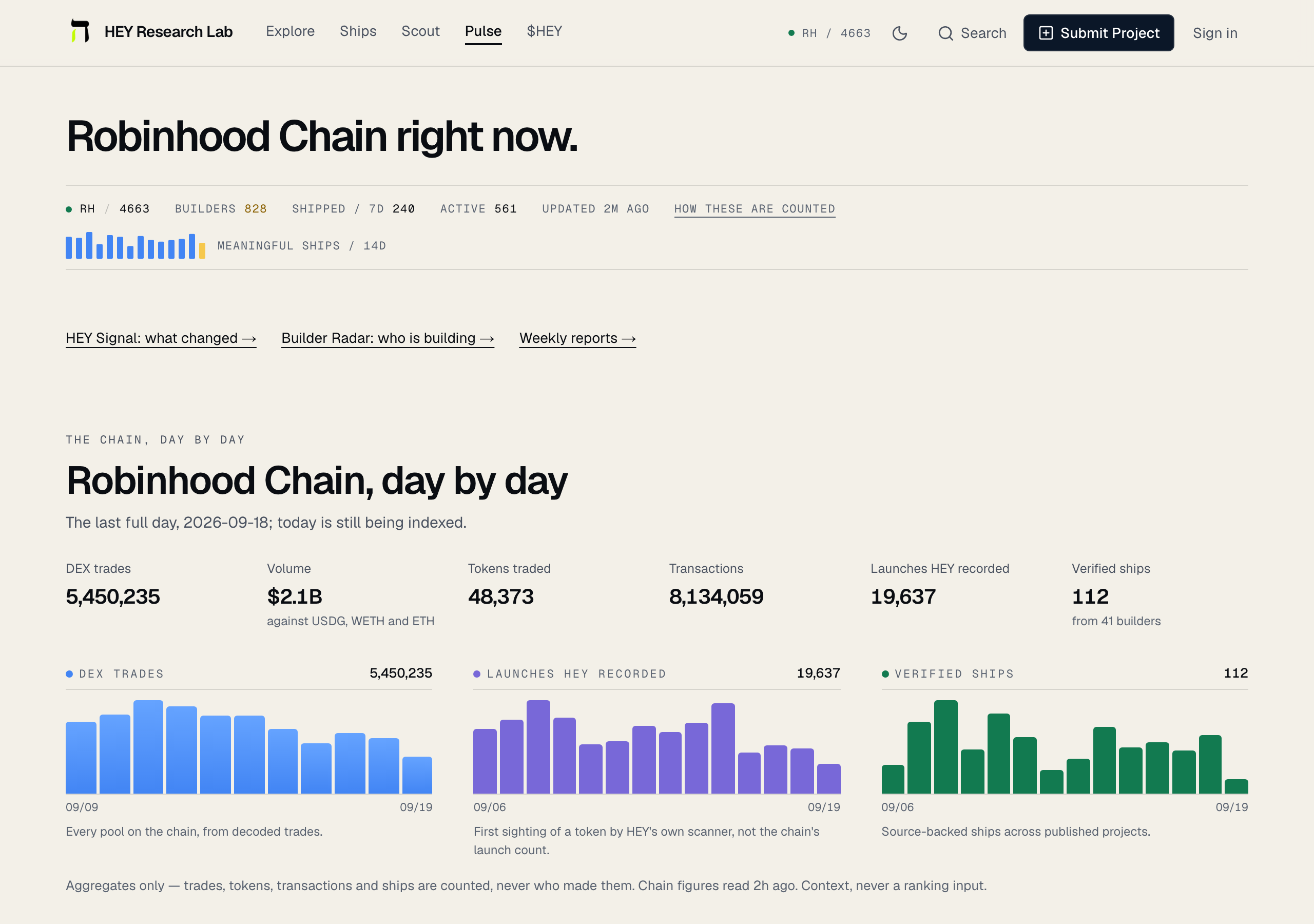 | 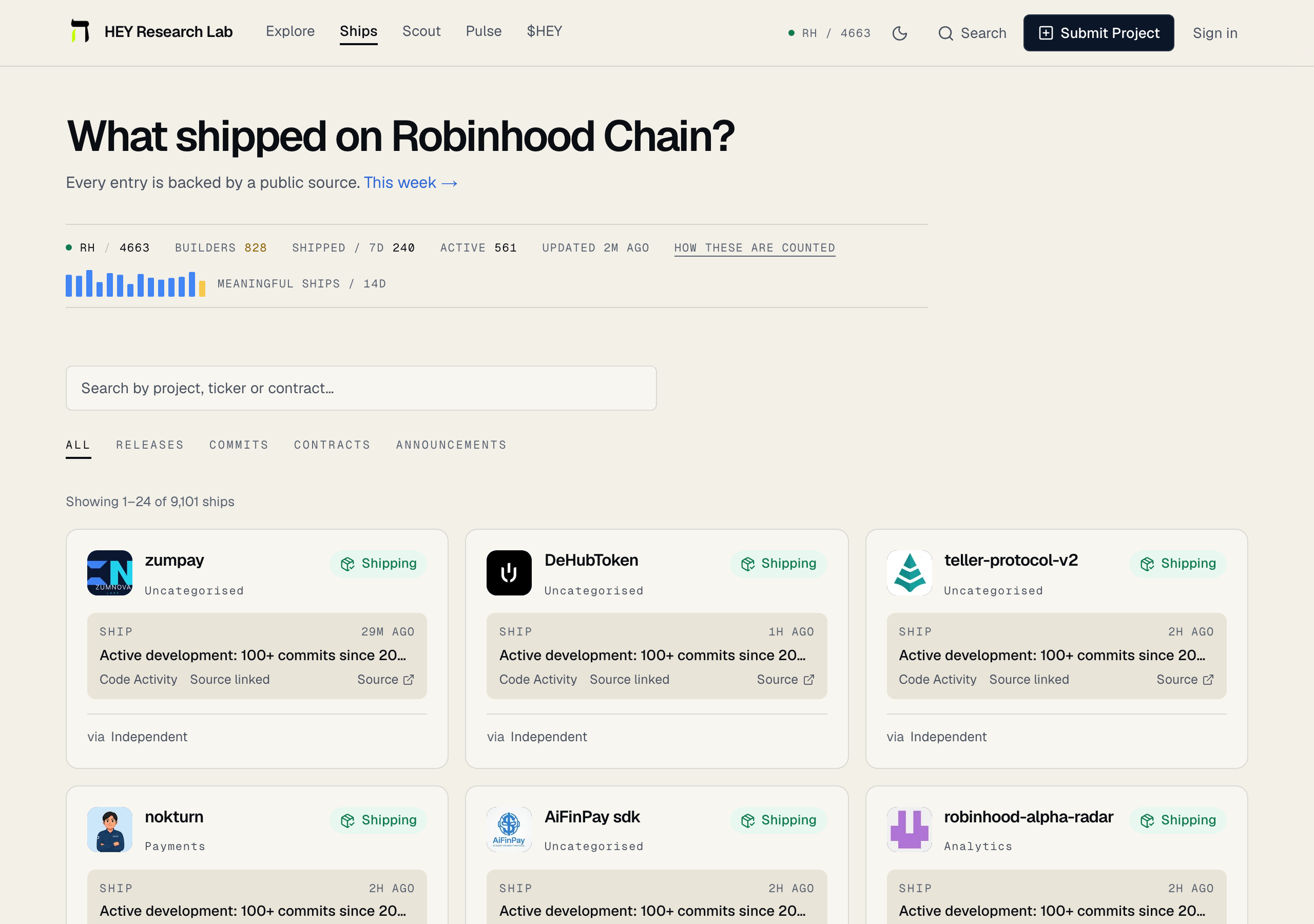 |
| Scout — earn by finding evidence | Bounties — set in dollars, paid in HEY |
|---|---|
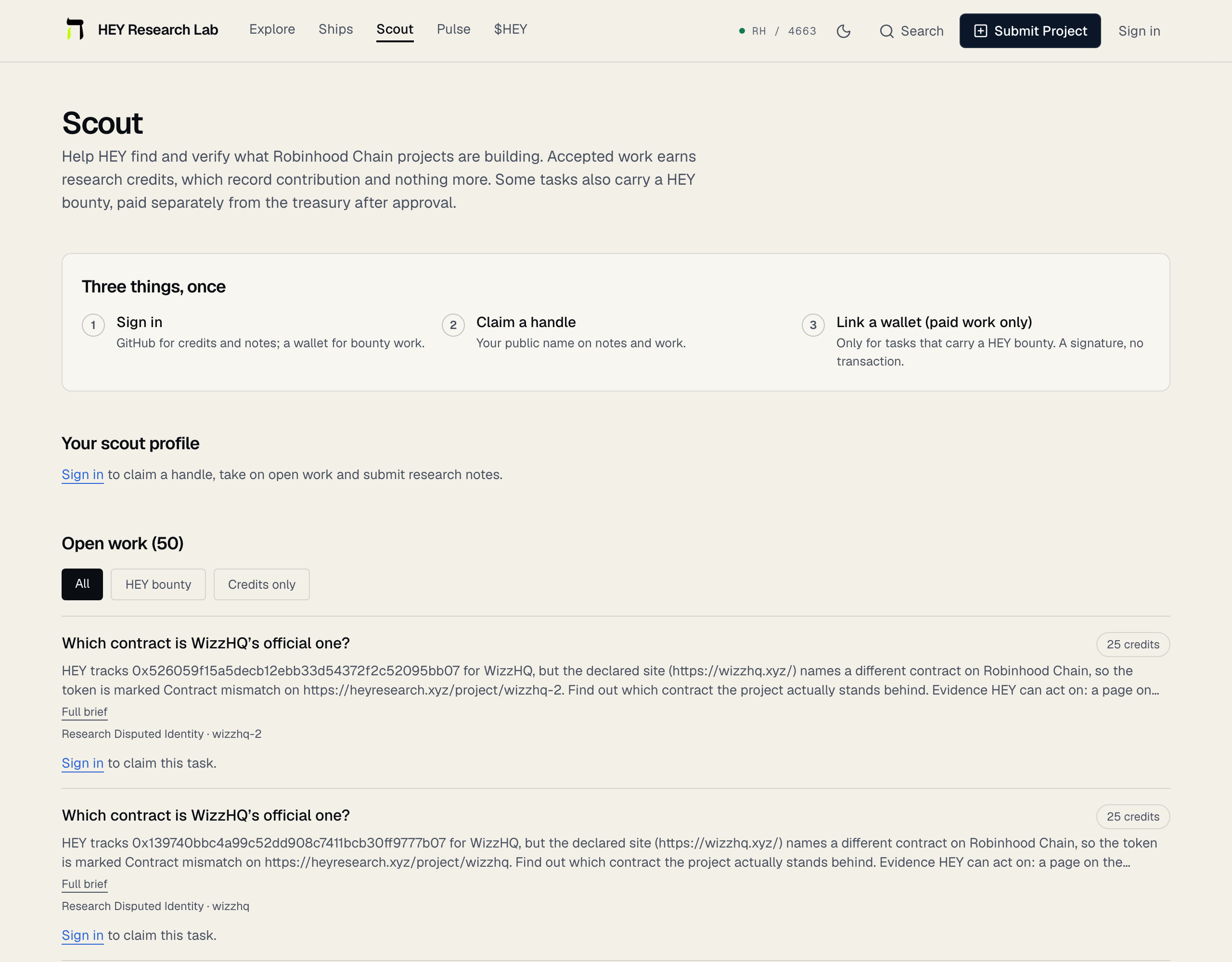 | 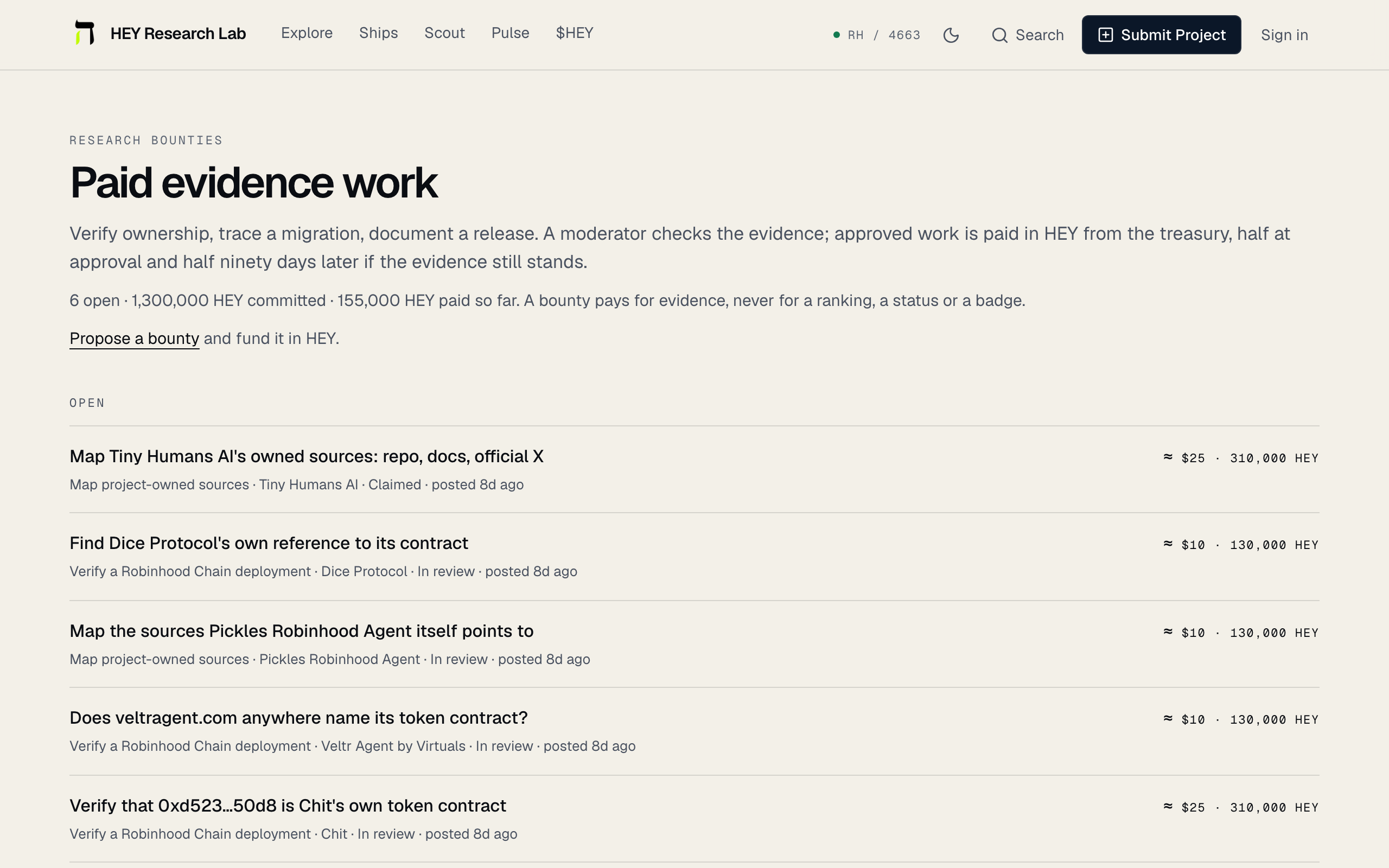 |
| Developers | Methodology — every rule, stated |
|---|---|
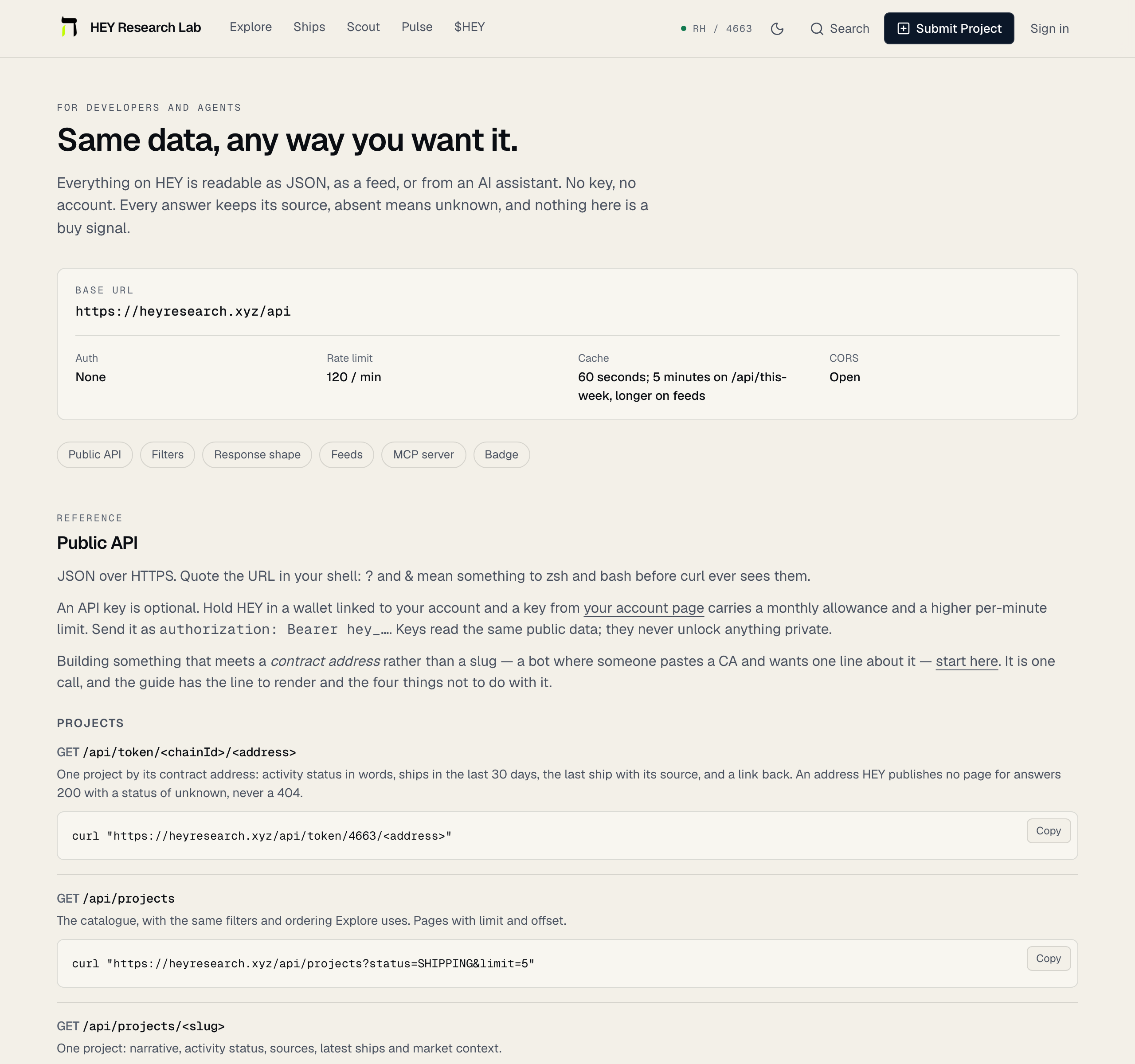 | 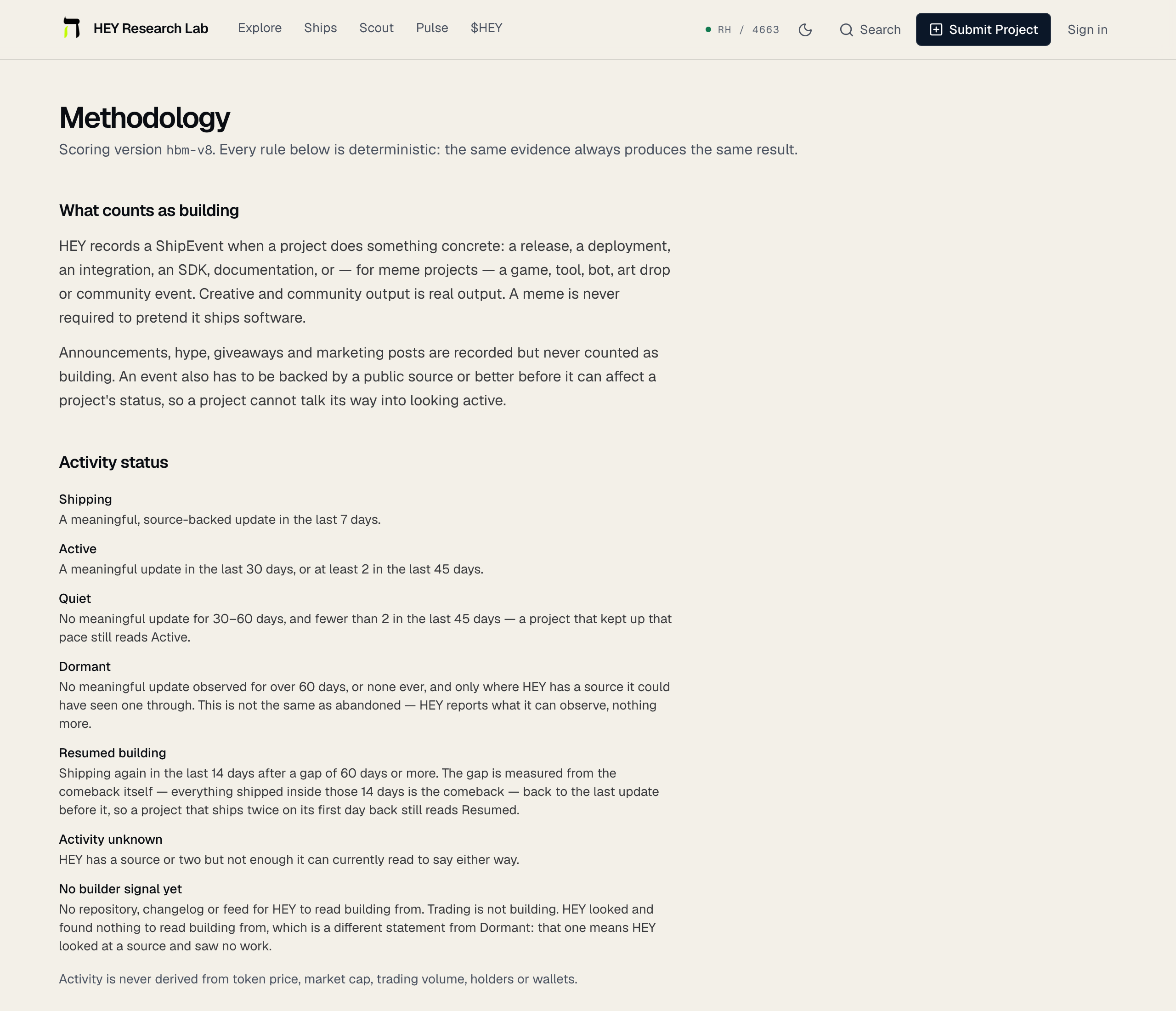 |
| Home, 375px | A project, 375px |
|---|---|
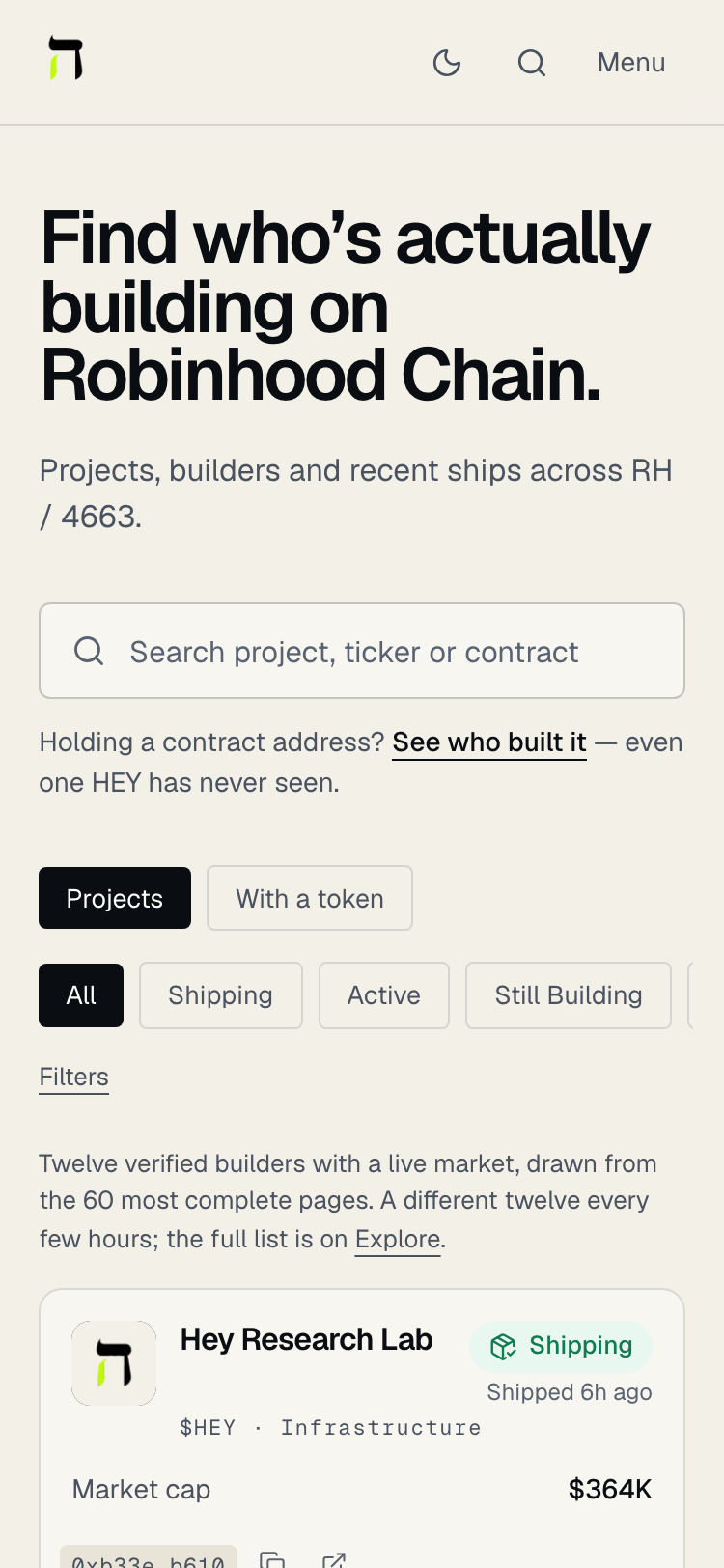 | 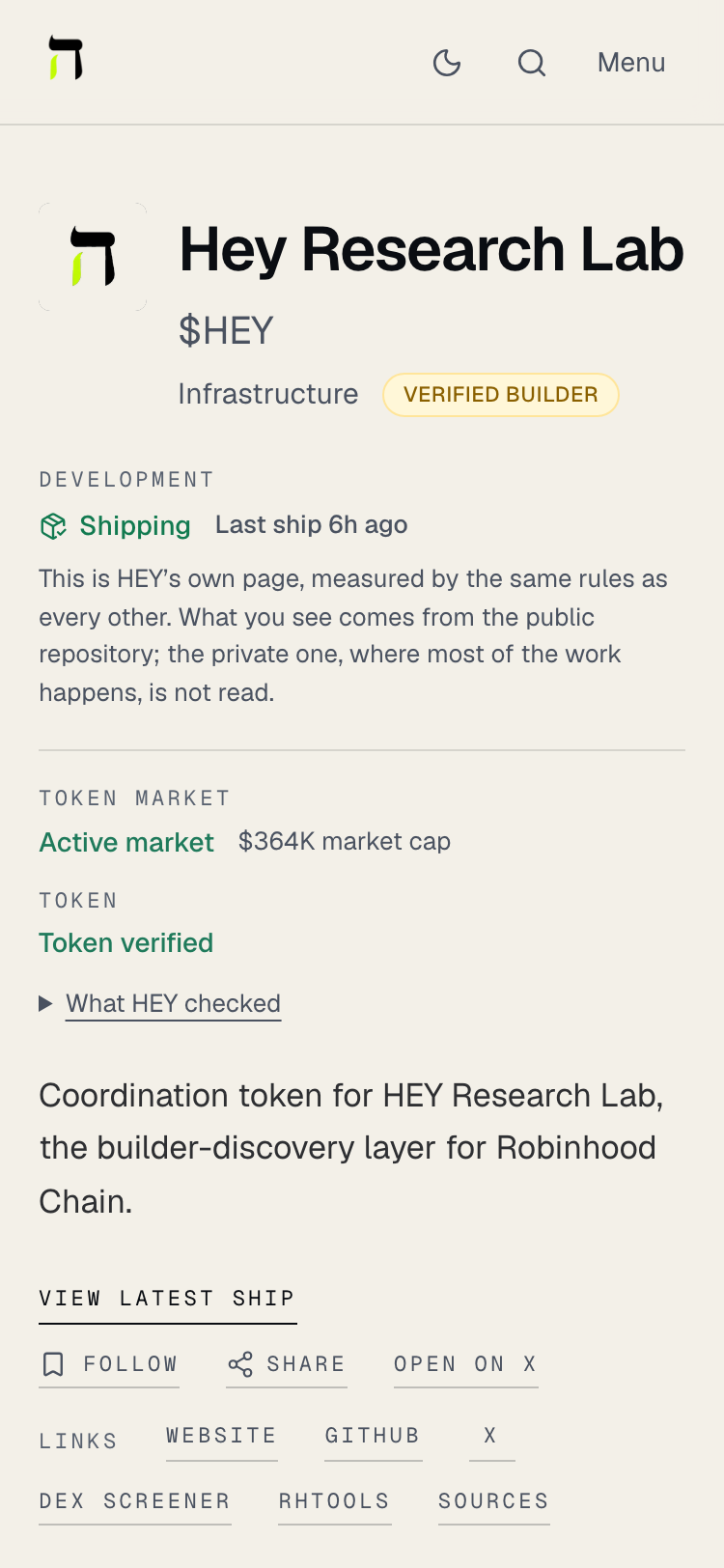 |
Captured from production on 20 September 2026. Since 30 September 2026 the whole site wears the Research Terminal's Luminous Glass material system — Lab Paper in light, graphite in dark, a glass header, translucent cards, a search that opens as a palette — with the same simple, card-first pages; the screenshots above predate it.
Since 1 October 2026 a first visit starts research-ready: Explore lists the projects HEY can answer the builder question for (a measured activity status or a source-backed ship in the last 90 days), with every indexed project one press away; the homepage shows real project cards right under the search; and a search that matches nothing says why and where to go next.
In this repository
This is the published half of HEY: the parts that stand on their own and are safe to read.
| Path | What it is |
|---|---|
packages/sources | Every public-data adapter HEY reads — GitHub, Blockscout, Sourcify (verification and its signature database), DEX Screener, GeckoTerminal, CoinGecko, launchpads, feeds, npm, deps.dev, OSV — each with saved fixtures and contract tests, plus the Telegram Bot API adapter HEY's alert bot sends through. The tests fail on a real network call. All of them go through one fetch guard (private-address and DNS-rebinding checks, redirect and credential rules, size, time and content-type limits) and bounded HTML and XML parsers, tested against hostile pages and feeds. |
packages/scoring | Activity status, Build Momentum, Still Building and Under the Radar, deterministic and versioned. They read no price and no balance, and that is tested. |
packages/sdk | @hey-research-lab/sdk, the typed client over the public API. No dependencies, ESM and CJS, Node 18 or a browser. |
packages/mcp-core | The MCP tools, renderers, resources and prompts with no transport: fifteen read-only tools, each answer tagged FACT, DERIVED or UNKNOWN. |
packages/agent-provider-core | The agent contract, AgentIntelligenceResponse v1: six bounded capabilities composed from the public API's own objects, the freshness contract, machine-safe text (contentOrigin), and thin REST, MCP and A2A adapters. The Robinhood Agent Apps adapter is an interface only, pending an official provider specification. |
apps/mcp | @hey-research-lab/mcp, the stdio entry point that bundles them. Node 20. The same tools are hosted at https://heyresearch.xyz/mcp. |
packages/config | Environment schema and chain constants. |
packages/ui | The presentation components — cards, chips, status, formatting, and the Terminal's candle chart (15m, 1H, 4H and 1D, with a code lane of commits, merged pull requests and exact-time releases), whose builder-event callouts are laid out from each event's time alone (terminal-chart-annotations.ts): never a price, never a cause. |
docs/ | The public API, the MCP server, the source registry, and every data source with what it refuses and why. |
The ingestion pipeline, the quality gate, the database schema, the web app and the operations tooling stay in the private repository.
Quickstart
Use the packages from npm (published 27 September 2026):
npm i @hey-research-lab/sdk                                   # the typed client
claude mcp add hey-research -- npx -y @hey-research-lab/mcp   # the MCP server
Or build this tree:
pnpm install
pnpm lint && pnpm typecheck && pnpm test     # 686 tests, no network
pnpm --filter @hey-research-lab/sdk build        # packages/sdk/dist
pnpm --filter @hey-research-lab/mcp build        # apps/mcp/dist/index.js
Which token, account and repository are a project's
An issuer's own token — a Robinhood stock token, read from the issuer factory's creation events
into issuer_tokens — is never a project's token, usage, valuation or market, and Scan says whose
it is. A site that only lists a contract among others does not verify it. A source copied from a
launch or market listing says so; Robinhood's own accounts are never a project's. Names that
borrow Robinhood's brand or a stock ticker carry a notice above every badge. Renamed GitHub
repositories are followed by GitHub's numeric id, and a pool is "Uniswap" only when the chain
confirms its factory.
A library or SDK repository, a test-data or fixture folder, a hand-kept deployments file deep in the tree, a file that names another repository as its source, or an asset list never proves that a token is a project's; a token a page took by a link that no longer holds gives that page no verified-contract ship. A GitHub release counts once across pages by its numeric release id, even after its repository was renamed. A description that claims a Robinhood partnership carries its own notice. A QUIET or DORMANT status that lost the builder source it rests on is rescored first, to "No builder source linked". Search lists an issuer's own token as its own row, above lookalikes.
A token a page took on a deploy record that no longer proves anything goes back to its own launch record, logged and reversible.
A repository that only names a token is never that token's project and never verifies it
(2026-10-05). A tracker, radar, bot or dashboard names the tokens it watches in its code and prints
them on its site; neither is the token's word. A builder's repository pairs with a launch record only
when the launch record itself declared that repository or its owner, or a deploy record proves the
deployment — and an address file without the creating transaction proves nothing about a contract
twenty or more GitHub accounts name (a launchpad's token, a protocol's position manager, a platform
token used as collateral). Links made the old way go back to their launch record with its own site,
docs and X account, logged and reversible. When published projects share a name or a ticker on different
contracts, the project page, the Terminal, search and the type-ahead say so in one line, with what
each project's own site or deploy record names — never which one is "real". /signals lists
projects with Robinhood Chain evidence first within each group.
A card's one line is a description, never a README (2026-10-03). Provider text — a listing, a
launchpad form, a repository's README — passes through one deterministic rule (descriptionLine):
Markdown, label headings, addresses, URLs and bot commands go; instructions, chat, relay
boilerplate and how-to sections are never the line; whole sentences are kept up to 200 characters.
Text with no description in it leaves the line empty rather than filling it with anything. A
project with no line takes its own site's meta description through the same rule, logged. Words an
owner typed are never rewritten.
Data correctness after a full audit (2026-10-03). The integrity audit no longer counts a Robinhood
stock token as an orphan (it belongs to no project by rule); a failing audit makes /status
critical and names the failing checks, and /api/status adds integrity.failing,
catalog.hidden and catalog.hiddenAsOf without changing any existing field. A verified
contract's timeline entry reads "Contract source verified", never "Contract deployed". A
description line keeps a dash before a closing emphasis mark, drops a mark left without its partner,
and is empty for text whose words run together. A repository that says it is a third-party profile
of someone else is never promoted into a project. Cards say "No token tracked" rather than "No
token".
Markets, the same day. A token that reads 0 decimals (an NFT collection) has no fungible market: no valuation, Discovery Gap, Under the Radar or Still Building, and NFT marketplaces such as Seaport are never read as a DEX. A market is never "Active" over a reading more than 36 hours old with no fresh trade record ("No current reading"). A market active only in another pool prints no valuation from the thin pool it follows. The Builder activity chart hatches weeks before HEY first read a project's sources as "not yet read", never zero. Holder figures say what they leave out and which supply they measure. A page under a publication hold says it is held and how the hold lifts, with no score, badge or Terminal link.
One project, one page, and bounties HEY already answered (2026-10-03). A registry listing whose site
or official X account a published page already holds (tokenless, or with a verified token) joins
that page instead of opening a second one; an unverified token page, a "V2"/"V3" sibling or a
launchpad's shared site still gets its own. Registry pages opened before that are held by one
reviewed, reversible command (pnpm data:duplicate-listings, dry run by default) and their address
points to the project's page. An open research bounty whose fact HEY has since verified by other
evidence is no longer listed as open and cannot be claimed; the hourly sweep closes the
treasury-funded ones nobody handed in work for (logged, reversible, no money moves), and handed-in
work waiting more than seven days is flagged for review.
Use the API
No key needed for the read API. 120 requests a minute anonymously, more with a key. Every answer names its
version in x-hey-api-version. A platform partner can ask for a partner key with its own quota and
route permissions; it reads the same public research, never anyone's account data (2026-09-30).
Filters that say no, and exports (2026-10-02). A value a parameter does not read is a 400 invalid_parameter listing the allowed values, never the unfiltered list (/api/ships?type=banana,
/api/projects?sort=momentum). /api/ships reads type=releases (every release type), a comma
list of types, and until (exclusive) beside since; a code-activity ship carries codeWeek, its
fixed Monday–Sunday UTC week with that week's commit count and up to three commit subjects.
/api/projects?sort=shipped7d|shipped30d orders by meaningful ships in the window.
/api/export/projects and /api/export/ships return the same lists as CSV, at most 1,000 rows.
One address, one line — the call a trading bot makes:
curl "https://heyresearch.xyz/api/v1/scan?chain=4663&token=0xB33eb16782776b4D738c0Fd643577cb0284Db610"
{
  "found": true,
  "status": "shipping",
  "status_label": "Shipping",
  "verified_builder": true,
  "activity": { "commits_30d": 100, "releases_30d": 1, "ships_30d": 3, "last_ship": "2026-09-18" },
  "project_url": "https://heyresearch.xyz/project/hey-research-lab",
  "cta": { "label": "See the builder on HEY", "url": "…" }
}
A token HEY has no published page for answers 200 with found: false, so a bot prints nothing
rather than guessing.
A person asks the same question at heyresearch.xyz/scan, or inside
the Research Terminal at /terminal/scan, where the ⌘K palette offers it for any address HEY does
not track. One scan behind both, and the same boundary: who is building this, never what the token
might do next. It has one name (2026-10-01): the navigation says "Scan", and the page asks
"Is anyone building this?". A published project answers with its Research Summary and the doors
to follow it; anything unresearched says "Builder not established yet." and what HEY holds. What
readers keep asking about is summed per record (research_demand) and decides only what HEY
researches next — an hourly, capped sweep queues the canonical site, contract-source and
quality-gate jobs for the most-asked under-researched records — never a status, score or rank.
The Research Terminal answers questions (2026-10-01). A reader previewing it is told what Terminal
access opens as questions about the project in view — full timeline, build evidence, usage history,
the market around releases, holders and locks, contract intelligence, Ask HEY in depth, watchlist
and alerts — filled from public identity only. Two ways in, said the same way everywhere and
explained at /terminal/access (2026-10-03): hold $HEY in a wallet you sign in with, or request
early access and an admin reviews it by hand. The same page's "Terminal vs free" table is built
from what the code actually gates, so the Terminal never claims to lock what the public site and
API already give away. The workspace Overview opens on the Research Brief, its lines led by
What changed? · Build · Usage · Market · Contracts · Evidence. Ask HEY never dead-ends: each answer
that cannot answer in full says why and offers next steps, including "Did you mean …" from the one
search matcher.
One project is fully open in the Research Terminal for every reader (2026-10-03): every tab, the real data, no decoys — the console's choice, by default HEY's own project (since 2026-10-04, labelled as such), else the published project with the most the Terminal can draw. Every other project's research stays behind the gate. HEY's own project's row says "HEY’s own project — researched by the same rules" wherever it is listed. Each workspace opens on a coverage strip (Build, Market, Usage, Intraday — states, never a score); HEY Today folds a project's weeks of code into one line with "Show every row"; and, with the model layer on, the Overview leads with a pre-answered Ask HEY brief for the most-opened projects, written ahead of time from HEY's records, cached by their hash and held to half the day's AI budget.
The Research Terminal has a reader-facing guide at /docs/terminal (2026-10-04): what it is,
what stays free, how to get in, a tour of every view, the command palette and keyboard shortcuts,
how to read what it shows, and how to report a bug or ask for a feature. It is served only while
the Terminal resolves, and a test holds it to the access figures, the workspace's views, the keys
and the canonical sentences the code uses. Each step carries a real screenshot of the live
Terminal, taken signed out on the sample project (what a signed-out reader cannot open is shown
locked, as it is), drawn without layout shift and linked to the full-size picture. Since the same
day's redesign it reads as a guide rather than a document: the answer and one primary action
(open the sample project), three cards to start from, a table of contents, the access rules as
short rows, the tour as one card per view whose screenshot and fuller explanation open in an
accessible dialog, and the reading rules as definitions — about a quarter of its old length at
rest, with the words still in one markdown file.
Search, What changed and Compare say one thing (2026-10-01). The header type-ahead lists projects
first, labels an empty page that shares a researched project's name, and folds launch records of
one name into a single row that opens the search page (emptyNamesake and moreLaunchRecords on
/api/search/suggest, additive). A question typed into search is answered — a question about one
project with its latest ship and Research Summary lines, anything else with where Ask HEY answers
it — never "nothing matches". "What changed" is always /updates; HEY Signal is "Signals", and
each page says what its count counts. "Compare with…" sits on every project page and under search
results; /api/compare?a=&b= mirrors /compare?a=&b=, and each compared project carries
valuation: { usd, kind, label } beside marketCapUsd, which may be an FDV. Explore names its
sets in one line: published projects · research-ready · verified builders.
Round 3 (2026-10-01): "Evidence →" opens /evidence/<id>, the receipt in words — source, dates,
whether it counts toward building and what it does not establish — with /api/evidence/<id> as
"As data"; machine surfaces still cite the API. Section links are built from one list of the
project page's anchors and only to a section the page draws. The type-ahead says "Several" where
its read was cut, the project page holds one current liquidity figure (the rest, each named, are
the market page's), and the market page names each date by what it dates.
HEY Signal's confidence (0–1) is a method statistic — how much evidence a rule read, which
scales importance — never a probability or a trading confidence. The API keeps it; since
2026-10-01 no HEY page prints it, and /signals shows one row per kind per UTC day with its true
count, opening to the projects.
Builder intelligence in your product, in one call — the Partner Card (2026-09-30):
curl -H "x-hey-integration: my-bot/1.0.0" "https://heyresearch.xyz/api/v1/builder?chain=4663&token=0x…"
Builder status in HEY's words, verified builder, the latest meaningful ship with its evidence id,
meaningful ships in 30 days (null, never 0, when not measured), the latest builder-side change and
signal, the token's market state as context, a badge and project_link — the page to link, labelled
so HEY can count your click-through. Since 2026-10-05 the latest ship also carries evidence_link
(its receipt page, labelled the same way), and partner answers are private, max-age=60: every call
reaches HEY and is counted, never served from a shared cache. The fields, the rules of use and eight tested examples
(Telegram, Discord, a trading terminal, a DEX, a launchpad, an explorer, a directory, an AI agent)
are at heyresearch.xyz/developers/partners and in
docs/PUBLIC_API.md.
The same thing, typed:
import { HeyClient, HeyApiError } from '@hey-research-lab/sdk';

const hey = new HeyClient();
const card = await hey.scanCard(4663, address);
if (!card.found) return null;

for await (const project of hey.projects.items({ tab: 'still-building' })) {
  console.log(project.slug, project.lastShippedAt ?? 'no ship recorded');
}
The developers page opens on a fifteen-minute quickstart (2026-10-05): the curl against a live
contract, the typed hey.builderCard(4663, token) with new HeyClient({ integration: 'my-product/1.0.0' }),
and a small React panel that prints nothing when HEY has no answer — with how evidence ids resolve
(GET /api/evidence/{id}) and the rate limits the deployment enforces. HEY counts an integration as in
use when an identified caller (a key, or a declared x-hey-integration name) is answered on two or
more distinct days and five or more times within seven days; a name sent with no key is only
observed until then, and the example names in these docs (my-product, your-product) and hey-
names are never counted. That count is traffic, never an input to any project's status or rank.
A listed project with a token carries tokenMarket — the market state the card shows — and the
single-project route sends everything the listing does. /api/projects/{slug}/market adds the
contract's deployer, its pools and 1% depth, and a supply-concentration summary with no addresses
(2026-09-25).
A Research Desk is a reader's published board of projects: GET /api/desks lists them by last
change (never by popularity), and GET /api/desks/{slug} answers its projects, the curator's
self-declared handle and its facts over its window — projects, shipped, development spikes,
contract changes — with null and a reason for anything HEY cannot state (2026-09-30). Any
signed-in account may curate and publish one; readers can report a desk, and HEY's moderators can
take one down.
/api/projects/{slug}/relationships lists what a project is connected to and why HEY thinks so —
every edge with its standing and evidence, never an account and never a "partnership" — and the
snapshot's peerContext places some of its figures among comparable projects, one figure at a time,
never as a combined score (2026-09-28).
The snapshot (/api/projects/{slug}/snapshot) opens on summary — one answer-first line per
question (building, usage, market, contracts, security, the latest change, what HEY does not know),
each tagged FACT, DERIVED or UNKNOWN with its evidence ids — and carries usage (calls and
distinct caller addresses per day, never people, never summed into a window) and security
(audits, bounties, security.txt, advisories; context, never a verdict). /api/projects/{slug}/usage
adds the daily series (2026-09-28).
Paging follows the API's own cursor, a 429 arrives as HeyApiError with retryAfterSeconds
and is never retried for you, and an absent field means HEY does not know — never a zero. A keyed
account's monthly allowance is counted per UTC month; once it is spent every counted call answers
429 with the reset date until the first of the next month, and HEY's operators see the account
as exhausted (from 80 % they see a warning) rather than learning it from the caller. A 503 service_unavailable with retry-after means HEY's database was busy for a moment; ask again
(2026-09-30).
A value a listing cannot read is refused, never dropped into a wider answer: an unknown type or
domain on /api/changes, an unknown Radar filter on /api/builders, like an unknown tab or
sort on /api/projects, is a 400 invalid_parameter naming the values it accepts, and a change
cursor past the end of the ledger is a 400 invalid_cursor. Only an unknown parameter name is
ignored. The OpenAPI document states each of those vocabularies as an enum (2026-10-03).
For an assistant — fifteen read-only tools over the same API, hosted or on your machine, listed in the
Official MCP Registry as io.github.hey-research-lab/hey-research. The research profile at
/mcp/research is builder intelligence first: no market-move, Under the Radar or valuation tool,
while research_answer there still carries its agent contract's market context, labelled context
only:
claude mcp add --transport http hey-research https://heyresearch.xyz/mcp

# or from npm
npx -y @hey-research-lab/mcp

# or from this repository
pnpm --filter @hey-research-lab/mcp build
claude mcp add hey-research -- node "$PWD/apps/mcp/dist/index.js"
Full reference: docs/PUBLIC_API.md · docs/MCP.md · docs/INTEGRATIONS.md — the line to render, the three answers to handle, and the four things not to do.
The open ecosystem
Ten more repositories sit beside the mirror, each independent,
MIT and Robinhood Chain only: hey-project-manifest
(the /.well-known/hey-project.json declaration — declared, never verified),
hey-ship-action (ship evidence from a GitHub
workflow), hey-agent-contract and
hey-research-receipts (the public agent
and receipt contracts, byte-faithful with parity tests), hey-cli,
rhchain-registry (sourced infrastructure
registry), chainprint (offline Robinhood Chain marker
detector), hey-embed,
hey-telegram-bot (read-only, public API only) and
hey-data (snapshots of HEY's own facts, CC BY 4.0; no
market or provider data). None reads HEY's database; production does not consume any of them yet. HEY serves its own manifest at
/.well-known/hey-project.json, derived from
the machine identity, as the working reference; /developers#open-source maps each package to its
job. An outside-in check on 2026-10-02 (fresh clones and npm installs as a builder, a developer and
an agent) led to 0.1.1 of nine of them.
For autonomous agents
From the domain alone, with no JavaScript and no cookies:
| Entry point | What it is |
|---|---|
https://heyresearch.xyz/llms.txt | What HEY is, what it will not do, every machine entry point (llms.txt v2) |
https://heyresearch.xyz/.well-known/agent-card.json | A2A 1.0 Agent Card; JSON-RPC at /api/a2a, six read-only skills |
https://heyresearch.xyz/openapi.json | OpenAPI 3.1 for the public API |
https://heyresearch.xyz/mcp | Hosted MCP (Streamable HTTP); listed in the Official MCP Registry as io.github.hey-research-lab/hey-research (apps/mcp/server.json). Every tool returns typed structuredContent with an outputSchema |
https://heyresearch.xyz/mcp/research | The MCP research profile: builder intelligence only — research_answer, a project lookup by identity, the ledger without market events, timeline, explain, evidence, contracts; no market-move, Under the Radar or valuation tool |
https://heyresearch.xyz/api/hey/profile | $HEY as research data: each utility LIVE, PLANNED, RETIRED or UNKNOWN |
https://heyresearch.xyz/developers/agents | The guide (Markdown at /developers/agents.md) |
https://heyresearch.xyz/api/agent | The agent contract: research_project, what_changed, builder_status, verify_project, compare_builders, unknowns — the same answer on REST, MCP (research_answer) and A2A |
https://heyresearch.xyz/developers/robinhood-agents | HEY for Robinhood Agents: the questions, the four interfaces, the evidence model and privacy. Integration readiness; HEY Research Lab is not currently an official Robinhood Agent App. A demo that answers four questions from live data is at /lab/robinhood-agent |
Start in one minute — each of these was run against production before it was documented; no key, no account, no install for the hosted doors:
claude mcp add --transport http hey-research https://heyresearch.xyz/mcp        # Claude Code, hosted
# any MCP client, hosted:  { "mcpServers": { "hey-research": { "type": "http", "url": "https://heyresearch.xyz/mcp" } } }
# any MCP client, local:   { "mcpServers": { "hey-research": { "command": "npx", "args": ["-y", "@hey-research-lab/mcp"] } } }

# REST end to end: find a project that shipped this week, read it, open the evidence behind it
BASE=https://heyresearch.xyz
SLUG=$(curl -s "$BASE/api/projects?tab=shipping-now&limit=1" | jq -r '.items[0].slug')
ID=$(curl -s "$BASE/api/projects/$SLUG/snapshot" | jq -r '[.summary.lines[].evidence[]?.id][0]')
curl -s "$BASE/api/evidence/$ID" | jq '{id, summary, sourceUrl, verification}'
The same flow in TypeScript, with A2A and a raw MCP call, is on
/developers/agents. Name your software (an MCP
clientInfo name, or x-hey-integration: <name>/<version> on REST and A2A) so HEY can tell an
agent's use from a registry probe when it counts use — your own name, not the my-agent of the
examples, which HEY files as a test client; it changes no answer. The hosted endpoint
answers JSON to a client that accepts application/json alone (2026-10-05).
An agent that forms a thesis can record it as an AgentResearchReceipt — neutral, for any project, checked but never stored or endorsed by HEY. HEY gives no trade instructions and runs no agents of its own. HEY is not an official Robinhood Agent App.
The agent contract has a deterministic quality benchmark
(packages/agent-provider-core/src/benchmark): 75
questions from "What has AgentOS shipped recently?" to "Which token should I buy?", each mapped to
one call by a checked-in table, judged on the schema, evidence, unknowns, freshness and the absence
of any trading output. Run it against a deployment, read-only and paced:
pnpm --filter @hey/agent-provider-core bench -- --base-url https://heyresearch.xyz.
An adversarial review from eight perspectives (a platform PM, an integration engineer,
compliance, security, an AI platform engineer, a builder on the chain, a trader and HEY's own
methodology) tightened the contract, additively: what_changed leads with what counts as building
and takes building=only; a comparison says when it did not happen; the 64 KB bound is held when
an answer is made; invisible Unicode tag characters are stripped and instruction detection reads
normalised text; a caller's text is never repeated back as HEY's words.
A design and data-wiring audit (2026-10-01) held the same rule on the answers: a null
latestMeaningfulChange now carries latestMeaningfulChangeReason — not_in_recent_changes
when HEY holds meaningful building that is not among the newest changes listed, so null is never
read as "none" — and the explain engine calls a project Under the Radar only on a positive gap,
as /radar does.
Every line of a project's Research Summary (summary.lines on the snapshot) carries a basis:
a FACT either cites typed evidence ids or names a basis no evidence id can cite — a market
reading, a usage reading, HEY's own registry record, a field of the canonical read, the change
ledger or a coverage state. A FACT with neither is never published as a FACT.
What counts as shipping (2026-10-02)
Outside readers found automation leading the ship feeds. Since 2026-10-02 a commit from a bot
account (*-bot, bot e-mails) or from an automated stream — one templated message repeated on a
clock, or carrying its own changing timestamp or figures — is kept on the record and never counted;
a CI-only commit is maintenance; a week of 25 or more commits counts as building only when 3 of a
10-commit sample change code (commit-substance-v3). Date-stamped automated tags
(data-2026-10-01, backend-202610010354-6802318) are rolling tags; a sitemap, an oEmbed card or
a comments feed is never a release feed, and a reader's comment is never a ship. A launch pool is
"Launch pool only", never a measured market: no Discovery Gap, Under the Radar or Still Building.
A project with no repository, changelog or feed linked reads "No builder source linked", never
Dormant. Sources are read on their project's current tier, HOT first. /ships, /this-week and
"Recently shipped" put releases and launches above commit summaries within a day, show a
repository's releases of one day once and one GitHub release once. A repository that only lists
Robinhood Chain among many chains is no longer published as a Robinhood Chain project; the pages
published before the rule are held only by one reviewed command, pnpm data:publication-holds
(reversible, logged).
Since scoring hbm-v23 (2026-10-03) a release burst is one ship: a repository's full GitHub
releases of one UTC day count once — the newest corroborated one stands for the day — in activity
status, Build Momentum and every count of building. Prereleases keep their weekly rule, two
repositories on one day count as two, a release whose ship id names no repository is never
collapsed, and every release stays on the timeline. Chain feeds show the burst as one line ("27
releases in owner/repo on 1 Oct") and /signals announces it once, by count.
Since scoring hbm-v24 (founder ruling, 2026-10-03) a deploy batch is one ship: a project's
follow-up contract deployments recorded in the same UTC second count once — the newest
corroborated one stands for the batch — in activity status, Build Momentum and every count of
building. Deploys a second apart count apart, an upgrade is never part of a batch, and every
contract stays on the timeline with its creating transaction. Chain feeds show the batch as one
line ("4 contracts deployed by the project's deployer at 16:02:38 UTC on 30 Sep") and /signals
announces it once, by count.
A week of code activity has one title everywhere (2026-10-03): "Code changes, week of 2026-09-28 –
2026-10-04", the fixed UTC week it is keyed on, on the ledger, the API, the partner card and every
page; pages that read the week add its own commit count. "Week of" always names the Monday. Every
count of meaningful events — the snapshot, the agent answers, the Terminal — is the scorer's: a
week HEY read as documentation only counts nowhere. Rows written before are rewritten by one logged,
reversible command, pnpm data:code-week-titles.
Following and what changed
Follow a project and it joins your private watchlist; the project page then offers the alerts
that can fire for it — a release, a contract implementation change, building resuming, an
official docs or site change — as one press. In the Research Terminal, Follow carries one box,
ticked by default, that turns on alerts for every project you follow: a release, a contract
deploy, an implementation change, an unlock due within 7 days, a Market Integrity event or an
activity status change — never a price or trading alert. An empty watchlist is offered a starter
set of recently shipping projects to choose from (never read from your wallet), and a daily email
of what changed on the projects you follow is one switch away (off by default, to a confirmed
address only, nothing on a quiet day). /updates is the public "What changed": the
change ledger grouped by meaning, and, signed in, what changed on your projects since you were
last here first. Every row, alert email and Telegram alert opens the change on the project's
page, with its source. The HEY Telegram bot (2026-10-05) answers a lookup the way a card does:
a bold title with the status as text ("🟢 Shipping"), one canonical sentence, one short line per
fact, one "context, not a verdict" note, and buttons to the project, its evidence, a share and —
in your own linked chat — Watch. /start opens with a banner and a menu; groups get text and
public links only. An alert email's links carry utm_medium=email&utm_campaign=alert
(2026-10-05), so HEY can count that an alert brought a reader back — a count of returns, never
who returned.
Without an account (2026-10-02): /feed/updates.xml and /project/<slug>/feed.xml carry the
public change ledger, each item dated by the event's own date and keyed on its ledger id, and
every page with a feed declares it in its head. An email address alone subscribes to the weekly
digest, a daily digest or one project's changes — double opt-in, one-click unsubscribe that
deletes the address, nothing else stored. Data checks (two of HEY's own readings disagreeing)
fold under their own heading; "+N more" opens the kind's full list; "Today" is a UTC calendar
day. Telegram alerts are not available yet.
A correction is not news (2026-10-03): every "what is new" window — Today, What changed,
/updates, the email digests and alerts — dates a change by when it first reached HEY, and a
later revision (a repaired title, a return after a retraction) keeps that time, so history revised
later never comes back as new and never alerts twice. /api/changes and webhooks still deliver
each revision in ledger order, so a mirror receives the corrected content.
For builders
/builders/guide is the one-screen checklist: get researched, get linked, read as shipping,
become a Verified Builder, claim (GitHub or a wallet), keep the page accurate, show the badge.
A contract your site links on the explorer becomes a declared contract HEY watches once the
chain confirms it holds code; a verified owner can add product contracts the same way. Every
surface prints one status label, and a share leads with the strongest true fact.
Sharing a record
Any eligible record — a ship, a release, a deployment, a development spike, a builder resuming,
a verified builder, a contract implementation or interface change, a HoodLock lock or unlock, a
material change to a project's official site, a weekly report, an event window — can be shared
from its page as a ready-made post for X or Telegram, a short plain text, a link or its raw facts.
The words come from one deterministic template module keyed by change type: the project first,
only facts HEY holds (a sentence is dropped rather than filled when a fact is unknown), with its
evidence id and source, and never promotional language. GET /api/share/<subject> returns the
same composition as JSON.
Where a shared link lands
A project page opened from a HEY badge, widget, partner card, shared link, the Telegram bot or an agent's answer says so in one quiet line, in fixed words that never repeat what the link carried, with HEY's thesis and a way to the Research Terminal's open sample project. The campaign labels the link carried are counted once and then removed from the address bar, so a copied link does not carry them on. Counts are per day-bound tab session; nothing joins two days or a visit to an account.
A project's whole research summary can be shared too ("Share this research", subject
research:<slug>): a post that carries the building lines and never a market figure, and a
citation that lists every summary line with its tag (Fact, Derived, Unknown), when HEY read it,
and each evidence id with its page and its receipt, ending in a link back labelled
utm_source=cite. A weekly builder recap (recap:<slug>) states the canonical 7-day count of
meaningful development events and the newest meaningful ship, and exists only for a measured week
with at least one. Usage resuming after a silence (contract.method_resumed) is shareable as usage,
never as building. /researchers walks the path: search, the summary, building beside the market,
the evidence, the citation. Nobody is paid, rewarded or ranked for sharing.
Event research
/events/<slug> answers "What actually changed on Robinhood Chain during ?" from HEY's
change ledger inside the event's official window. Announcements made at the event are listed apart
with their official source and are never counted as shipped. The first is HOOD Summit '26
(/events/hood-summit-26).
Around a ship
A project page shows what HEY observed in the week before and the week after the project's latest
ship — the token's price move, volume and liquidity, and its contracts' calls and distinct caller
addresses — each with its state and source, and only where it was measured. The Terminal chart
shows the same for any event a reader selects, and GET /api/projects/<slug>/around/<eventId>
returns it as JSON. Observed around the same time: HEY never claims a release caused a move.
Collection starts at the first price, liquidity or volume reading — not at a day that holds
back-filled trade counts alone — and a ship before it says when HEY began reading
(market.collectedFrom, usage.collectedFrom). For days HEY never read itself, the price and volume
come from the provider's daily archive of the same pool (GeckoTerminal's OHLCV, read once and kept
apart from HEY's own readings): every such row says "provider archive", with the source and when HEY
read it, and the archive never supplies a liquidity or a valuation. It is display context only — no
status, score, gap, badge, signal or order reads it.
HEY also runs this across its whole record, for its own use (rules before-attention-v1): every
meaningful ship it knew of at the time, set against quiet builders on the same days. T0 is when HEY
first held the work, never the source's date; work HEY read late or the change ledger took as
backfill is excluded and counted; every exclusion, every unmeasured window and both tails of the case
studies are shown. It is an analysis, never a forecast or a market signal, and nothing that decides a
status, a score or an order may read it.
Uniswap on Robinhood Chain
HEY links a project's token to its page on the Uniswap web app when the chain shows it in a Uniswap pool — liquidity in Uniswap v4's published PoolManager, or a pool Uniswap's published v2/v3 factory created. A venue a data provider merely names "uniswap" is not enough, and forks are never called Uniswap. Market activity never affects HEY's builder research. See https://heyresearch.xyz/integrations/uniswap. Uniswap is a trademark of Uniswap Labs; HEY Research Lab is not affiliated with or endorsed by Uniswap Labs.
HEY also records which Uniswap v4 hook contract each v4 pool on Robinhood Chain names, from the
PoolManager logs its pool scan already reads, and which hooks a launch protocol's own event names.
A hook is kept as a contract — never an account, a pool count or a volume. Since 2026-10-02 HEY
reads who created each hook from the explorer, compares the sender with the account that launched a
tracked project's token, and keeps only the outcome. A hook the project's own token deployer created
is recorded as an ordinary follow-up deployment, counting exactly like any other contract it
deploys; a hook a launch protocol or a factory created is context. Each attributed hook has an
evidence id, v4hook:<chainId>:<address>.
Since 2026-10-04 the hooks HEY ties to a published project are listed at
https://heyresearch.xyz/integrations/uniswap/hooks and as data at GET /api/v4-hooks: each with the
project's activity status, how it is tied and its receipt, when it was deployed and first used, the
callbacks its address declares, and market context labelled as context — newest deployment first,
never ranked. Every other hook is one aggregate count, never listed or grouped by who created it.
The deployment of a project's hook is one ledger event that says it is a hook (facts.v4Hook), and
a hook the project only declares gets its own canonical event; both reach What changed, alerts, RSS
and webhooks like any contract deployment.
The list shows one card per published project, its hooks inside, the project with the newest hook
deployment first (GET /api/v4-hooks adds the same grouping as projects[]). HEY also reads
Uniswap's public hooklist (github.com/Uniswap/hooklist) once a day, conditionally, as context: for a
listed hook it shows "Listed in Uniswap's hooklist as ", linked to the file at the commit it
read, and both readings when the listed flags and the address disagree. It keeps the name, flags,
properties, path and commit only — never the list's descriptions or deployer accounts — and a listing
never ties a hook to a project. Coverage is counts: how many listed hooks HEY has seen in a pool, and
why the rest are missing (HEY finds a hook when a pool is created with it).
The hooklist is also a source of leads for HEY's own attribution, never proof: a listed hook is read ahead of unlisted ones in HEY's creation-read queue, first when the listing's claimed deployer equals a published project's recorded token deployer (compared in memory; only the outcome is kept, never the account). HEY's own read of the creator still decides every attribution. Listed names that match a project's name — never on generic words such as launch, meme, token, swap or hook — are shown to HEY's own moderators as leads, never publicly.
Since 2026-10-04 the list names every project shipping a hook that HEY can tie to it, each hook labelled by what the tie rests on: "Proven on chain", "Listed by the project", "Made by the project's factory" or "Confirmed by HEY's review". A hook a factory contract created is listed under a project only when HEY ties the factory itself to it — the factory is the project's own follow-up deployment, read from the chain, or the project's official contract listing names it — and then once per project, as a count with a few examples: instances are the factory's product in use, never counted as the project's shipping. A hook can also be confirmed by HEY's review: a person checks it against the project's own material, the confirmation is audited and reversible, and it is labelled apart from chain proof; it never counts as shipping, and HEY's own reading of the chain supersedes it. Neither is a ledger event. Who created a hook or a factory is compared in memory and never stored.
Since 2026-10-04 the list is wider and fills faster. HEY reads 1,400 hook creation records a day, leaving the other explorer work what its own record says it needs, and reads last the hooks whose first pool was created through a launchpad's own factory (the chain's node says so; they are still read). A hook one of a project's qualified linked addresses created — the deployer of its token or of a contract it lists, the signer of its verified on-chain claim, a treasury it published, its launch or liquidity manager — is listed as "Created by an address linked to the project", the relationship named, never the address, and never counted as shipping. Builders' own submissions to Uniswap's hooklist that name a project's official website are shown to HEY's moderators as leads to confirm by review; HEY keeps only the hook address and the website host from them.
Terms and privacy
What HEY records about a reader, what it never stores and for how long: https://heyresearch.xyz/privacy. The terms of using the site, the API and the MCP server — research, not advice; no trade execution; keys, allowances and limits; and Uniswap Labs' own terms for quotes: https://heyresearch.xyz/terms.
Signed-in readers can download everything HEY holds about their account, or delete it, from their account page; what deletion keeps (the treasury's record of a transfer, a closed vote's tally, published research, the audit trail) stays with nothing linking it to them. Anyone signed in can report an error on a project page; a moderator checks it against the page's sources, and a report never changes a status, a score or a ranking by itself.
Who runs HEY, what it is not and how it is funded: https://heyresearch.xyz/about. What HEY's words mean, in plain language: https://heyresearch.xyz/glossary. What HEY got wrong and fixed — accepted error reports and the changes it withdrew from its own record, never naming a reader or a hidden project: https://heyresearch.xyz/corrections.
The badge
Any project HEY tracks can embed its own status. It updates itself, and it links back to the evidence behind it.

[](https://heyresearch.xyz/project/<slug>?utm_source=badge&utm_medium=readme)
The link's utm_source=badge lets HEY count a click from your README as the badge's, as a number
and nothing more.
?theme=dark and ?style=pill are the other two looks. docs/BADGES.md on the site.
Share pack for builders
Every verified builder's page has a share pack at https://heyresearch.xyz/project/<slug>/share:
what HEY
Installation
Source-derived launch command. Check the maintainer’s required arguments and credentials before running:
npx -y @hey-research-lab/mcpSet up in your AI client
Merge this template into ~/Library/Application Support/Claude/claude_desktop_config.json. Keep existing servers. Add any arguments, credentials, and permissions required by the maintainer; this template has not been install-tested.
{
  "mcpServers": {
    "io-github-hey-research-lab-hey-research": {
      "command": "npx",
      "args": [
        "-y",
        "@hey-research-lab/mcp"
      ]
    }
  }
}
Restart Claude Desktop completely for changes to take effect. Confirm the server appears connected in the client’s tool list, then try a read-only example from its documentation.
Claude Desktop setup referencePackage
Compatible MCP Clients
HEY Research Lab works with any MCP-compatible client. Copy the config snippet from the Configuration section above and add it to the file shown for your client, then restart the application.
- Claude Desktop
~/Library/Application Support/Claude/claude_desktop_config.jsonRestart Claude Desktop completely for changes to take effect. - Cursor
~/.cursor/mcp.jsonRestart Cursor for changes to take effect. - VS Code
.vscode/mcp.jsonReload VS Code window for changes to take effect. - Windsurf
~/.codeium/windsurf/mcp_config.jsonRestart Windsurf for changes to take effect. - Claude Code
.mcp.jsonSave at the project root, then start Claude Code in that project and review the MCP server approval prompt. Keep real credentials out of shared files.