AISIX AI Gateway
Self-hosted AI gateway that governs MCP servers, LLM traffic, and A2A agents behind one endpoint
AISIX AI Gateway
The open-source, Rust-native AI gateway for LLMs and AI agents
One OpenAI-compatible API in front of every model. Route, govern, secure, cache, and observe all your LLM and AI-agent traffic from a single control point — shipped as one static binary with low per-request overhead. Run it in your infrastructure for free, forever.
Built by the original creators of Apache APISIX.




Start free · Documentation · Quickstart · AISIX Cloud · Roadmap
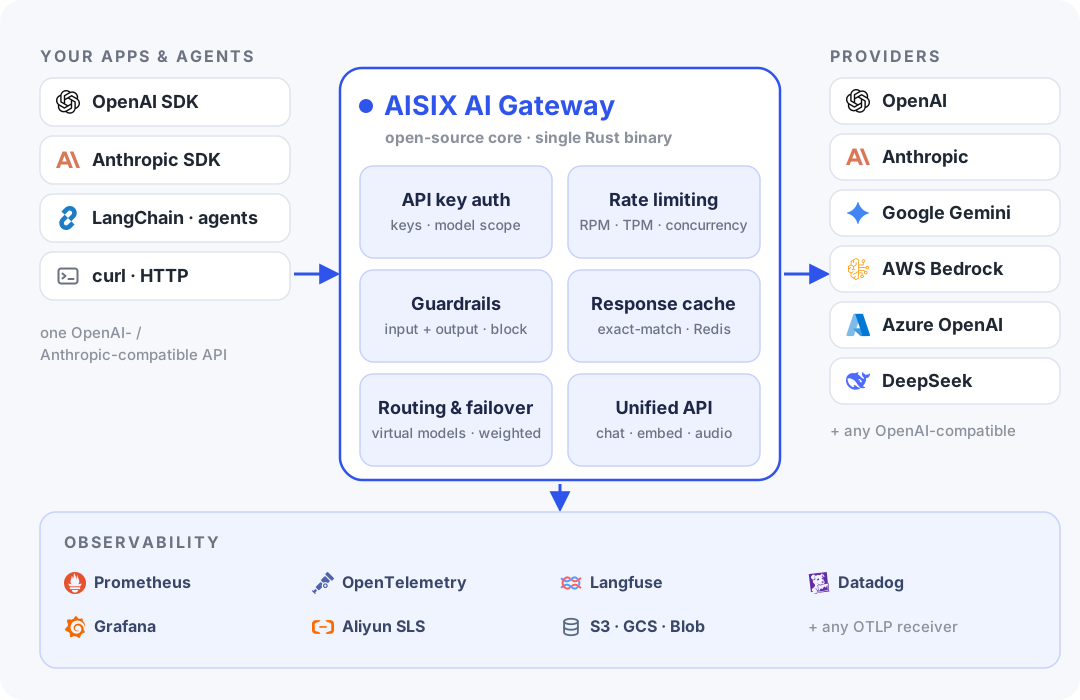
AISIX AI Gateway is a Rust-native gateway that puts a single, OpenAI-compatible API in front of every LLM provider — OpenAI, Anthropic, Google Gemini, AWS Bedrock, Azure OpenAI, DeepSeek, and any OpenAI-compatible endpoint. It gives platform teams one place to route, govern, secure, and observe LLM traffic, with first-class SSE streaming and low gateway overhead.
It runs as a single static binary — low cold-start, lock-free config reads, and hot
configuration reloads with no restarts: declare resources in one resources.yaml and
reload on SIGHUP, or point the gateway at etcd for a multi-replica cluster. Run the
open-source gateway in your infrastructure, or connect it to
AISIX Cloud
for centralized management with team governance, budgets, audit, and a dashboard.
AISIX AI Gateway (this repo) is the open-source product. It runs without a control plane using declarative configuration or etcd. When connected to AISIX Cloud, the same gateway serves as the data plane. AISIX Cloud adds a commercial control plane, either hosted by API7 (Hybrid Cloud) or hosted by you in your infrastructure (On-Premises). In both options, the gateway runs in your environment and calls providers directly; live AI traffic does not pass through the control plane or API7. The proxy API is identical throughout. Talk to us about AISIX Cloud →
⚡ Quickstart
One container. No control plane, no database, no configuration store — the gateway reads
every dynamic resource from one declarative resources.yaml.
# config.yaml
resources_file: /etc/aisix/resources.yaml
proxy:
  addr: "0.0.0.0:3000"
admin:
  enabled: false          # a declarative gateway needs no admin listener
observability:
  metrics:
    prometheus:
      enabled: true
      addr: "0.0.0.0:9090"
# resources.yaml
_format_version: "1"

provider_keys:
  - display_name: openai-main
    provider: openai
    api_key: ${OPENAI_API_KEY}        # interpolated from the environment

models:
  - display_name: my-model
    provider: openai
    model_name: gpt-4o-mini
    provider_key: openai-main

api_keys:
  - display_name: local-dev
    key_env: CALLER_API_KEY           # hashed at load; the plaintext is never stored
    allowed_models: ["my-model"]
export OPENAI_API_KEY="YOUR_PROVIDER_KEY"
export CALLER_API_KEY="YOUR_CALLER_KEY"

docker run -d --name aisix \
  --platform linux/amd64 \
  -v "$(pwd)/config.yaml:/etc/aisix/config.yaml:ro" \
  -v "$(pwd)/resources.yaml:/etc/aisix/resources.yaml:ro" \
  -e OPENAI_API_KEY -e CALLER_API_KEY \
  -p 3000:3000 -p 127.0.0.1:9090:9090 \
  ghcr.io/api7/aisix:latest        # proxy → :3000, metrics + status → :9090
#                                  ^ the metrics/status listener is unauthenticated;
#                                    keep it on loopback or a private network
Then call the gateway exactly like OpenAI:
curl http://localhost:3000/v1/chat/completions \
  -H "Authorization: Bearer $CALLER_API_KEY" \
  -H "Content-Type: application/json" \
  -d '{"model":"my-model","messages":[{"role":"user","content":"hello"}]}'
Edit resources.yaml and send SIGHUP (docker kill -s HUP aisix) to apply changes with
no restart — an invalid file is rejected whole and the last good configuration keeps
serving. Check a file before booting with aisix validate --resources resources.yaml.
Full walkthrough: the
Gateway Quickstart ·
every field: the resources file reference.
For a multi-replica cluster, point the gateway at etcd instead — resources_file and
etcd are mutually exclusive.
✨ Why AISIX
- One API, every model. Speak the OpenAI or Anthropic wire format in; the gateway
translates to whichever provider each model points at. Point an OpenAI or Claude SDK at
one
base_urland switch models without changing code. - A real gateway, in Rust. Single static binary, low cold-start, lock-free config reads on the hot path, native streaming.
- Open source, free forever. Apache-2.0 licensed and built to run in your infrastructure. Choose AISIX Cloud when you want centralized management through a control plane and dashboard.
- Production controls built in. Routing & failover, rate limits, guardrails, caching, and observability ship in the box. (Budgets and spend caps are an AISIX Cloud feature — the gateway enforces the control plane's decisions.)
🧩 Features — available today
Covered by 183 end-to-end scenario files (496 cases) that run against real gateway processes.
- OpenAI-compatible proxy (
:3000) —chat/completions,completions,responses,embeddings,rerank,images/{generations,edits},audio/{speech,transcriptions,translations},videos(submit → poll → fetch),files,batches,fine_tuning/jobs,realtime,GET /v1/models, plus a root-level/passthrough/:provider/*escape hatch. Native SSE streaming, tool/function calling, JSON mode, vision/multimodal input, and reasoning-content support. - Anthropic Messages API —
POST /v1/messagesas a first-class route, working against any configured upstream: requests and responses (including streaming) are translated both ways when a model points at a non-Anthropic provider. - Routing & failover — virtual/routing models with six strategies:
round_robin(smooth weighted round-robin),consistent_hash(session affinity keyed by header / cookie / API key / client IP),failover, plus metric-basedleast_cost,least_latency, andleast_busy. Per-targetprioritytiers (active/backup pools), retry budgets, cooldowns, tag-conditional targets, and per-attempt timeouts. - Ensemble models — fan one request out to a panel of models concurrently, then have a judge model synthesize a single answer, with a minimum-successful-responses threshold.
- Semantic routing — one virtual model that dispatches by the meaning of each request: it embeds the prompt, scores it against per-route example utterances, and routes to the best match (or a default). See the semantic routing docs.
- Rate limiting & concurrency — RPS/RPM/RPH/RPD + TPM/TPD + concurrency caps,
AND-combined across caller keys, models, and policy scopes (
api_key/model/team/member/team_member). Counters are per-process by default, or shared across replicas with the Redis backend. - Guardrails — content-policy enforcement on input and output, in-process or through a
provider: keyword/regex, built-in PII detection and redaction, Presidio, Lakera, OpenAI
Moderation, AWS Bedrock Guardrails, Azure AI Content Safety (Prompt Shield + text
moderation), and two Alibaba Cloud services. A block returns
422 content_filter; monitor mode records what would have happened without blocking. - Caching — exact-match response cache with per-policy TTL and model/key scope matchers; memory and Redis backends; cost-saved telemetry on every hit. Separately, automatic prompt caching can be enabled per direct Anthropic model to inject cache breakpoints, so callers get provider-side prompt discounts without changing their requests.
- MCP gateway — front registered upstream MCP servers at
/mcpwith gateway-held credentials, per-server tool namespaces, and per-caller access. It serves every Streamable HTTP revision from2025-03-26through stateless2026-07-28without downstream sessions. Upstreams useinitializeby default orserver/discoverwithprotocol_version: "2026-07-28". CI runs the official MCP suite's applicable tools-only protocol scenarios. Also exposes a REST API as MCP tools from its OpenAPI description. - A2A agent gateway — front A2A (Agent-to-Agent) agents at
/a2a/:agent, serving each agent's card with URLs rewritten to the gateway, over JSON-RPC 2.0. - Inbound authentication — caller API keys (SHA-256 hashed, model allowlists, expiry, rotation), or OIDC/JWT bearer tokens validated against registered providers (Entra ID, Okta, Google Workspace, or any OIDC issuer) with JWKS caching.
- Observability — Prometheus
/metrics, structured per-request access logs, usage events, OTLP/GenAI span export (Langfuse, Honeycomb, Grafana Cloud, or any OTLP receiver), plus dedicated Datadog and Aliyun SLS log exporters and object-storage (S3/GCS/Azure Blob) telemetry. - Declarative configuration — one
resources.yamlcarries all ten resource collections (provider keys, models, caller keys, guardrails, MCP servers, A2A agents, cache policies, observability exporters, rate-limit policies, OIDC providers), validated against the same JSON Schemas the gateway uses at runtime.aisix validatechecks a file offline;SIGHUPreloads it atomically. - Operational endpoints —
/livezand/readyzon the proxy listener;/status/config,/status/ready,/status/models, and Prometheus/metricson a dedicated metrics listener (:9090). The admin listener (:3001) additionally serves a read-only resource surface, OpenAPI 3 with a Scalar UI, and a playground. Resources are managed declaratively — through theresources_file(reloaded on SIGHUP) or direct etcd writes — not through the admin listener; its former write endpoints were removed.
🔌 Supported providers
AISIX dispatches through five native adapter families — distinct wire-protocol bridges, not one generic relabel. Whatever the upstream protocol, the client-facing API stays OpenAI-shaped.
| Adapter family | Reaches | Wire shape · auth |
|---|---|---|
openai | OpenAI + any OpenAI-compatible vendor — DeepSeek, Groq, Mistral, Together, Fireworks, Perplexity, vLLM, Ollama, or self-hosted OpenAI-compatible endpoints | OpenAI chat completions · Bearer |
anthropic | Anthropic Claude | Anthropic Messages · x-api-key |
bedrock | AWS Bedrock — Anthropic, Meta Llama, Mistral, Cohere, Amazon Titan/Nova, AI21 | Bedrock Converse + /invoke · SigV4 |
vertex | Google Vertex AI (Gemini) | Vertex :generateContent · OAuth2 |
azure-openai | Azure OpenAI | Azure deployments · api-key / Entra ID |
Plus specialized handling for vendor quirks (e.g. DeepSeek reasoning content) and dedicated rerank / embeddings vendors (Cohere, Jina). Details in adapter protocol families.
☁️ Open source vs AISIX Cloud
Same gateway binary, same proxy API — in every form the gateway runs in your environment. AISIX Cloud adds a commercial control plane, either hosted by API7 (Hybrid Cloud) or hosted in your infrastructure (On-Premises).
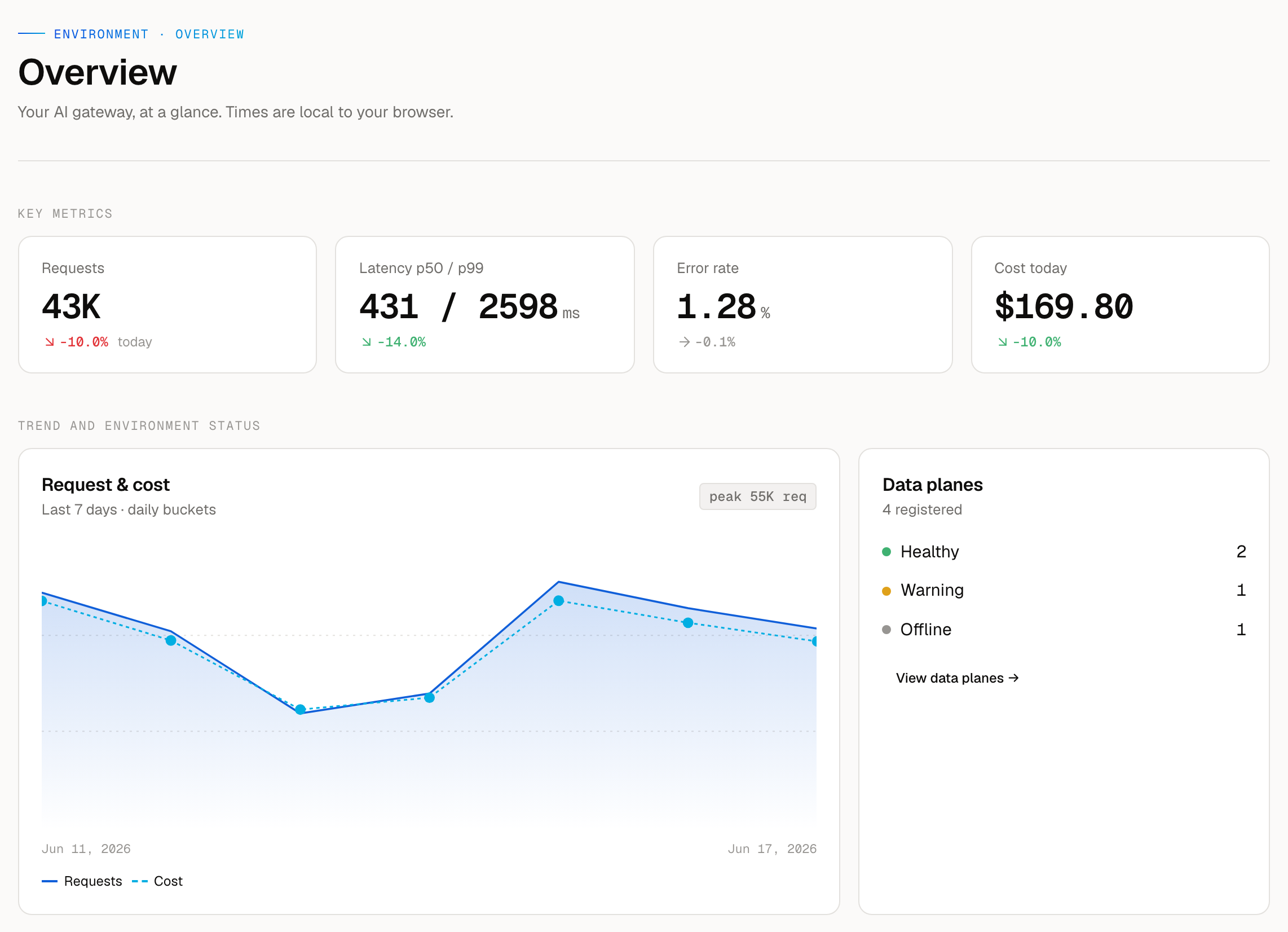 Overview — traffic, latency, error rate & spend at a glance 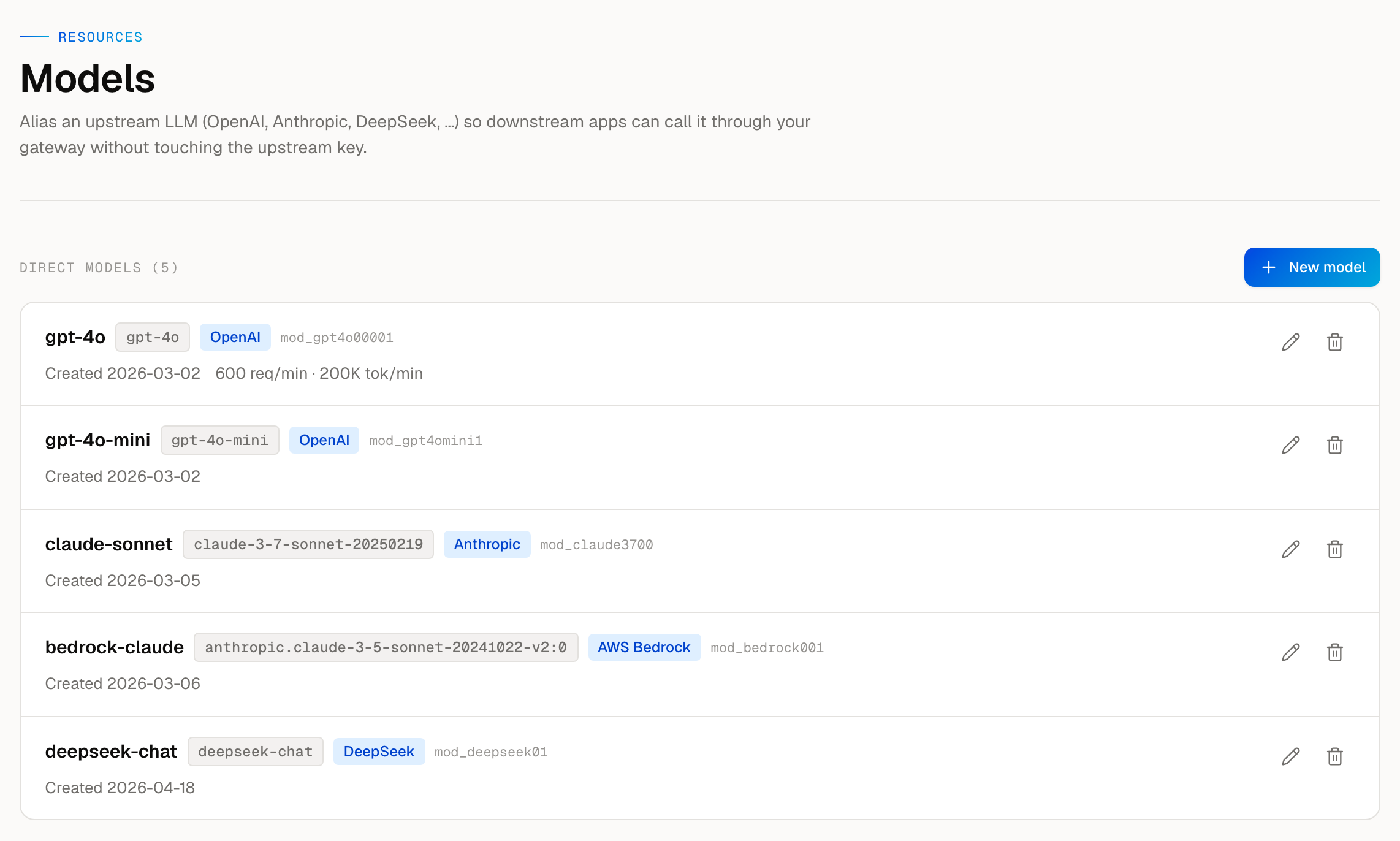 Models — one alias per upstream: OpenAI, Anthropic, Bedrock, DeepSeek… 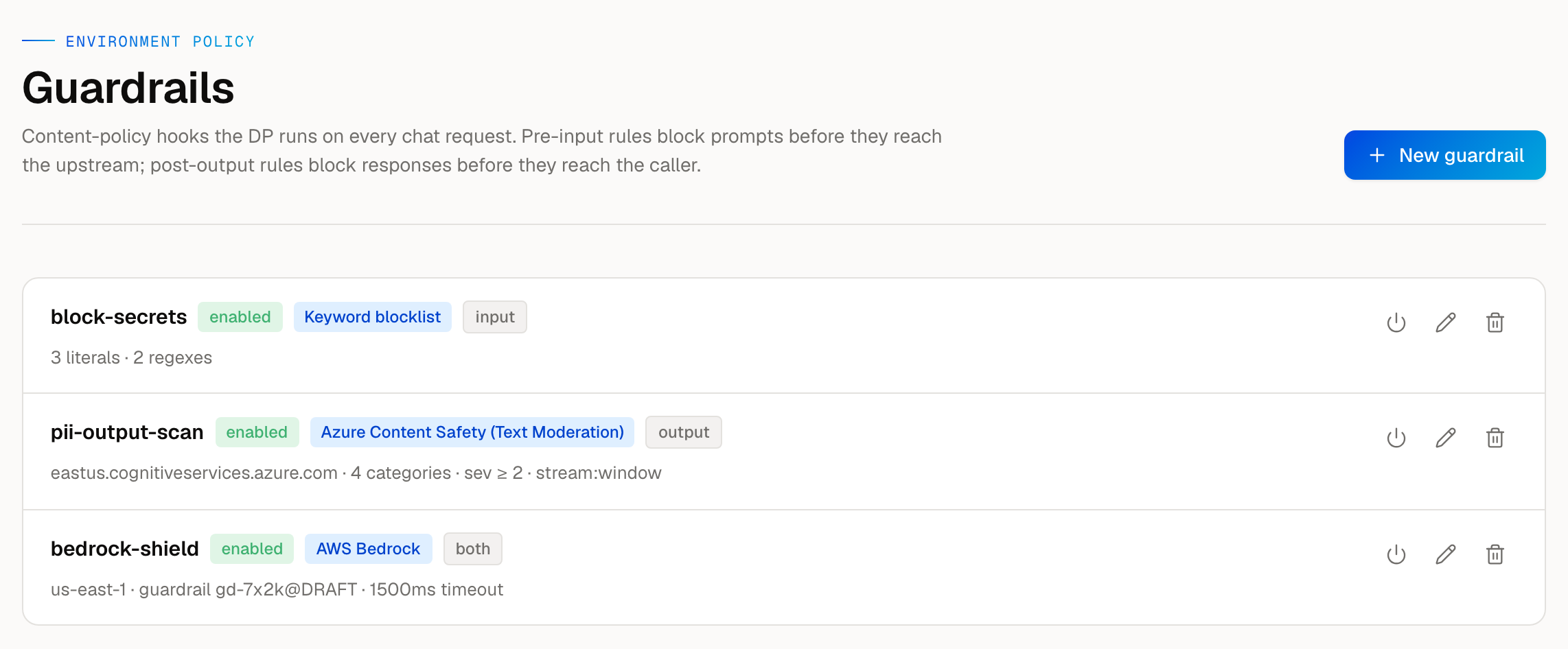 Guardrails — pre-input & post-output policies, block on violation |
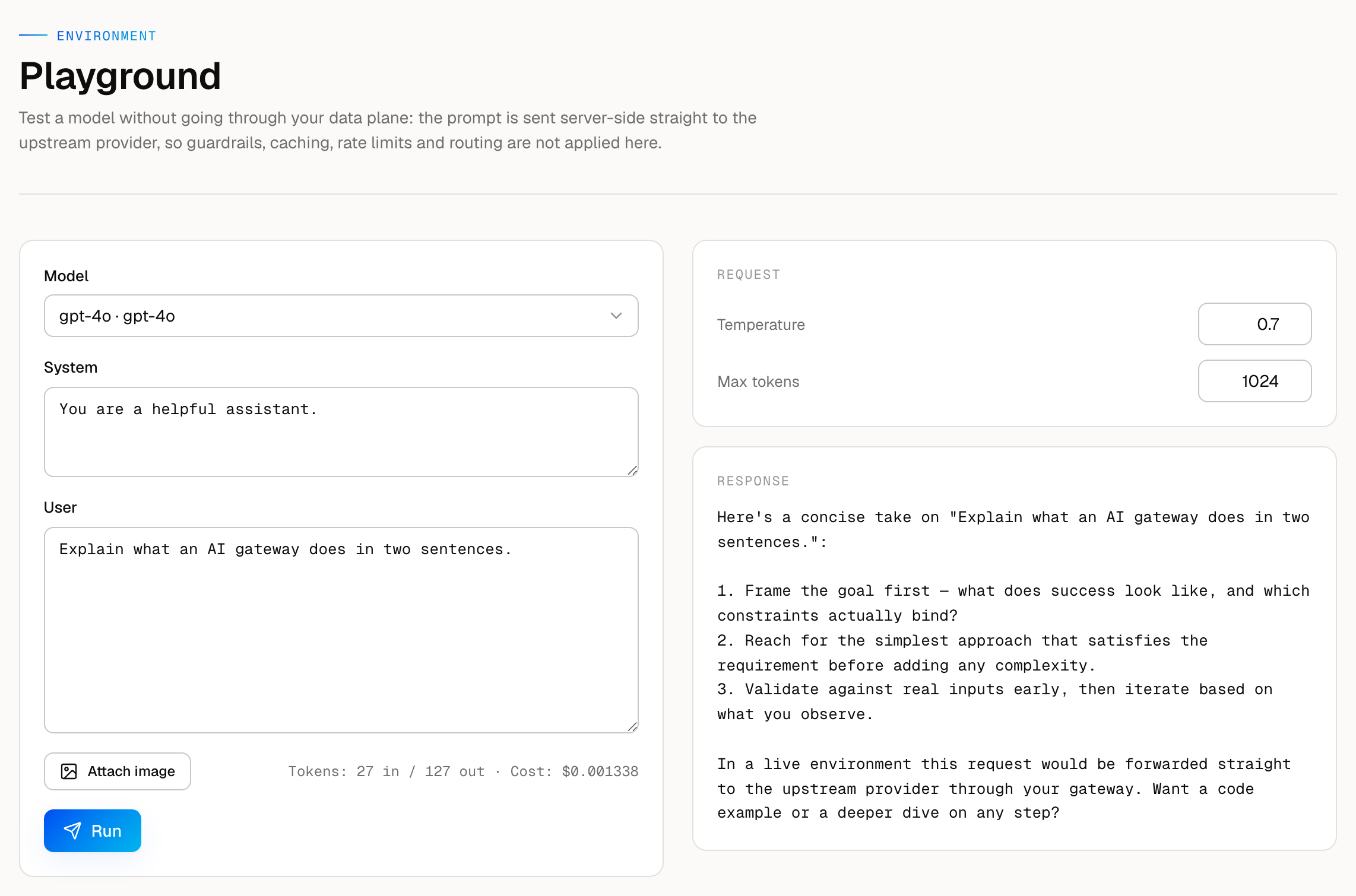 Playground — test any model with live token & cost metering 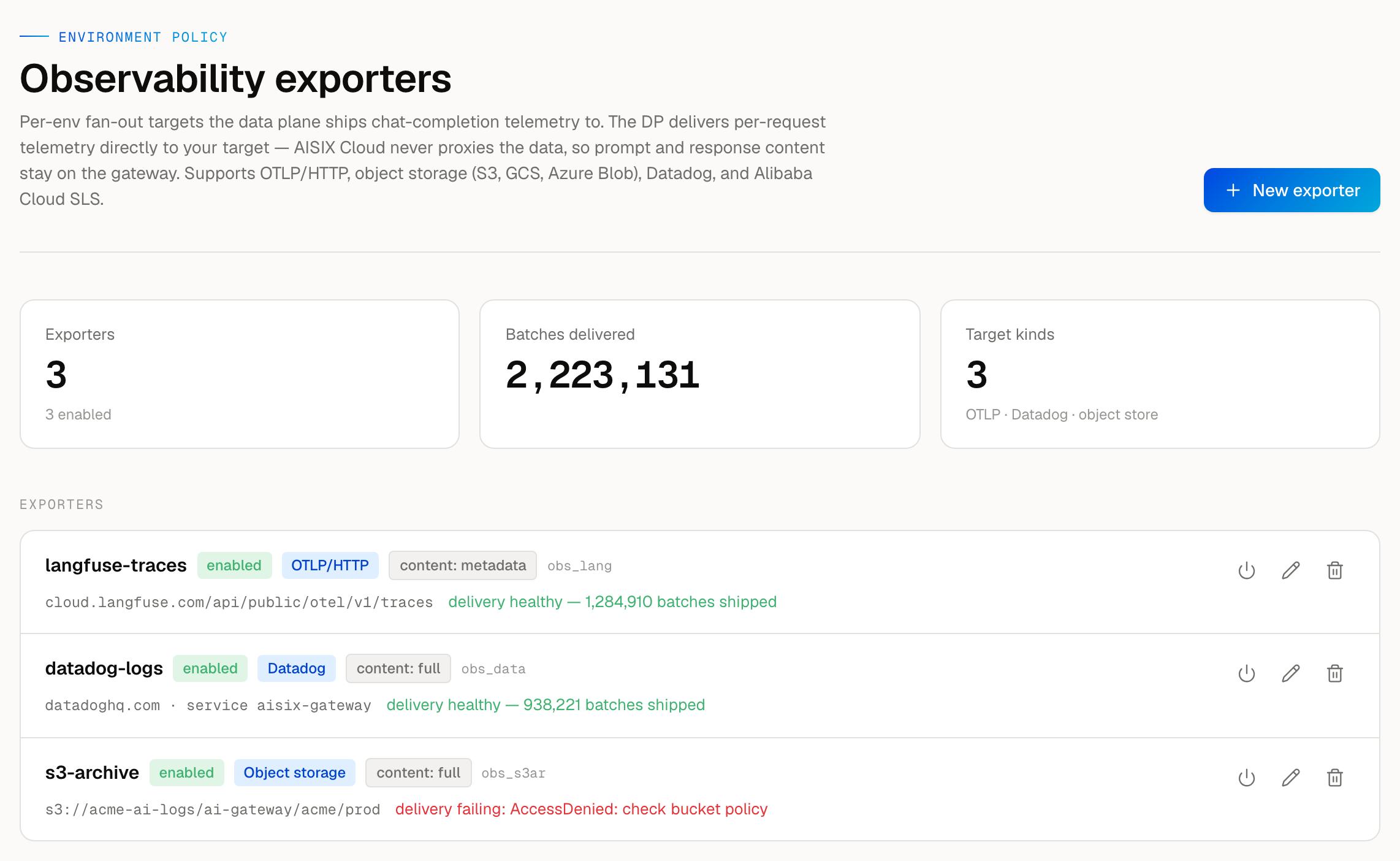 Observability — fan out traces & logs to OTLP, Datadog, object storage 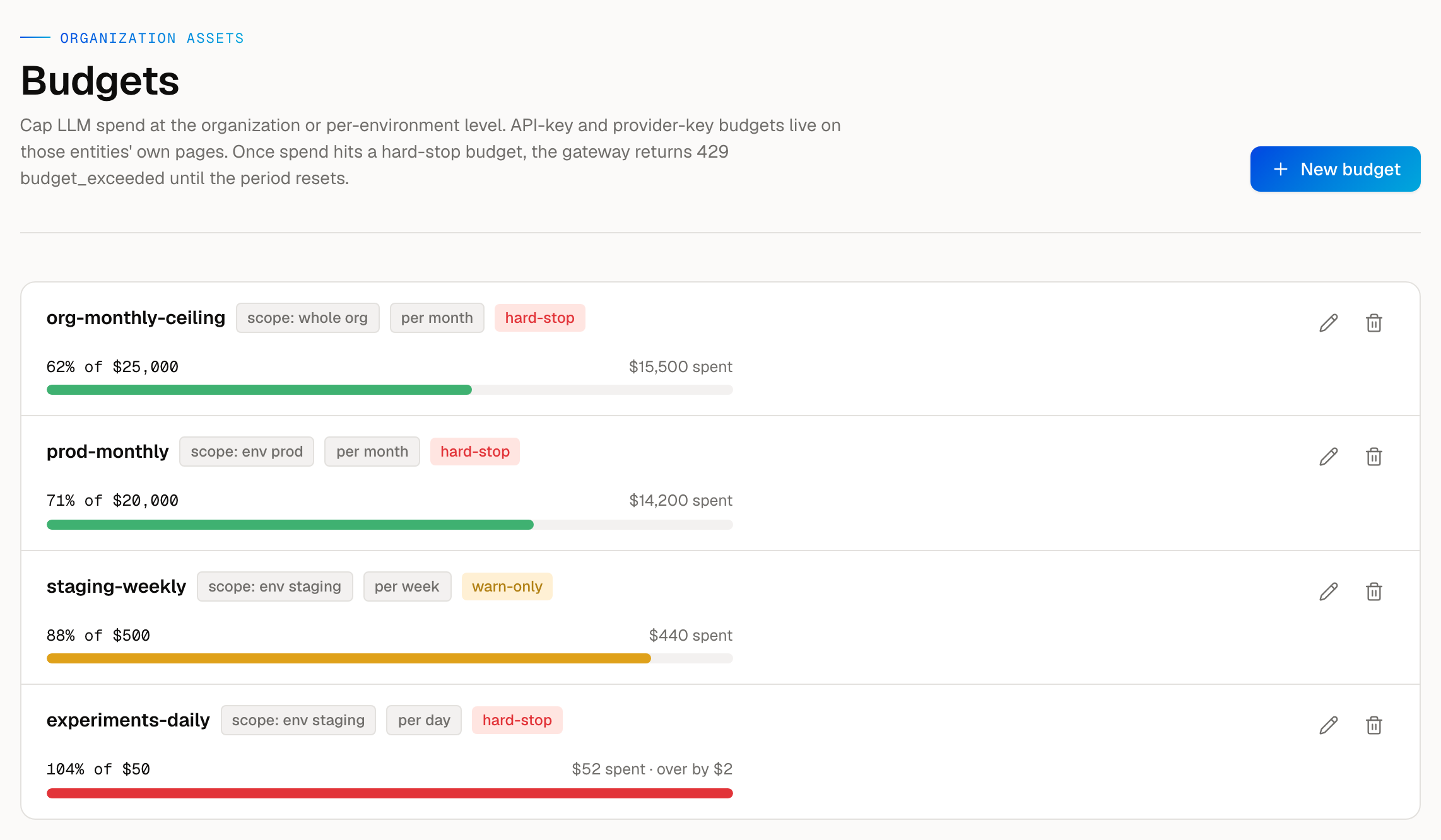 Budgets — hard-stop spend caps with warn-only tiers |
| Open-source gateway (this repo) | AISIX Cloud (Hybrid Cloud or On-Premises) | |
|---|---|---|
| Price | Free · Apache-2.0 · forever | Commercial — talk to us |
| Configuration | Declarative resources.yaml, or etcd for a cluster | Dashboard + Cloud Admin API, multi-environment |
| Tenancy | Single instance / namespace | Org → Team → Member → Environment |
| Provider keys | In the resources file as ${VAR} env references, or in etcd | Envelope-encrypted at rest, write-only, in-place rotation |
| Inbound auth | Caller keys (SHA-256 hashed, model allowlists, expiry), or OIDC/JWT bearers | Same, plus masked reveal, key ownership, and PATs |
| Budgets | — (rate and token limits only) | Per key / provider / env / org / team, hard-stop & alerts |
| RBAC | Admin key = read-only resource surface | Org roles (owner / admin / member), invites |
| Audit log | — | Full org-scoped audit with diff viewer |
| Usage & cost | Export logs, metrics, and usage events yourself | Managed usage views, model pricing catalog, spend reporting |
| Surface | Status endpoints, OpenAPI read surface, playground | Full dashboard + per-environment playground |
→ Want the AISIX Cloud control plane, governance, budgets, and dashboard? Talk to API7 about Hybrid Cloud or On-Premises, or book a demo.
🏗️ Architecture
A single Cargo workspace; the aisix-server crate builds one binary named aisix that
wires the crates together.
crates/
├── aisix-core           Config, snapshot, resource model, resources.yaml source, errors
├── aisix-etcd           Config provider + watch supervisor
├── aisix-gateway        Hub & bridge, SSE parser, provider trait
├── aisix-proxy          /v1/*, /mcp, /a2a handlers, routing, middleware
├── aisix-admin          Read-only resource surface + playground + OpenAPI
├── aisix-provider-*     openai · anthropic · azure-openai · bedrock · vertex
├── aisix-mcp            MCP gateway — server registry, tool ACL, transports
├── aisix-a2a            A2A agent gateway — agent cards, JSON-RPC bridge
├── aisix-ratelimit      fixed-window + token accounting + concurrency (local | redis)
├── aisix-cache          memory + redis backends
├── aisix-redis          shared Redis connection for cache + rate limits
├── aisix-guardrails     pre/post content-policy hooks
├── aisix-obs            tracing, metrics, access log, exporters
└── aisix-server         the `aisix` binary — bootstrap + CLI
🗺️ Roadmap
Highlights on the roadmap; tracked live in issues:
- Semantic (embedding-similarity) response caching
- More observability sinks — Langsmith, Helicone, Slack alerts
- Prompt templates managed as gateway resources
- Llama-Guard as a guardrail provider
Shipped since this list was last written: the MCP gateway, the A2A agent gateway, OIDC/JWT inbound auth, Redis-backed distributed rate limiting, and the Lakera, Presidio, PII, and OpenAI Moderation guardrails — see Features above.
🛠️ Development
Prerequisites: the Rust toolchain pinned in rust-toolchain.toml. Docker is only needed
for the tests that exercise etcd, Redis, or provider emulators.
cargo check --workspace
cargo fmt --check
cargo clippy --workspace -- -D warnings
cargo test --workspace

# Coverage (matches the CI gate)
cargo llvm-cov --workspace --lcov --output-path lcov.info

# Run locally against a resources.yaml (no etcd needed). Copy the Quickstart's two files
# and change resources_file to the local path, e.g. resources_file: ./resources.yaml
cargo run -p aisix-server --bin aisix -- --config config.local.yaml

# Check a resources file without starting a listener
cargo run -p aisix-server --bin aisix -- validate --resources resources.yaml
💬 Community
- Discord — discord.gg/dUmRZ7Rvf
- Issues & discussions — github.com/api7/aisix/issues
- Contributing — CONTRIBUTING.md
- Website — api7.ai/ai-gateway
If AISIX is useful to you, a ⭐ helps other engineers find it.
📄 License
Installation
Source-derived launch command. Check the maintainer’s required arguments and credentials before running:
docker run -i --rm ghcr.io/api7/aisix:1.3.0Set up in your AI client
Merge this template into ~/Library/Application Support/Claude/claude_desktop_config.json. Keep existing servers. Add any arguments, credentials, and permissions required by the maintainer; this template has not been install-tested.
{
  "mcpServers": {
    "io-github-api7-aisix": {
      "command": "docker",
      "args": [
        "run",
        "-i",
        "--rm",
        "ghcr.io/api7/aisix:1.3.0"
      ]
    }
  }
}
Restart Claude Desktop completely for changes to take effect. Confirm the server appears connected in the client’s tool list, then try a read-only example from its documentation.
Claude Desktop setup referencePackage
ghcr.io/api7/aisix:1.3.0dockerCompatible MCP Clients
AISIX AI Gateway works with any MCP-compatible client. Copy the config snippet from the Configuration section above and add it to the file shown for your client, then restart the application.
- Claude Desktop
~/Library/Application Support/Claude/claude_desktop_config.jsonRestart Claude Desktop completely for changes to take effect. - Cursor
~/.cursor/mcp.jsonRestart Cursor for changes to take effect. - VS Code
.vscode/mcp.jsonReload VS Code window for changes to take effect. - Windsurf
~/.codeium/windsurf/mcp_config.jsonRestart Windsurf for changes to take effect. - Claude Code
.mcp.jsonSave at the project root, then start Claude Code in that project and review the MCP server approval prompt. Keep real credentials out of shared files.