io.github.BerkKilicoglu/google-health-fitbit-mcp
Privacy-first Google Health API MCP server for health, sleep, activity and HR agents
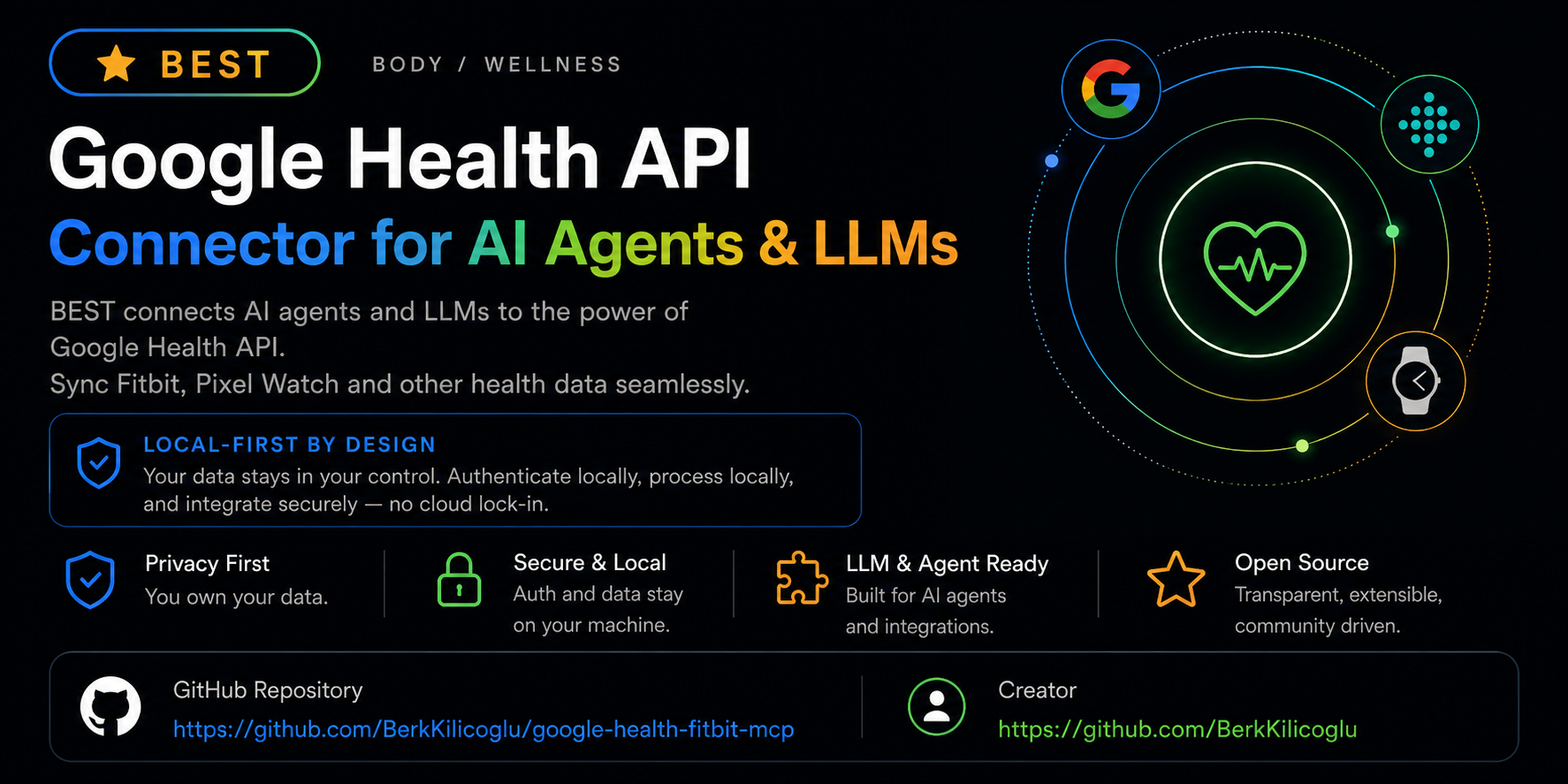
An MCP server that runs locally and hands your AI agent your own Google Health API data — from Fitbit trackers, Pixel Watch and supported partner sources — through OAuth.
- Install in one command —
npx -y google-health-fitbit-mcp setup - Run it in Claude Desktop · Claude Code · Cursor · Windsurf · Hermes · OpenClaw — see client examples.
- On your machine — OAuth tokens are stored locally with
0600permissions and are never returned by any tool (privacy). - Read-only by default — every shipped data tool is a read. Writes are a gated, opt-in, dry-run-first design that is not enabled.
Beta status: Google Health API is available to developers but the surface is still moving. Because Google's release notes keep listing scope and data-type changes after launch, this connector remains in beta and steers testers toward safe read-only validation before any production use.
Independent, community-built connector — no affiliation with, endorsement from or support by Google, Fitbit or Alphabet. Not a medical device or medical advice; treat the data as trend context only.
⚡ Quick Connect
Prerequisite: a Google Cloud OAuth client (type: Desktop) with the Google Health API enabled and the redirect
http://127.0.0.1:3000/callbackregistered — details in Install.
Step 1 — Install & authorize (once):
npx -y google-health-fitbit-mcp setup     # guided: Google Cloud OAuth client + scopes
npx -y google-health-fitbit-mcp auth      # browser OAuth — tokens stay on your machine
npx -y google-health-fitbit-mcp checkup   # ✓ verifies everything is ready
🔑 First time? Get your Google Client ID & Secret (~2 min)
setup asks for a Client ID and Client Secret. You create these once, for free, in Google Cloud:
- New project — open console.cloud.google.com/projectcreate, name it (e.g.
health-mcp), click Create, then select it. - Enable the API — open the Google Health API page and click Enable.
- Consent screen — go to OAuth consent screen, choose External, and fill in the required app name / email fields. Under Test users, add your own Google account — skip this and sign-in fails with
403: access_denied. - Create the client — go to Credentials → + Create credentials → OAuth client ID → Application type: Desktop app → Create.
- Copy the Client ID (ends in
…apps.googleusercontent.com) and the Client secret, then paste each one whensetupprompts you.
Redirect URI: Desktop-app clients allow the
http://127.0.0.1:3000/callbackloopback automatically — you don't register it anywhere. Just press Enter to accept the default whensetupasks. For every othersetupprompt (scope preset, privacy mode), pressing Enter picks a sensible default.
Heads-up — the 7-day rule: while the consent screen sits in Testing publishing status, Google revokes refresh tokens after 7 days. Around once a week the next request fails with
invalid_grant, which is normal and not a bug in this server. It reopens the consent flow for you (see Staying connected); approving takes a couple of seconds. Publishing the app removes the expiry entirely — check what your scopes require on the consent screen before switching.
Step 2 — Connect your app:
Claude Code
claude mcp add google-health -- npx -y google-health-fitbit-mcp
Claude Desktop
Settings → Developer → Edit Config, then add to claude_desktop_config.json:
{
  "mcpServers": {
    "google_health": {
      "command": "npx",
      "args": ["-y", "google-health-fitbit-mcp"]
    }
  }
}
Restart Claude Desktop — the tools appear under the 🔌 connectors menu.
Cursor
Add the same mcpServers block to .cursor/mcp.json (per-project) or ~/.cursor/mcp.json (global), or use Settings → MCP → Add new server.
{
  "mcpServers": {
    "google_health": {
      "command": "npx",
      "args": ["-y", "google-health-fitbit-mcp"]
    }
  }
}
Windsurf
Add the same mcpServers block to ~/.codeium/windsurf/mcp_config.json.
Hermes
npx -y google-health-fitbit-mcp setup --client hermes # writes the Hermes config for you
Then reload with /reload-mcp or hermes mcp test google_health.
Step 3 — Test it. Ask your agent:
Run google_health_connection_status and tell me if I'm connected.
Why this exists
The Google Health API is the successor to the Fitbit Web API: new OAuth, new base URL (https://health.googleapis.com), a streamlined endpoint schema, standardized kebab-case data types, reconciled cross-source streams and daily/physical-time rollups.
It gives agents a clean path to explore the API, verify their setup, sign in locally and pull data — with no need to paste tokens into prompts or agent configs.
Try it with your agent
Three good opening prompts, built around tools this connector genuinely ships:
Check my setup with google_health_connection_status, then call
google_health_data_inventory and tell me which Google Health
domains and scopes I've granted.
Pull today's google_health_daily_summary, then google_health_weekly_summary.
Keep observed data separate from any suggestions, and stay non-medical.
List my paired devices with google_health_list_paired_devices and tell me
which device is producing my sleep and heart-rate data.
Tools
29 tools, all read-only except the two explicitly gated local-profile/auth actions noted below.
Start here
| Tool | What it does |
|---|---|
google_health_connection_status | Local config, token, scope and MCP-client readiness — no Google call |
google_health_quickstart | Personalized 3-step setup walkthrough that adapts to your current state |
google_health_data_inventory | Supported domains, scopes, data-type naming and recommended agent flow |
google_health_list_data_types | The 39 kebab-case data-type slugs with units, scopes and supported verbs |
google_health_demo | Realistic synthetic payloads so agents see the contract before real calls |
Data reads (Google Health API)
| Tool | Endpoint |
|---|---|
google_health_get_identity | /v4/users/me/identity — Google Health + legacy Fitbit identity mapping |
google_health_get_profile | /v4/users/me/profile |
google_health_get_settings | /v4/users/me/settings — units, timezone |
google_health_list_paired_devices | /v4/users/me/pairedDevices — your Fitbit trackers and Pixel Watches, and which device produces which data |
google_health_get_irn_profile | /v4/users/me/irnProfile — irregular-rhythm (AFib) notification engagement status |
google_health_list_data_points | /v4/.../dataPoints — intraday detail for any data type |
google_health_get_data_point | /v4/.../dataPoints/{id} — one specific sleep session, exercise or measurement |
google_health_reconcile_data_points | /v4/.../dataPoints:reconcile — one clean stream across sources (all-sources, google-wearables, google-sources) |
google_health_daily_rollup | /v4/.../dataPoints:dailyRollUp — civil-day aggregates |
google_health_rollup | /v4/.../dataPoints:rollUp — physical-time window aggregates |
Summaries & wellness context
| Tool | What it does |
|---|---|
google_health_daily_summary | Steps, distance, calories, active-zone minutes, sleep, resting HR, HRV and weight for one day, with data-quality flags |
google_health_weekly_summary | Weekly scorecard with optional prior-window comparison, load classification and bottlenecks |
google_health_wellness_context | Normalized activity/sleep context for recommendation engines |
Auth, diagnostics & metadata
google_health_get_auth_url · google_health_exchange_code (gated: requires explicit user intent) · google_health_revoke_access (gated + destructive: disconnects Google Health) · google_health_privacy_audit · google_health_cache_status · google_health_data_type_coverage · google_health_capabilities · google_health_agent_manifest · google_health_onboarding · google_health_profile_get · google_health_profile_update (local file only, requires explicit_user_intent=true)
Resources & prompts
MCP resources: google-health://agent-manifest, google-health://capabilities, google-health://inventory, google-health://latest/steps, google-health://profile, google-health://summary/daily, google-health://summary/weekly.
MCP prompts: google_health_daily_checkin, google_health_weekly_review, google_health_data_type_investigation.
Data types
39 data types from the official Google Health table, including steps, sleep, heart-rate, heart-rate-variability, daily-resting-heart-rate, active-zone-minutes, distance, total-calories, weight, body-fat, blood-glucose, oxygen-saturation, vo2-max, electrocardiogram, irregular-rhythm-notification, exercise, floors, swim-lengths-data, nutrition-log and hydration-log.
Naming rules agents need:
- Endpoints use kebab-case data types:
steps,daily-resting-heart-rate. - Filters use snake_case field paths:
sleep.interval.civil_start_time,heart_rate.sample_time.physical_time. - Source families:
all-sources,google-wearables,google-sources.
Call google_health_list_data_types for the full catalog with units, scopes and which verbs (list/reconcile/rollup) each type supports.
Privacy & what runs offline
- OAuth tokens live on disk at
~/.google-health-mcp/tokens.json, locked down to0600permissions. - Client secrets go in
~/.google-health-mcp/config.jsonor theGOOGLE_HEALTH_*environment variables. - No tool ever hands back an access token, refresh token or client secret; error output is redacted too.
- The default privacy mode is
GOOGLE_HEALTH_PRIVACY_MODE=structured;summarystrips identifiers further, andrawis an explicit opt-in for debugging. - GPS/route data is treated as sensitive and redacted unless explicitly requested.
supportprints a copy-paste support bundle for GitHub issues — always redacted, never contains tokens, secrets, local paths or health measurements.support --feedback --jsonprints an anonymous setup-feedback bundle for beta testers (guide).coverage --live --jsonprints only redacted data-type status and point-count buckets — never raw Google Health payloads (guide).
Install
Set up a Google Cloud OAuth client (type: Desktop), turn on the Google Health API, and register the local redirect:
http://127.0.0.1:3000/callback
Then run:
npx -y google-health-fitbit-mcp setup --scope-preset full
npx -y google-health-fitbit-mcp auth
npx -y google-health-fitbit-mcp checkup
Scope presets
Presets keep OAuth consent easy to reason about — request only what your use case needs:
| Preset | Grants |
|---|---|
basic | profile + settings |
activity | basic + activity/fitness + health metrics |
sleep | basic + sleep |
heart | basic + health metrics + ECG + irregular-rhythm notifications |
full | all recommended read-only scopes (default) |
nutrition-write | opt-in nutrition write scope — the only preset with any write capability; no write tool ships yet |
Advanced users can pass --scopes with an explicit space/comma-separated scope list.
If setup gets stuck
npx -y google-health-fitbit-mcp checkup --fix        # repairs local config/token permissions (chmod 600 where supported)
npx -y google-health-fitbit-mcp checkup --live       # hits read-only identity/profile/settings endpoints to confirm the API responds
npx -y google-health-fitbit-mcp coverage --live --json  # redacted read-only data-type coverage report
npx -y google-health-fitbit-mcp support             # shareable support bundle, stripped of tokens/secrets/measurements
npx -y google-health-fitbit-mcp support --feedback --json  # anonymous setup feedback bundle
Staying connected
Access tokens refresh silently in the background. The refresh token behind them is what expires — Google revokes it after 7 days while the consent screen is in Testing publishing status, and the next call comes back as invalid_grant. Retrying cannot fix that: the grant is gone, and only a fresh authorization brings it back.
So the server does the authorization for you. On the first call that hits a revoked grant it opens your browser at Google's consent screen; approve, and the original request finishes on its own — no command to run, nothing to diagnose. If you take longer than GOOGLE_HEALTH_REAUTH_WAIT_MS (45s by default), the call returns the URL instead and the listener stays up, so approving still works and the next request goes through.
This only runs on the local stdio transport, where the browser and the server are on the same machine. Under the HTTP transport — where the server may be remote, and its default port collides with the loopback redirect — the call fails with an explicit instruction to run auth instead. Set GOOGLE_HEALTH_AUTO_REAUTH=0 to always handle re-authorization yourself, or GOOGLE_HEALTH_AUTH_NO_BROWSER=1 on headless hosts to get the URL without a browser launch.
MCP client config
Claude Desktop / Cursor / Windsurf (see examples/):
{
  "mcpServers": {
    "google_health": {
      "command": "npx",
      "args": ["-y", "google-health-fitbit-mcp"]
    }
  }
}
Hermes
npx -y google-health-fitbit-mcp setup --client hermes --no-auth
npx -y google-health-fitbit-mcp auth
npx -y google-health-fitbit-mcp checkup --client hermes
Once the config changes, run /reload-mcp or hermes mcp test google_health — there's no need to restart the gateway just to read data.
HTTP transport (optional)
The default transport is stdio. A local Streamable-HTTP transport is available for clients that need it:
npx -y google-health-fitbit-mcp --http # serves http://127.0.0.1:3000/mcp (+ /health)
Configuration
| Environment variable | Purpose | Default |
|---|---|---|
GOOGLE_HEALTH_CLIENT_ID | Google Cloud OAuth client ID | — (or local config) |
GOOGLE_HEALTH_CLIENT_SECRET | OAuth client secret (prefer local config over MCP client config) | — (or local config) |
GOOGLE_HEALTH_REDIRECT_URI | Registered redirect URI | — (or local config) |
GOOGLE_HEALTH_TOKEN_PATH | Token file location | ~/.google-health-mcp/tokens.json |
GOOGLE_HEALTH_PRIVACY_MODE | summary | structured | raw | structured |
GOOGLE_HEALTH_CACHE | Optional SQLite response cache (true/sqlite) | disabled |
GOOGLE_HEALTH_CACHE_PATH | SQLite cache location | ~/.google-health-mcp/cache.sqlite |
GOOGLE_HEALTH_NO_CACHE | Bypass the in-memory HTTP cache (60s TTL, GET-only) | unset |
GOOGLE_HEALTH_MCP_TRANSPORT | stdio | http | stdio |
GOOGLE_HEALTH_MCP_HOST / GOOGLE_HEALTH_MCP_PORT | HTTP transport bind address | 127.0.0.1 / 3000 |
GOOGLE_HEALTH_AUTO_REAUTH | Reopen the consent flow automatically when the grant is revoked (0/false to disable) | enabled |
GOOGLE_HEALTH_REAUTH_WAIT_MS | How long a tool call waits for you to approve before returning the URL instead | 45000 |
GOOGLE_HEALTH_AUTH_NO_BROWSER | Never launch a browser; print/return the URL only (headless hosts) | unset |
Reliability built in: every Google call goes through retry middleware (exponential backoff + jitter, honors Retry-After, retries 408/429/5xx) and a 60-second GET-only response cache. Multi-day summaries limit request concurrency to stay under rate limits.
CLI commands
All commands run via npx -y google-health-fitbit-mcp <command> (installed binary: google-health-fitbit-mcp-server).
| Command | What it does | Key flags |
|---|---|---|
| (none) | Start the MCP server on stdio | --http — local Streamable-HTTP on 127.0.0.1:3000/mcp |
setup | Guided setup: writes local config + MCP client config | --scope-preset <basic|activity|sleep|heart|full|nutrition-write> · --scopes "<url …>" · --client <generic|claude|cursor|windsurf|hermes|openclaw> · --no-auth · --json |
auth | Browser OAuth with local callback; saves tokens with 0600 permissions | --no-open — print the auth URL instead of opening the browser |
checkup | Setup diagnosis with ✓/✗ checks and next steps (aliases: doctor, status) | --json · --client <name> · --fix — repair file permissions · --live — prove API reachability · --live-write — dry-run the write path, never POSTs |
coverage | Data-type coverage report across list/reconcile/rollup | --json · --live — redacted read-only checks against your real account |
support | Redacted support bundle for GitHub issues | --json · --feedback — anonymous setup-feedback bundle |
onboarding | Shared wellness onboarding flow as JSON | --pt-BR |
version / help | Print version / full usage |
Beta testers wanted
Right now the most valuable thing you can contribute is hands-on setup feedback from real Fitbit, Pixel Watch, Android and Google Health API accounts.
If you have a real account to test with:
- Run
npx -y google-health-fitbit-mcp checkupand let us know whether the OAuth flow reads clearly. - Run
npx -y google-health-fitbit-mcp support --feedback --jsonand drop the anonymous bundle into a GitHub issue. - Once OAuth is done, run
npx -y google-health-fitbit-mcp coverage --live --jsonand post the redacted coverage report after you've reviewed it. - Exercise
google_health_connection_status,google_health_data_inventoryandgoogle_health_daily_summaryfrom inside your MCP client. - File an issue if you hit missing data types, unclear setup steps, client-specific friction or privacy concerns.
- Please keep OAuth tokens, client secrets, local paths and personal health measurements out of public issues.
Development
git clone https://github.com/BerkKilicoglu/google-health-fitbit-mcp.git
cd google-health-fitbit-mcp
npm install
npm test
npm test runs typecheck, build, MCP smoke tests (stdio + HTTP), summary fixtures, privacy/cache/retry suites, CLI UX checks and metadata validation. See CONTRIBUTING.md for guidelines and SECURITY.md for the security policy.
Links
- Google Health API: https://developers.google.com/health
- Release notes: https://developers.google.com/health/release-notes
- REST reference: https://developers.google.com/health/reference/rest
- Scopes: https://developers.google.com/health/scopes
- Data types: https://developers.google.com/health/data-types
- Migration guide (Fitbit → Google Health): https://developers.google.com/health/migration
Contact & support
- 🐛 Bug reports / feature requests — GitHub Issues
- 📨 klcogluberk@gmail.com — general questions and integration help
License
MIT — see LICENSE.
Installation
Source-derived launch command. Check the maintainer’s required arguments and credentials before running:
npx -y google-health-fitbit-mcpSet up in your AI client
Merge this template into ~/Library/Application Support/Claude/claude_desktop_config.json. Keep existing servers. Add any arguments, credentials, and permissions required by the maintainer; this template has not been install-tested.
{
  "mcpServers": {
    "io-github-berkkilicoglu-google-health-fitbit-mcp": {
      "command": "npx",
      "args": [
        "-y",
        "google-health-fitbit-mcp"
      ]
    }
  }
}
Restart Claude Desktop completely for changes to take effect. Confirm the server appears connected in the client’s tool list, then try a read-only example from its documentation.
Claude Desktop setup referencePackage
google-health-fitbit-mcpnpmCompatible MCP Clients
io.github.BerkKilicoglu/google-health-fitbit-mcp works with any MCP-compatible client. Copy the config snippet from the Configuration section above and add it to the file shown for your client, then restart the application.
- Claude Desktop
~/Library/Application Support/Claude/claude_desktop_config.jsonRestart Claude Desktop completely for changes to take effect. - Cursor
~/.cursor/mcp.jsonRestart Cursor for changes to take effect. - VS Code
.vscode/mcp.jsonReload VS Code window for changes to take effect. - Windsurf
~/.codeium/windsurf/mcp_config.jsonRestart Windsurf for changes to take effect. - Claude Code
.mcp.jsonSave at the project root, then start Claude Code in that project and review the MCP server approval prompt. Keep real credentials out of shared files.