Countersign
Kill switch + spend guard for AI agents that spend money, across every wallet vendor at once.
Countersign





A neutral, cross-vendor control plane for AI agents that spend money. Countersign holds the policy, the freeze, and the audit ledger across multiple agent-wallet backends at once — the one thing no single wallet vendor can do, because each only governs its own rail. That aggregation is the moat.
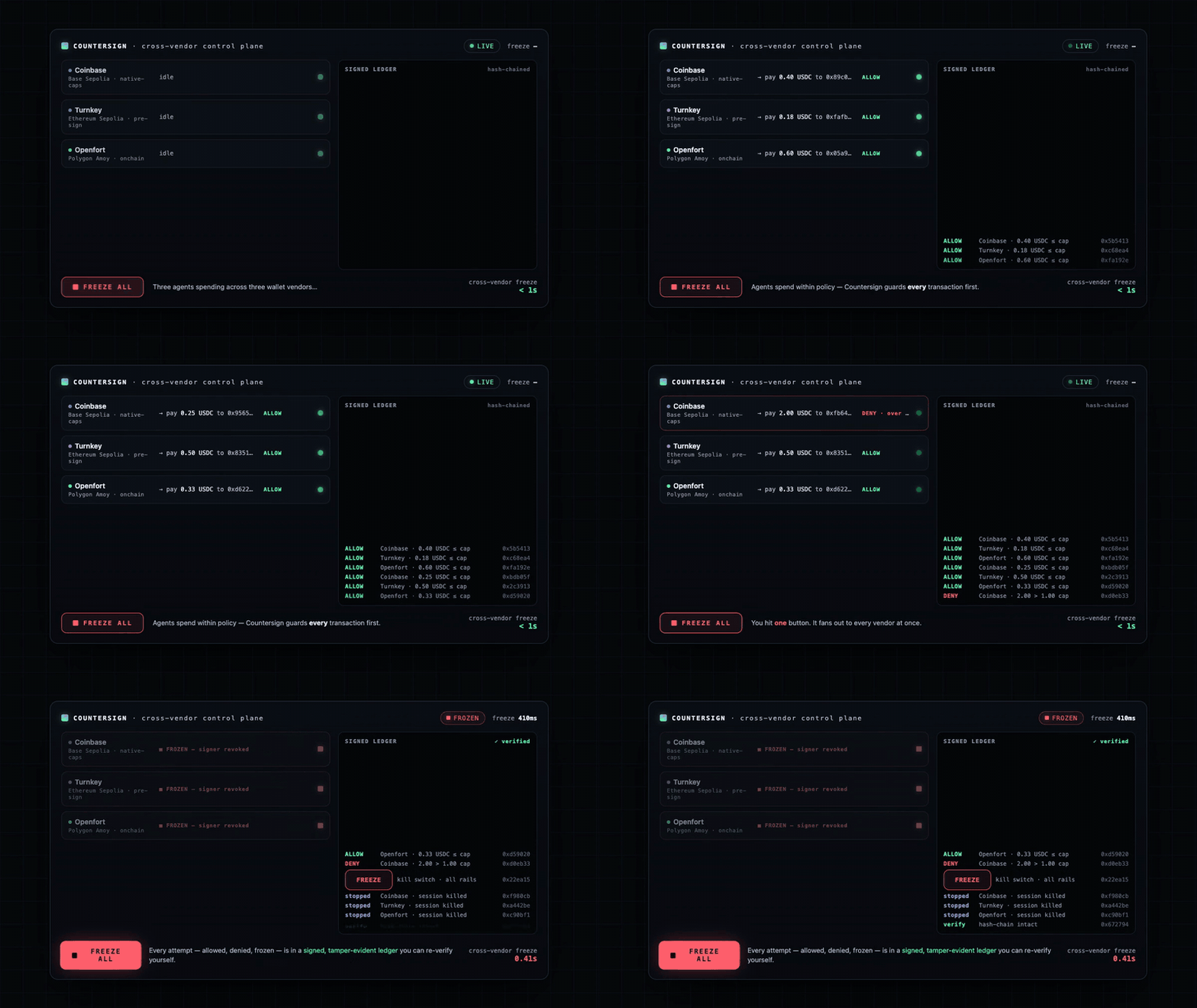
Live version of this loop: countersign.network/demo.html · 60s video
One falsifiable test defines it: can Countersign freeze agents across many backends at once, in under a second, with a unified tamper-evident ledger of every attempt? Proven LIVE across four rails (Coinbase, Turnkey, Openfort, and a Lithic Visa card) in ~432ms on testnet.
❄️ The hosted Core is paused (2026-09-18).
app.countersign.networkis switched off: it issues no keys and existing keys no longer authenticate. These packages are unaffected — they are Apache-2.0, still published on npm, and work against a Core you run yourself. PointCOUNTERSIGN_URLat your own instance wherever this README saysapp.countersign.network.
This repository is the open-core front door — the Apache-2.0 packages you build against: the integration contract, the typed client, the MCP tools, and the x402 guard. The control-plane "brain" (the policy compiler, the hash-chained ledger, the vendor adapters, and the hosted Core) is separate and proprietary; you reach it over the network via the SDK/MCP. It was hosted at app.countersign.network, which is currently paused — self-host the Core to use these packages today.
Quickstart
Drop the kill switch + spend guard into any MCP client (Claude, Cursor, …) — one line:
// claude / cursor mcp config
{ "mcpServers": { "countersign": {
  "command": "npx", "args": ["-y", "@countersign/mcp"],
  "env": { "COUNTERSIGN_URL": "https://app.countersign.network", "COUNTERSIGN_API_KEY": "csk_…" }
}}}
Or wire it into your own agent with the SDK:
import { CountersignClient } from "@countersign/sdk";
const cs = new CountersignClient({ baseUrl, apiKey });

await cs.evaluate({ agentId, amount, asset, venue }); // may this spend happen? (allow / deny / needs_approval)
await cs.freeze();                                     // the kill switch — every backend, < 1s
Get a free testnet key at — the hosted signup is paused. Run your
own Core and issue yourself a key with app.countersign.network/startPOST /signup.
Agents paying agents? See examples/guarded-payee — the A2A/AP2
pattern where a payee advertises it is governed and the payer verifies that (and guards its own
payment) before any mandate is signed.
Packages (this repo — all Apache-2.0)
| Package | Role |
|---|---|
@countersign/core | the EnforcementProvider interface, branded ids, the unified policy schema, the fail-closed freeze controller — the integration contract every backend implements |
@countersign/api-contract | OpenAPI + typed REST/ws schema — the single source of truth for the Client↔Core wire interface |
@countersign/sdk | typed client over the Core API + live ledger subscribe |
@countersign/mcp | Countersign as MCP tools — kill switch + spend guard inside any MCP client |
@countersign/x402 | govern x402 (HTTP-402 machine payments) — guard a payment before it pays |
@countersign/verify | verify a ledger entry offline — hash chain, RFC 6962 Merkle inclusion, Ed25519 signatures |
@countersign/ap2 | govern AP2 (Agent Payments Protocol) — guard an agent-payment mandate before it executes |
The proprietary brain (policy compiler to each backend's native controls, ledger, Coinbase / Turnkey / Openfort / Lithic adapters, the hosted Core) lives in a separate private repository.
Prime directives (invariants)
- Don't build cryptography — integrate vendor MPC/TEE; session keys, never master keys.
- Build the layer above the wallets; cross-vendor aggregation is the product.
- Fail-closed: no decision / no backend response ⇒ the transaction does not execute.
- Backend-agnostic core; no vendor logic leaks past the
EnforcementProviderinterface. - Append-only, hash-chained ledger is the source of truth.
- Testnet only — mainnet follows a third-party security audit.
Links
- Home: https://countersign.network · Hosted Core: paused since 2026-09-18
- npm:
@countersign/sdk·@countersign/mcp·@countersign/x402·@countersign/ap2 - Architecture:
docs/architecture.md· Security:SECURITY.md
Apache-2.0. Countersign holds policy, freeze, and a tamper-evident ledger — it never takes custody of funds.
Installation
Source-derived launch command. Check the maintainer’s required arguments and credentials before running:
npx -y @countersign/mcpSet up in your AI client
Merge this template into ~/Library/Application Support/Claude/claude_desktop_config.json. Keep existing servers. Add any arguments, credentials, and permissions required by the maintainer; this template has not been install-tested.
{
  "mcpServers": {
    "io-github-countersign-network-countersign": {
      "command": "npx",
      "args": [
        "-y",
        "@countersign/mcp"
      ]
    }
  }
}
Restart Claude Desktop completely for changes to take effect. Confirm the server appears connected in the client’s tool list, then try a read-only example from its documentation.
Claude Desktop setup referencePackage
Compatible MCP Clients
Countersign works with any MCP-compatible client. Copy the config snippet from the Configuration section above and add it to the file shown for your client, then restart the application.
- Claude Desktop
~/Library/Application Support/Claude/claude_desktop_config.jsonRestart Claude Desktop completely for changes to take effect. - Cursor
~/.cursor/mcp.jsonRestart Cursor for changes to take effect. - VS Code
.vscode/mcp.jsonReload VS Code window for changes to take effect. - Windsurf
~/.codeium/windsurf/mcp_config.jsonRestart Windsurf for changes to take effect. - Claude Code
.mcp.jsonSave at the project root, then start Claude Code in that project and review the MCP server approval prompt. Keep real credentials out of shared files.