BioHarbor
Run real bioinformatics from your AI agent. Reliable, reproducible, on your own GPUs.
BioHarbor
Run real bioinformatics from your AI agent. Reliable, reproducible, on your own GPUs.



🧪 Alpha (v0.1). Sequence tools, homology search (MMseqs2) and structure prediction (ESMFold, validated on RTX 5090) work. Feedback welcome — see the roadmap.
BioHarbor is an MCP server that lets AI agents such as Claude, Cursor and Codex execute bioinformatics tools — not just look things up. Agents ask for an analysis; BioHarbor validates the input, schedules it on a GPU with room, records exactly how it ran, and hands back a compact, agent-readable summary.

Why another bio MCP server?
Most bio MCP servers wrap databases (UniProt, PDB, PubMed…). Use them — BioHarbor complements them by running the compute:
| Database MCP servers | BioHarbor | |
|---|---|---|
| Runs real analyses (search, fold, cluster) | ❌ | ✅ |
| Validates inputs before burning GPU time | ❌ | ✅ |
| GPU-aware queue, polite on shared GPUs | ❌ | ✅ |
Long jobs return a job_id instead of timing out | ❌ | ✅ |
| Compact summaries + files on disk (saves tokens) | ❌ | ✅ |
| Provenance for every run, export to a pipeline | ❌ | ✅ (export: planned) |
Quick start
pip install bioharbor
bioharbor doctor             # checks Python, GPUs, workspace, tools
bioharbor setup-db swissprot # reference database for search_homologs (needs MMseqs2)
bioharbor install            # shows how to connect Claude, Cursor or Codex
For structure prediction on a GPU: pip install "bioharbor[esmfold]" — see
docs/gpu-setup.md (RTX 50xx needs a CUDA 12.8+ PyTorch).
Connect your agent
BioHarbor is a standard MCP server, so it works with any MCP client. One command sets up the popular ones (it writes an absolute path, so GUI apps find it even outside your venv):
| Client | Set up |
|---|---|
| Claude Code | claude mcp add bioharbor -- bioharbor serve |
| Claude Desktop | bioharbor install claude-desktop --write, then restart the app |
| Cursor | bioharbor install cursor --write, or  |
| Codex (CLI, IDE extension, app) | codex mcp add bioharbor -- bioharbor serve, or bioharbor install codex --write |
| Anything else | run bioharbor serve (stdio) or bioharbor serve --http (Streamable HTTP) |
Long-running tools return a job_id within ~20 s instead of blocking, so they stay
within every client's tool-call timeout.
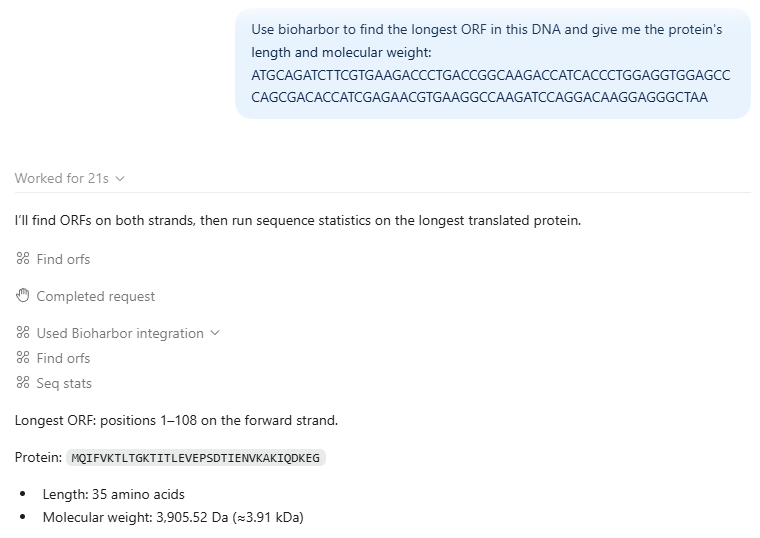
Step-by-step setup (local or on a GPU server, with troubleshooting): docs/connect-clients.md.
Then ask your agent something like:
Find the longest ORF in this contig, translate it, search Swiss-Prot for homologs and predict its structure. Which regions are low confidence?
Use it without an agent
Every tool is also a CLI command, with identical behaviour:
bioharbor tools list
bioharbor run find_orfs sequence=@contig.fa min_aa=100 --brief   # human-readable
bioharbor run seq_stats sequence=MKTAYIAKQRQISFVKSHFSRQ
bioharbor jobs
Shared GPU server
GPUs on a lab server, agent on your laptop? Run BioHarbor on the server and reach it through an SSH tunnel; no extra port is opened on the server:
# on the GPU server
bioharbor serve --http --host 127.0.0.1 --port 8765
# on your laptop, then point Cursor / Codex / Claude Code at http://127.0.0.1:8765/mcp
ssh -N -L 8765:127.0.0.1:8765 you@gpu-server
⚠️ HTTP mode has no authentication yet (on the roadmap), so keep it on
127.0.0.1and use the tunnel. Details: docs/connect-clients.md.
Tools
| Tool | What it does | Runs |
|---|---|---|
seq_stats | Validate sequences; type, length, GC%, molecular weight | inline |
translate_sequence | DNA/RNA → protein, one or all six frames | inline |
find_orfs | Longest ORFs on both strands, with coordinates | inline |
search_homologs | MMseqs2 search (protein, or translated DNA) vs local DBs | job |
predict_structure | ESMFold structure, pLDDT bands, low-confidence regions, pTM | job (GPU) |
scrna_pipeline | scanpy QC → clustering → markers | planned |
Runtime tools: get_job, list_jobs, cancel_job, describe_tool, list_databases,
gpu_status, read_file.
How it works
Agent ──MCP──▶ validate input ─▶ inline? ──yes──▶ run ─┐
                                   │ no                  ├─▶ provenance + summary ─▶ Agent
                                   ▼                     │
                     job queue (SQLite) ─▶ GPU placement ┘
                     (waits politely for a GPU with free memory)
- Every call is a job recorded in SQLite with params, versions, timings and GPU used,
plus a
provenance.jsonnext to its outputs. - GPU placement reads live free memory and utilisation (NVML or
nvidia-smi), keeps headroom, and reserves memory for jobs it has started so two jobs never grab the same space. Other users' processes are respected. - Fail fast: input, binaries and databases are checked before a job is queued, so a bad request never waits behind a busy GPU.
- Results are agent-shaped:
summary,message,files,suggestions. Errors carry ahintand aretryableflag.
Details: docs/design.md.
Writing a tool
from pydantic import BaseModel, Field
from bioharbor.registry import Resources, RunContext, tool
from bioharbor.results import ToolResult

class FoldParams(BaseModel):
    sequence: str = Field(..., description="Protein sequence")

@tool(
    version="1",
    slow=True,
    resources=Resources(gpu=True, gpu_mem_gb=lambda p: 4 + len(p.sequence) / 100),
)
def predict_structure(params: FoldParams, ctx: RunContext) -> ToolResult:
    """Predict a protein structure with ESMFold."""
    ...
    return ToolResult(summary={"mean_plddt": 87.1}, files=["model.pdb"])
Plugins can ship tools in their own package via the bioharbor.tools entry-point group.
See CONTRIBUTING.md.
License
Installation
Source-derived launch command. Check the maintainer’s required arguments and credentials before running:
uvx bioharborSet up in your AI client
Merge this template into ~/Library/Application Support/Claude/claude_desktop_config.json. Keep existing servers. Add any arguments, credentials, and permissions required by the maintainer; this template has not been install-tested.
{
  "mcpServers": {
    "io-github-danielluo2-bioharbor": {
      "command": "uvx",
      "args": [
        "bioharbor"
      ]
    }
  }
}
Restart Claude Desktop completely for changes to take effect. Confirm the server appears connected in the client’s tool list, then try a read-only example from its documentation.
Claude Desktop setup referencePackage
bioharborpypiCompatible MCP Clients
BioHarbor works with any MCP-compatible client. Copy the config snippet from the Configuration section above and add it to the file shown for your client, then restart the application.
- Claude Desktop
~/Library/Application Support/Claude/claude_desktop_config.jsonRestart Claude Desktop completely for changes to take effect. - Cursor
~/.cursor/mcp.jsonRestart Cursor for changes to take effect. - VS Code
.vscode/mcp.jsonReload VS Code window for changes to take effect. - Windsurf
~/.codeium/windsurf/mcp_config.jsonRestart Windsurf for changes to take effect. - Claude Code
.mcp.jsonSave at the project root, then start Claude Code in that project and review the MCP server approval prompt. Keep real credentials out of shared files.