io.github.Evil-Bane/eyebrowse
Stealthy, LLM-drivable browser engine — a Python library + 85-tool MCP server on stealth Chromium.
👁️ EyeBrowse
A stealthy, LLM-drivable browser engine — one codebase, two faces.
A Python library and an MCP server for driving a real, hard-to-detect browser, so legitimate automation isn't false-flagged or IP-banned by Cloudflare, DataDome, Akamai, or PerimeterX. Built on CloakBrowser — a stealth Chromium (Chrome/146) that's a Playwright drop-in — so EyeBrowse gets the full Chrome DevTools Protocol: trusted cursorless clicks, deep network inspection, MHTML, PDF, and native video.





-4285F4.svg)


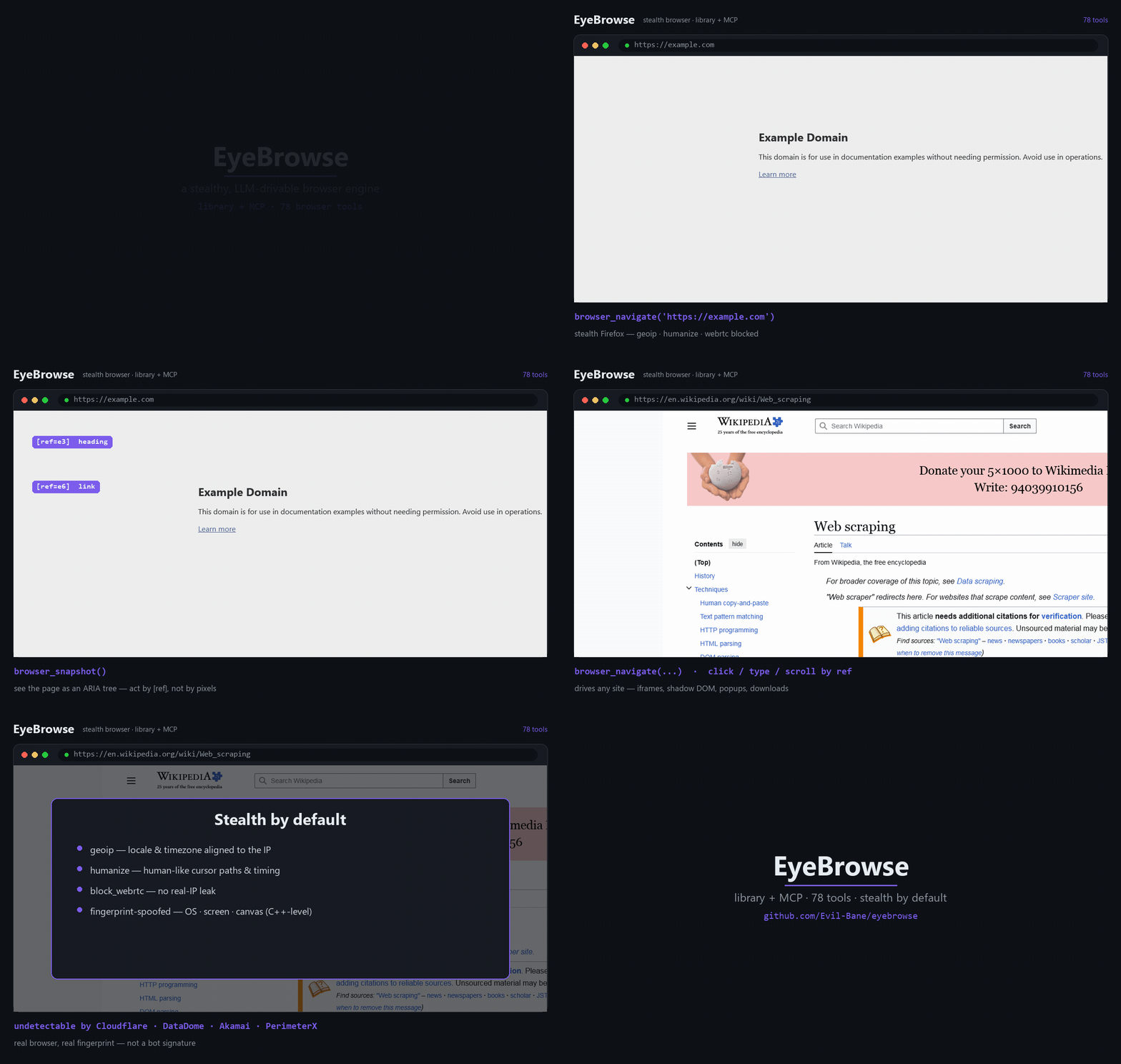
▶ Full-quality MP4: docs/demo.mp4 — an AI agent drives EyeBrowse over MCP: clears a Cloudflare check, then reads real docs (asyncio · httpx · MDN).
Why EyeBrowse?
- 🥷 Stealth by default — engine-level fingerprint spoofing (
geoip+humanizeon out of the box, novel fingerprint per launch);navigator.webdrivermasked; viewport auto-sized to the spoofed screen. Nopuppeteer-extraband-aids — the anti-detection is compiled into the browser. - 🤖 Built for LLMs — pages are read as an ARIA tree with
[ref=…]handles; the model acts by ref (click/type/hover), not by brittle CSS or raw pixels. Cross-origin iframes, shadow DOM, popups — handled. - ⚡ Chrome DevTools Protocol — trusted, cursorless clicks by node ref (
Input.dispatchMouseEvent), rawNetwork/Performance/Emulationaccess, MHTML snapshots, PDF export, and native video — all reachable as tools. - 🧰 Library and MCP from one codebase — a clean Python API (
EyeBrowse+Session), mirrored 1:1 by a thin MCP server (85browser_*tools) for Claude Code and any MCP client. - 🪟 Never boxed in — the curated high-level API doesn't hide Playwright: reach
session.page/.context/.browserfor anything it doesn't wrap. - 🔋 Batteries included — multi-session, proxy + identity rotation, API-mode captcha solvers, native video, full HAR capture, and clean-markdown extraction.
Scope. EyeBrowse is a low-level browser engine — it holds no workflow logic. Consumers decide what to do; the engine provides what's possible.
Contents
Quickstart · Install · Features · Compare · Library · MCP · Proxy & identity · Extraction · Recording · How it works · Caveats · Tools · License
Quickstart
pip install eyebrowse
# The stealth-Chromium binary downloads automatically on first launch — nothing else to run.
import asyncio
from eyebrowse import EyeBrowse

async def main():
    eb = EyeBrowse()                          # stealth defaults: geoip · humanize
    async with eb.session() as s:
        await s.navigate("https://example.com")
        print(await s.snapshot())             # ARIA tree with [ref=...] handles
        await s.click("e6")                   # act on a ref from the snapshot
    await eb.aclose()

asyncio.run(main())
…or wire it into Claude Code (or any MCP client) — see Use over MCP.
Install
From PyPI
pip install eyebrowse                 # or: uv pip install eyebrowse
# CloakBrowser fetches its Chromium binary lazily on first launch — nothing to run.
pip install "eyebrowse[extract]"     # optional: + Crawl4AI markdown extraction (heavier)
From source (development)
git clone https://github.com/Evil-Bane/eyebrowse && cd eyebrowse
uv sync                              # core engine  (add --extra extract for Crawl4AI)
cp .env.example .env                 # only if you use a proxy / captcha keys
Python 3.12 (pinned <3.13). Engine: cloakbrowser>=0.3 (stealth Chromium, Chrome/146), on
playwright 1.60 and mcp 1.27.
Features
| 🥷 Stealth | CloakBrowser's patched-Chromium fingerprint spoofing (novel --fingerprint per launch); geoip + humanize by default; webdriver masked; viewport matched to the spoofed screen. |
| 🤖 LLM interaction | aria_snapshot(mode="ai") → ARIA tree + [ref] handles; click / type / hover / select / drag / file-upload / dialogs / keyboard; coordinate mouse too. |
| ⚡ CDP | trusted cursorless click by ref, raw CDP (Network / Performance / Emulation), MHTML capture, PDF export. |
| 🪟 Frames & DOM | cross-origin iframe routing by ref, shadow-DOM piercing, popup/new-tab switching, evaluate inside any frame. |
| 🗂 Multi-session | independent stealth sessions, each with its own context / identity / proxy. |
| 🌐 Network | inspect requests/responses (incl. XHR/fetch bodies & WebSocket frames), block URLs, mock responses, go offline, full HAR export. |
| 💾 State | cookies, localStorage & sessionStorage (CRUD), storage_state save/reload. |
| 🪪 Identity rotation | fresh fingerprint + isolated profile + paired proxy; pluggable residential ProxyProvider. |
| 🧩 Captcha | pluggable API-mode solvers (CapSolver / 2Captcha / CapMonster / NextCaptcha) + TOTP — no browser extension. |
| 📄 Extraction | Crawl4AI raw: feed → clean, token-efficient markdown (no LLM, no API keys). |
| 🎥 Capture | screenshots, Playwright tracing, and native video (.webm). |
| ✅ Verify & debug | assertions, element highlighting, locator generation, geolocation/header emulation. |
Full per-tool reference: docs/TOOLS.md (85 tools across 18 groups).
How EyeBrowse compares
| EyeBrowse | Playwright MCP | browser-use | playwright-stealth | |
|---|---|---|---|---|
| Anti-detection compiled into the browser | ✅ | ❌ | ❌ | ⚠️ JS patches |
LLM-native ARIA [ref] interaction model | ✅ | ✅ | ✅ | ❌ |
| Ships an MCP server | ✅ (85 tools) | ✅ | ⚠️ partial | ❌ |
| One codebase: Python library and MCP | ✅ | MCP-only | lib-only | lib-only |
| Full CDP (trusted clicks · network · MHTML · PDF · video) | ✅ | ⚠️ partial | ❌ | ⚠️ partial |
| Captcha (API-mode) + TOTP | ✅ | ❌ | ❌ | ❌ |
| Proxy + identity rotation built in | ✅ | ❌ | ⚠️ partial | ❌ |
| Cross-origin iframes · shadow DOM · popups | ✅ | ✅ | ⚠️ partial | n/a |
Fair-use note: each project targets a different niche — this compares them on the axes EyeBrowse optimizes for (stealth + LLM-drivable + one library/MCP codebase), not as an overall ranking.
Use as a library
import asyncio
from eyebrowse import EyeBrowse

async def main():
    eb = EyeBrowse()                           # stealth defaults
    try:
        async with eb.session() as s:          # a stealth session (auto-closed)
            await s.navigate("https://example.com")
            print(await s.snapshot())          # ARIA tree with [ref=...] handles
            await s.click("e6")                # act on a ref
            await s.type("e8", "hello", submit=True)
            png = await s.screenshot(full_page=True)
            title = await s.page.title()        # full Playwright power when you need it
    finally:
        await eb.aclose()

asyncio.run(main())
Run the included proof: uv run python examples/direct_usage.py.
Use over MCP
EyeBrowse ships an MCP server (eyebrowse-mcp, FastMCP over stdio). Add it to any MCP client.
Claude Code (CLI):
claude mcp add eyebrowse -- eyebrowse-mcp
Any MCP client (JSON config):
{
  "mcpServers": {
    "eyebrowse": {
      "command": "eyebrowse-mcp"
    }
  }
}
Then drive the loop: browser_navigate(url) → read the snapshot → act by ref
(browser_click / browser_type / …). A default session is auto-created, so most tools just
work. Full list: docs/TOOLS.md.
Proxy & identity (optional)
Runs proxyless by default (geoip still aligns locale/timezone to your real IP). Add a proxy
only when you want one:
await eb.new_session(proxy="http://user:pass@residential.example:8080")
await eb.rotate_identity(proxy="socks5://host:1080")   # fresh fingerprint + paired IP
await eb.new_session(no_proxy=True)                     # force proxyless
Set a default once via EYEBROWSE_PROXY_* in .env, eb.set_static_proxy(...), or a custom
ProxyProvider for rotation. Over MCP: browser_new_session(proxy_url=…) /
browser_new_identity(proxy_url=…) / browser_set_proxy(…).
reCAPTCHA v3 / reputation gates are score-based and key off IP + session reputation — a fresh browser on a flagged IP fails regardless of stealth. Pair EyeBrowse with a clean residential proxy.
Extraction
eb.extract() (or browser_extract) hands the rendered HTML to Crawl4AI's raw: feed and
returns clean, pruned markdown — no LLM is called and no LLM keys are ever read; the
consuming agent does any structuring.
md  = await eb.extract()                            # markdown string
res = await eb.extract(output_path="data/page.md")  # → {"path": ..., "chars": ...}
Recording
Native video — Playwright records the whole session to a .webm, written on close. The path
is known up-front; the file finalizes when the session closes:
s = await eb.new_session(record_video=True)
# ... drive the browser ...
print(await s.video_path())          # path is known up-front; file finalizes on close
await eb.close_session(s.id)
Over MCP: browser_new_session(record_video=True) → browser_video_path. Want a GIF for a README?
Convert the .webm with ffmpeg (ffmpeg -i demo.webm demo.gif). The demo at the top was captured
this way — see examples/make_demo.py.
How it works
CONSUMERS                         ENGINE (library: eyebrowse/)
 Claude Code  ──MCP──▶  mcp/  ──▶  EyeBrowse façade (public API)
 your code   ─ import ──────────▶   ├─ BrowserEngine (CloakBrowser / stealth Chromium)
 any MCP client                     ├─ proxy / identity rotation (pluggable)
                                    ├─ captcha solvers (pluggable, API-mode)
                                    └─ Crawl4AI (raw: feed) → clean markdown
The façade (EyeBrowse + Session) is the product; the MCP adapter is a thin 1:1 wrapper over
it. The high-level API is curated and LLM-friendly — not a reimplementation of all of Playwright
— and the raw page / context / browser objects are always one attribute away. The launcher
is the only engine-specific layer; everything else is plain Playwright.
Caveats
Worth knowing:
evaluateruns in the page's main world (page globals reachable). To override a page's widget globals and fire a site callback (e.g. for captcha), EyeBrowse injects a<script>so the code runs in the page world — seecaptcha/inject.py.- HAR export closes the session — Playwright only flushes the HAR buffer when the context
closes. Use the checkpoint pattern:
browser_storage_state→browser_har_export→browser_new_session(storage_state=...). For the initiator-rich Chrome HAR (JS call stacks), reach theNetwork.*domain viabrowser_cdp_send. - Native video is
.webm— convert to GIF/MP4 with ffmpeg if you need another format.
Project layout
eyebrowse/
  api.py            EyeBrowse façade — the single public entry point
  config.py         settings / secrets (pydantic-settings)
  snapshot.py       aria_snapshot(mode="ai") + aria-ref= resolution
  proxy.py          ProxyConfig + pluggable ProxyProvider
  identity.py       Identity + random_identity() (isolated profile dir)
  extract.py        Crawl4AI raw: feed → markdown (lazy, optional dep)
  engine/           engine.py (CloakBrowser launch) + session.py (verbs + registry)
  captcha/          solver ABC + 4 providers + DOM detect/inject
  mcp/              FastMCP server + state + tools/ (18 groups · 85 tools)
examples/direct_usage.py   library proof (no MCP)
examples/make_demo.py      the native-video demo above
docs/TOOLS.md              full tool reference
Build notes, version-pin rationale, and verified engine behavior live in CLAUDE.md.
Use responsibly
EyeBrowse drives a real browser with anti-detection features. Use it only against sites you own or are explicitly authorized to automate, and within their terms and applicable law.
License
MIT © Evil-Bane
Found EyeBrowse useful? ⭐ Star the repo — it genuinely helps.
Built with Python · Playwright · CloakBrowser · FastMCP · the Model Context Protocol
Installation
Source-derived launch command. Check the maintainer’s required arguments and credentials before running:
uvx eyebrowseSet up in your AI client
Merge this template into ~/Library/Application Support/Claude/claude_desktop_config.json. Keep existing servers. Add any arguments, credentials, and permissions required by the maintainer; this template has not been install-tested.
{
  "mcpServers": {
    "io-github-evil-bane-eyebrowse": {
      "command": "uvx",
      "args": [
        "eyebrowse"
      ]
    }
  }
}
Restart Claude Desktop completely for changes to take effect. Confirm the server appears connected in the client’s tool list, then try a read-only example from its documentation.
Claude Desktop setup referencePackage
Compatible MCP Clients
io.github.Evil-Bane/eyebrowse works with any MCP-compatible client. Copy the config snippet from the Configuration section above and add it to the file shown for your client, then restart the application.
- Claude Desktop
~/Library/Application Support/Claude/claude_desktop_config.jsonRestart Claude Desktop completely for changes to take effect. - Cursor
~/.cursor/mcp.jsonRestart Cursor for changes to take effect. - VS Code
.vscode/mcp.jsonReload VS Code window for changes to take effect. - Windsurf
~/.codeium/windsurf/mcp_config.jsonRestart Windsurf for changes to take effect. - Claude Code
.mcp.jsonSave at the project root, then start Claude Code in that project and review the MCP server approval prompt. Keep real credentials out of shared files.