io.github.ivanlai/primer-mcp
A Jira-lite MCP server that guides planning-first workflows for AI-assisted development.
primer-mcp


Beta — the core workflow is stable and tested, but the tool is new. Expect rough edges.
A Jira-lite MCP server that guides planning-first workflows for AI-assisted development — tickets as markdown files, your AI agent as the interface.
Does it work? An eval of 108 runs found it took planning-before-coding from 0/15 to 15/15 on features and open-ended requests. But one line in CLAUDE.md got a saved plan too, so what primer-mcp adds is the structure of the record. Details below.
Why
Getting real value from AI coding agents takes more than prompting. It takes shaping what they build, engineering the workflow around them, and deploying something that holds up in practice.
Left to their own devices, agents jump straight to implementation. Primer-mcp makes them plan first:
- state why the work matters
- record decisions and weigh trade-offs
- break the work into stories and tasks
- check the plan with you before coding
- complete and verify each one
The tickets are plain markdown with YAML frontmatter, committed alongside your code. There's no external service and no database. Everything is visible in your repo and easy to browse with tools like Obsidian.
primer-mcp is designed for solo developers and small projects — one person (and their AI agent) working through a backlog. It doesn't have assignment, notifications, or multi-user coordination, and that's deliberate: it's a lightweight complement to the AI workflow, not a replacement for Jira.
Quick start
Requires Python 3.12+ and uv.
Add to your MCP client config (e.g. Claude Code settings.json, Claude Desktop claude_desktop_config.json):
{
  "mcpServers": {
    "primer-mcp": {
      "command": "uvx",
      "args": ["primer-mcp"]
    }
  }
}
That's it — your MCP client downloads and runs primer-mcp automatically. You don't need to install anything manually.
Tell your AI agent what you want to build — it handles the rest. The server guides the agent through a planning-first workflow: why the work matters, decisions, stories, tasks, completion. Not sure what to do next? Ask your agent — it reads the current state and knows what comes next.
Manual install (optional)
If you prefer to install primer-mcp as a standalone tool (e.g. for the list-actionable CLI command):
uv tool install primer-mcp

# Update to latest
uv tool upgrade primer-mcp

# Uninstall
uv tool uninstall primer-mcp
What it looks like
A typical session — you describe the work, the agent handles the planning:
You:  I want to add user authentication.

Agent: You have EP-001: "Launch the app" — auth fits under that.
       Or I can create a separate epic if this is a bigger initiative.

You:  EP-001 is fine.

Agent: Before we build, we should decide on the auth approach.
       A few common options:

         1. JWT with refresh tokens — stateless, good for mobile/SPAs
         2. Server-side sessions — simple, but needs sticky storage
         3. OAuth2 only — delegates to a provider, less to maintain
            ...

You:  Option 1 — we need mobile support.

Agent: I'll record that decision so we don't revisit it later.
       → Recorded ADR-003: "Use JWT with refresh tokens"
         Rejected: server-side sessions (no mobile support),
                   OAuth2 only (need local accounts too)

       Breaking this into stories.
       → Created ST-005: "Login and registration endpoints"
       → Created ST-006: "Token refresh and revocation"

       And tasks for the first story:
       → Created TK-010: "Add /register endpoint with validation"
       → Created TK-011: "Add /login endpoint returning JWT pair"
       → Created TK-012: "Write integration tests for auth flow"

You:  Let's start with TK-010.

Agent: → Started TK-010

       [implements the register endpoint]

       Done — added POST /register with email/password validation,
       password hashing, and duplicate-email check.
       → Completed TK-010

You:  Looks good, verify it.

Agent: → Verified TK-010 (evidence: "all tests pass — a1b2c3d")

       TK-011 is next. Want me to continue?
Every ticket is a markdown file in primer/, committed alongside your code. The export_graph tool visualises how they connect:
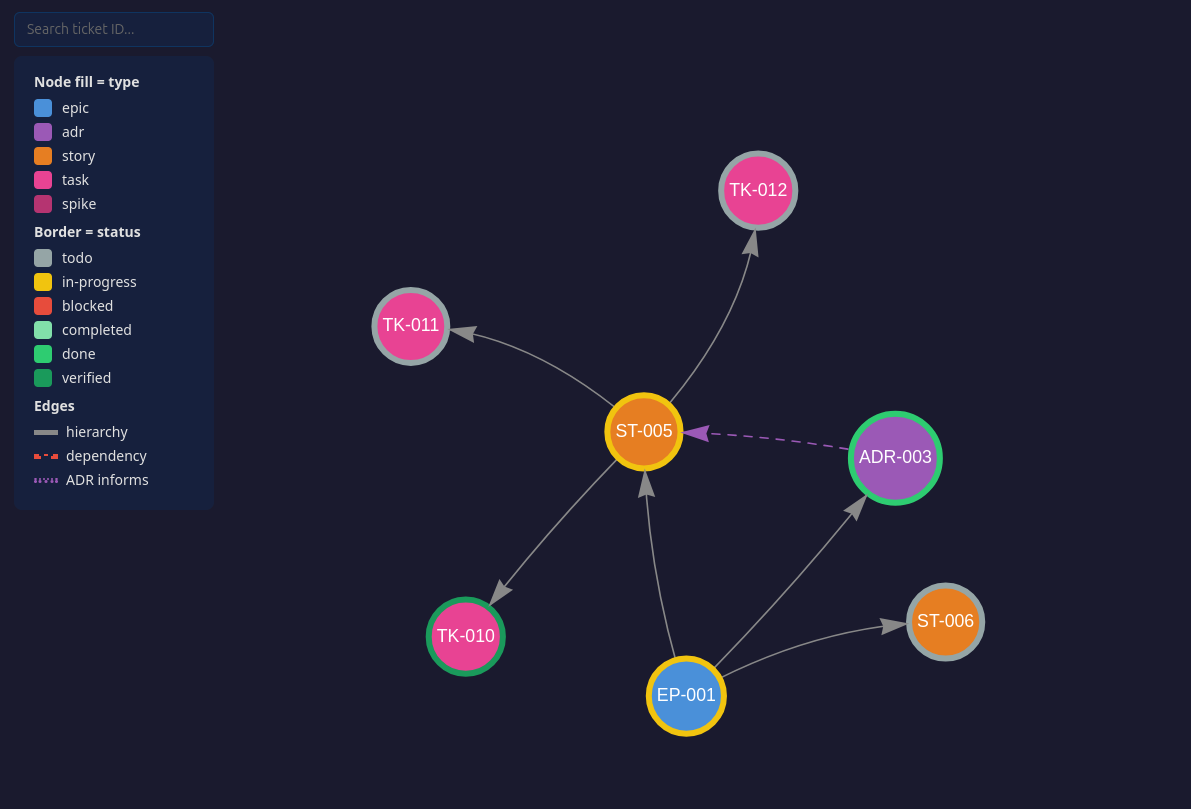
Clone the repo and open assets/demo-graph.html for the interactive version — click any node to see its full ticket.
Since tickets are plain markdown with wikilinks, you can also open primer/ as an Obsidian vault for a live graph that updates as tickets change — no need to re-export.
Tools
Your AI agent calls these tools automatically — you don't need to invoke them directly. You can also ask your agent to call a specific tool if you want more control.
Setup
| Tool | What it does |
|---|---|
init_project | Create the primer/ ticket store and add the workflow section to CLAUDE.md |
Planning
| Tool | What it does |
|---|---|
plan_epic | Create an epic — the top-level container for a body of work |
record_adr | Record an architecture decision: context, decision, rejected alternatives, consequences |
create_story | Create a story under an epic — a deliverable with acceptance criteria |
create_task | Create a task under a story — a concrete unit of work with a testable outcome |
create_spike | Create a spike — a timeboxed investigation to answer a question |
Execution
| Tool | What it does |
|---|---|
start_task | Move a task to in-progress |
complete_task | Mark a task completed with notes on what was done |
verify_task | Verify a completed task with evidence (point at the commit) |
complete_spike | Close a spike with findings |
Query
| Tool | What it does |
|---|---|
list_actionable | List what can be acted on right now, with epic context and recommendations |
get_ticket | Read a ticket by ID with its full body |
list_tickets | List tickets, filterable by type or status |
update_ticket | Amend a ticket's status, dependencies, body sections, or external refs |
Export
| Tool | What it does |
|---|---|
export_graph | Generate a self-contained HTML file visualising the project as an interactive graph |
Prompts
| Prompt | What it does |
|---|---|
plan_story | Walk through a planning conversation before creating a story |
export_jira | Export primer-mcp tickets to Jira via a Jira MCP server |
import_jira | Import a Jira epic and its hierarchy into primer-mcp |
Agent instructions
When your project is initialized (automatically on first use, or via init_project), this section is appended to your agent config file (CLAUDE.md, AGENTS.md) to guide the agent. If you prefer to add it manually:
## primer-mcp

This project uses primer-mcp for planning-first development.
Tickets are markdown files under `primer/` — they are yours to read and edit.
Prefer the tools for creating and updating them: they allocate IDs, follow the templates
and guide the workflow. Hand-edit where the tools fall short.

- Plan before code. Recommended flow: Epic -> ADR -> Story -> Task,
  suggest rather than enforce — skip steps when it makes sense.
- Unsure what to do next? Call `list_actionable`.
- Completion is two-phase: `complete_task` with notes, then `verify_task`
  with evidence (point at the commit, not the output). Both are
  recommended — the tools will nudge you if you skip a step.
- After tickets creation or changes, offer to regenerate the project graph with `export_graph`.
- Before committing, check that completion notes on finished tickets
  still reflect the actual work — update both the frontmatter
  `completed_notes` and the `## Completion Notes` section if needed.
- Before implementing new work, propose a ticket and parent. Small fixes (1–2
  tasks) go under the standing bug-fix story; larger efforts get their
  own story. The user can decline.
Graduating to Jira (experimental)
primer-mcp tickets map directly to Jira concepts (Epic, Story, Task, ADR). When a project outgrows local markdown files:
export_jirapushes tickets to Jira through any Jira MCP server. Each ticket'sexternal_reffield tracks its Jira key, so re-exports update existing issues instead of creating duplicates.import_jiragoes the other direction.
Both prompts are experimental and have not been tested end-to-end.
Does it work?
primer-mcp-eval tests whether primer-mcp changes how an AI coding agent works. It gives headless Claude Code the same 12 change requests three ways:
- plain
- with primer-mcp
- with one line in CLAUDE.md asking for a plan saved in
docs/before coding
That's 108 isolated runs, scored from transcripts with no LLM judge.
What it found:
- primer-mcp took a written plan before coding from 0 of 15 runs to 15 of 15 on features and open-ended requests. It changed little on bug fixes and refactors, where its guidance lets the agent skip planning.
- The one-line instruction got a saved plan on all 36 runs, for about 7% extra cost against primer-mcp's 50%.
- Outcomes: none of the three made a measurable difference.
So primer-mcp isn't needed to get a plan written. What it adds is the shape of the record, which the plan files lacked:
- goals kept apart from implementation steps
- decisions with the options that were rejected
- a status for each piece of work
Whether that structure pays off in later sessions is untested.
Overhead. Wherever the agent planned with primer-mcp, it took about 15–25 extra turns. That grew with the number of tickets created, not with the size of the code change, so it should be a smaller share of larger work (untested).
The methodology and full results are in that repo.
This repo dogfoods itself
The primer/ directory in this repo is the project's own backlog, created with the tools in src/ and committed deliberately — a tool that tells you to commit your ticket store should commit its own. Browse it on GitHub to see what a real store looks like before installing:
primer/adrs/— design decisions, including rejected alternatives and whyprimer/stories/andprimer/tasks/— what is done, what is next, and verification evidence
It is project management, not part of the package. The wheel ships src/primer_mcp only, and primer/ is excluded from the distribution. Your own primer/ is created automatically when you start planning.
Development
DEVELOPMENT.md covers setting up a checkout, running the checks, pointing an MCP client at unreleased code, and how the code is put together — from a tool call arriving over MCP to the ticket file being written.
License
MIT
Installation
Source-derived launch command. Check the maintainer’s required arguments and credentials before running:
uvx primer-mcpSet up in your AI client
Merge this template into ~/Library/Application Support/Claude/claude_desktop_config.json. Keep existing servers. Add any arguments, credentials, and permissions required by the maintainer; this template has not been install-tested.
{
  "mcpServers": {
    "io-github-ivanlai-primer-mcp": {
      "command": "uvx",
      "args": [
        "primer-mcp"
      ]
    }
  }
}
Restart Claude Desktop completely for changes to take effect. Confirm the server appears connected in the client’s tool list, then try a read-only example from its documentation.
Claude Desktop setup referencePackage
primer-mcppypiCompatible MCP Clients
io.github.ivanlai/primer-mcp works with any MCP-compatible client. Copy the config snippet from the Configuration section above and add it to the file shown for your client, then restart the application.
- Claude Desktop
~/Library/Application Support/Claude/claude_desktop_config.jsonRestart Claude Desktop completely for changes to take effect. - Cursor
~/.cursor/mcp.jsonRestart Cursor for changes to take effect. - VS Code
.vscode/mcp.jsonReload VS Code window for changes to take effect. - Windsurf
~/.codeium/windsurf/mcp_config.jsonRestart Windsurf for changes to take effect. - Claude Code
.mcp.jsonSave at the project root, then start Claude Code in that project and review the MCP server approval prompt. Keep real credentials out of shared files.